
Claim transcribed by Cathy Tarpley Dillon
Scroll down for a full transcript of this claim
For research on Jack Walker, click HERE.
About the Southern Claims Commission
The Southern Claims Commmission was set up by Congress in 1871 to adjudicate claims for property taken by U.S. federal troops during the Civil War. More than 140 Liberty County residents — both black and white — filed claims, mostly for property taken during December 1864 when a unit of Sherman’s Army commanded by General Kilpatrick camped at Midway Church and conducted foraging raids throughout Liberty County. Horses, cows, hogs, poultry, corn and rice were the most common items of property taken. In Liberty County, many slaveowners allowed their enslaved people to work on their own time and own small amounts of property, most of which was taken by the U.S. troops for use by the Army.
The claims files, which are held at the National Archives and Records Administration (NARA), have been digitized and are available at Ancestry.com or Fold3.com. For more information on these files, click here. A set of standard questions were used to take the testimony of claimants and witnesses. This set of questions was amended twice, in 1872 and 1874. The questions are not usually part of the digitized file, but we have included them to help make sense of the answers. The questions we used were provided online courtesy of the St. Louis County Library Special Collections, as taken from National Archives Microfilm Publication M87, Roll 1, Frames 104–105, Records of the Commissioners of Claims (Southern Claims Commission, 1871-1880), and can be found here.
About This Transcription
What you are seeing: The Southern Claims Commission files for each claimant included all forms filed for the claimant, including cover pages, standard forms with filled in information, a special agent’s report about the claim, remarks made by the Special Commissioner summarizing the case, testimony from the claimant and his or her witnesses based on a standard set of questions, and copies of other paperwork involved. Much of the information contained in the forms is repetitive. We have summarized that information into one block, and transcribed all testimony, the Special Commissioner’s remarks, the special agent’s report, and any other relevant text.
Methodology: The testimony of the claimant and the witnesses has been transcribed exactly as seen. Some of the files are faded and/or difficult to read. Any words that cannot be read are indicated by “[word]”, or, in the case of entire sections, “[section illegible]”. Alternative spellings of names are also indicated with brackets.
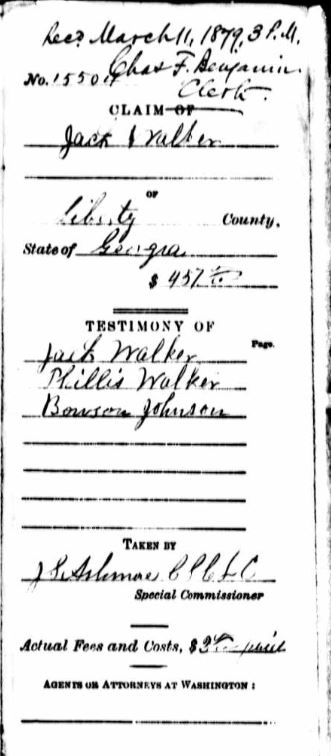
The Claim: Summary & Transcription
Find the digitized original of this claim file at this Ancestry.com link.
Summary
Claimant’s Name (Last Name, First Name): Walker, Jack
Listed as “Colored”? (Y/N): Y
Amount of Claim: $457
Total Amount Allowed: N/A, disallowed
Nature of Claim: Provisions taken for use of the U.S. Army Jan 1865
Claimant living in: Liberty County, Georgia
Incident occurred in: [not listed]
Claim #: 15504
Secondary Claim #: N/A, disallowed
Date Claim Submitted [YYYY-MM-DD]: 1872-07-24
Date Testimony taken [YYYY-MM-DD]: 1879-02-26
Claimant’s Attorney: Hosmer & Co; M.J. O’Donoghue, Savannah
Special Commissioner: Virgil Hillyer; J. Sloeman Ashmore, C.S.C.L.C.
Property Removed to: “their camps”
Date property removed: 1865-01-??
Army unit involved: Sherman’s Army commanded by General Hudson Kilpatrick
Date Submitted to Congress [YYYY-MM-DD]: N/A, disallowed
Post Office of Claimant: Taylor’s Creek
Witnesses to be Called: |
Phillis Walker |
Boson Johnson (also spelled Bowson) |
Items Claimed
Item # | Description | Amt Claimed |
1 | One horse at $150 | 150 |
2 | One saddle & bridle at $12 | 12 |
3 | (20) Twenty hogs at $5 | 100 |
4 | 2000 lbs fodder at $2.00 per 100 lbs | 40 |
5 | 150 lbs sugar at 20 c per lb | 100 |
6 | 50 bushels corn at $2 | 100 |
7 | 50 chickens at 50 c | 25 |
TOTAL | 457 |
Transcription
Remarks: The claimant was a slave till made free by Gen’l Sherman’s capture of Savannah.
The only proof of ownership of the property is the testimony of claimant, who says he bought it with money made by working Sundays & nights. We do not feel justified in allowing claims for persons formerly slaves without more satisfactory proof that they owned the property than this clmt has furnished. Claim disallowed.
A.O. Aldis
O. Ferris } Commrs of Claims
[Transcriber’s Comments: Claimant named Col. Atkins of Kilpatrick’s Division as being present. The testimony claim cover page lists J.S. Ashmore C.S.C.L.C. as the Special Commissioner and he took the testimony, but the claim application was originally made in 1872 when Virgil Hillyer was the Special Commissioner. J.S. Ashmore wrote in by hand above his signature: “and I certify that I have no beneficial interest in this claim.” In the original application, claimant stated as his reason for not being able to travel to Washington to give testimony: “He is poor being a small farmer & not able to go to the expense to produce said witnesses in the city of Washington.” Testimony was given in Hinesville.]
Testimony of Claimant
1. What is your name, your age, your residence, and how long has it been such, and your occupation?
Jack Walker. Sixty years. In 1132 Dis. G.M of Liberty County Ga. Fifty years. Farmer.
2. If you are not the claimant, in what manner, if any, are you related to the claimant or interested in the success of the claim?
Claimant answers. I am the Claimant.
44. After the Presidential election of 1860, if of age, did you vote for any candidates, or on any questions, during the war, and how did you vote? Did you vote for or against candidates favoring secession? Did you vote for or against the ratification of the ordinance of secession, or for or against separation in your State?
Claimant. Did not vote at all
45. Did you belong to any vigilance committee, or committee of safety, homeguard, or any other form of organization or combination designed to suppress Union sentiment in your vicinity?
Claimant. Did not
46. Were you in the Confederate army, State militia, or any military or naval organization hostile to the United States? If so, state when, where, in what organizations, how and why you entered, how long you remained each time, and when and how you left. If you claim that you were conscripted, when and where was it, how did you receive notice, and from whom, and what was the precise manner in which the conscription was enforced against you? If you were never in the rebel army or other hostile organization, explain how you escaped service. If you furnished a substitute, when and why did you furnish one, and what is his name, and his present address, if living?
Claimant. Was not
47. Were you in any way connected with or employed in the Confederate quartermaster, commissary, ordnance, engineer, or medical department, or any other department, or employed on any railroad transporting troops or supplies for the Confederacy, or otherwise engaged in transportation of men and supplies for the Confederacy? If so, state how employed, when, where , or for how long, under whose direction, and why such employment was not given ―aid and comfort‖ to the rebellion?
Claimant. Was not
48. Did you at any time have charge of trains, teams, wagons, vessels, boats, or military supplies or property of any kind for the Confederate government? If so, give all the facts as in previous questions.
Claimant. Did not
49. Were you employed in saltpeter works, in tanning or milling for the Confederate government, or making clothing, boots, shoes, saddles, harness, arms, ammunition, accoutrements, or any other kind of munitions of war for the Confederacy? If so, give all the particulars of time, place and nature of service or supplies.
Claimant. Was not
50. Were you ever engaged in holding in custody, directly or indirectly, any persons taken by the rebel government as prisoners of war, or any persons imprisoned or confined by the Confederate government, or the authorities of any rebel State, for political causes? If so, when, where, under what circumstances, in what capacity were you engaged, and what was the name and rank of your principal?
Claimant. Was not
51. Were you ever in the Union army or navy, or in any service connected therewith? If so, when, where, in what capacity, under whose command or authority, for what period of time, and when and how did you leave service? Produce your discharge papers, so that their contents may be noted herein.
Claimant. Was not
66. Who was the owner of the property charged in this claim when it was taken, and how did such person become owner?
Claimant. I was the owner worked for it in my own time.
67. If any of the property was taken from a farm or plantation, where was such farm or plantation situated, what was its size, how much was cultivated, how much was woodland, and how much was waste land?
Claimant. In this County, Large farm. About 130 or 140 acres. The rest of the farm woodland and wasteland.
68. Has the person who owned the property when taken since filed a petition in bankruptcy, or been declared a bankrupt?
Claimant. Has not.
[Question 69 only asked of women]
The following questions will be put to colored claimants:
70. Were you a slave or free at the beginning of the war? If ever a slave, when did you become free? What business did you follow after obtaining your freedom? Did you own this property before or after you became free? When did you get it? How did you become owner, and from whom did you obtain it? Where did you get the means to pay for it? What was the name and residence of your master, and is he still living? Is he a witness for you, and if not, why not? Are you in his employ now, or do you live on his land or on land bought from him? Are you in his debt? What other person besides yourself has any interest in this claim?
Claimant Was a slave In the Spring of 1865. Farming, Before became free, While a slave, Bought with money made by working Sundays and nights, David Baggs of Liberty County. He is dead. Not a witness because dead. Wife.
[Question 71 not applicable]
The following questions will be put to claimants and witnesses who testify to the taking of property, omitting in the case of each claimant or witness any questions that are clearly unnecessary:
72. Were you present when any of the property charged in this claim was taken? Did you actually see any taken? If so, specify what you saw taken.
Claimant. Was present when the whole was taken and cried like a child. Actually did see it taken. 2 ½ Stacks fodder 50 Bushels corn, 50 chickens Thirty hogs 1 horse, 1 saddle and bridle half Barrel shugar [sugar], about 8000 stacks cane seed
73. Was any of the property taken in the night time, or was any taken secretly, so that you did not know of it at the time?
“Claimant” all taken in the daytime openly.
74. Was any complaint made to any officer of the taking of any of the property? If so, give the name, rank and regiment of the officer, and state who made the complaint to him, what he said and did in consequence, and what was the result of the complaint.
Claimant. Made Complaints, Atkins, Col. Reg’t [Regiment] unknown, made complaint myself. Sent two men with complainant to take the horse back could not find horse, returned to Col Atkins who said he could not help it.
75. Were any vouchers or receipts asked for or given? If given, where are the vouchers or receipts? If lost, state fully how lost. If asked and not given, by whom were they asked, who was asked to give them, and why were they refused or not given? State very fully in regard to the failure to ask or obtain receipts.
Claimant. Did not ask for voucher or receipts, knowed it was no use.
76. Has any payment ever been made for any property charged in this claim? Has any payment been made for any property taken at the same times as the property charged in this claim? Has any payment been made for any property taken from the same claimant during the war, and if so, when, by whom, for what property and to what amount? Has this property, or any part of it, been included in any claim heretofore presented to Congress, or any court, department or officer of the United States, or to any board of survey, military commission, State commission or officer, or any other authority? If so, when and to what tribunal or officers was the claim presented; was it larger or smaller in amount than this claim, and how is the difference explained, and what was the decision, if any, of the tribunal to which it was presented?
Claimant. Never has not a cent. No, No, not a cent. It has never been included in any other claim.
77. Was the property charged in this claim taken by troops encamped in the vicinity, or were they on the march, or were they on a raid or expedition, or had there been any recent battle or skirmish?
Claimant. By troops camped in vicinity three days. Had been no recent battle or skirmish.
78. You will please listen attentively while the list of items, but not the quantities, is read to you, and as each kind of property is called off, say whether you saw any such property taken.
Claimant. Saw each of the items taken.
79. Begin now with the first item of property you have just said you saw taken, and give the following information about it. 1st.. Describe its exact condition, as for instance, if corn, whether green or ripe, standing or harvested, in shuck, or husked, or shelled; if lumber, whether new or old, in buildings or piled; if grain, whether growing or cut. 2d. State where it was. 3d. What was the quantity; explain fully how you know the quantity, and if estimated, describe your method of making the estimate.4th. Describe the quality to your best judgment. 5th. State as nearly as you can the market value of such property at the time in United States money. 6th. Say when the property was taken. 7th. Give the name of the detachment, regiment, brigade, division, corps, or army, taking the property, and the names of any officers belonging to the command. 8th. Describe the precise manner in which the property was taken into possession by the troops, and the manner in which it was removed. 9th. State as closely as you can how many men, animals, wagons, or other means of transport, were engaged in the removal, how long they were occupied, and to what place they removed the property. 10th. State if any officers were present; how you knew them to be officers; what they said or did in relation to the property, and give the names of any, if you can. 11th. Give any reasons that you may have for believing that the taking of the property was authorized by the proper officers or that it was for the necessary use of the army.
Claimant. Horse in good condition, round as corn and fodder could make it.
Saddle and Bridle new.
Hogs. “Wood hogs, powerfull [powerful] good range.”
Hogs in good condition
Fodder dry and in stacks.
Shugar [Sugar]. Good but not done dripping.
Corn. Ripe and in house in shuck not shelled.
Chickens. mostly grown
It was on David Baggs plantation in Liberty County one horse worth $150.00
One saddle and Bridle worth $14.00
Thirty head hogs counted $120.00
Fodder 2 ½ stacks Quantity judge by the size of the stack quantity estimated 22.50 lbs worth $22.50
Shugar [Sugar] judged by the size of barrel Quantity 150 lbs worth 25 cts [cents] per pound
Corn about 50 bushels Quantity judged by the size of pile and house worth $7.00 per bushel
50 Chickens worth about $25 per head
All the above property taken in January 1865.
Dont [Don’t] know Detachment Brigade Corps or army (was too mad to know) Nor the names of any officers except Col. Atkins The troops came right in and took it Carried on horses and in wagons. Two or three thousand men Horses and wagons strewed as far as to Smart Girardeau house, only a few hours to carry mine which they removed to their camps. No officers to my knowledge. The officers must have allowed it because they did not stop it when complained to. And it was necessary for their subsistence.
[signed] Jack Walker [signed by mark]
Sworn to and subscribed before me this 26th Feb’y [February] 1879
J Sloeman Ashmore Clerk, S.C.L.C.
Testimony of Witness (Phillis Walker)
1. What is your name, your age, your residence, and how long has it been such, and your occupation?
Phillis Walker being duly sworn deposeth and answers to – forty seven years, Liberty County since the war, housekeeping
2. If you are not the claimant, in what manner, if any, are you related to the claimant or interested in the success of the claim?
Am Claimant’s wife and as such interested in the claim
72. Were you present when any of the property charged in this claim was taken? Did you actually see any taken? If so, specify what you saw taken.
Did not live the same place with claimant, knows he had the property specified in the claim a few days before the raid and after the raid the property was gone
[signed] Phillis Walker [signed by mark]
Sworn to and subscribed before me this 26th Feby [February] 1879
J Sloeman Ashmore Clerk S.C.L.C.
Testimony of Witness (Bowson Johnson)
1. What is your name, your age, your residence, and how long has it been such, and your occupation?
Bowson Johnson being duly sworn Testifies and answers to About sixty three years old Liberty County forty or fifty years. farming
2. If you are not the claimant, in what manner, if any, are you related to the claimant or interested in the success of the claim?
Am not Claimant, am not related to the claimant, am not interested in claim
72. Were you present when any of the property charged in this claim was taken? Did you actually see any taken? If so, specify what you saw taken.
Yes sir I was there did see it taken saw taken the horse saddle and Bridle, the shugar [sugar], all the chickens, the corn the fodder, the shugar [sugar] cane, the hogs.
73. Was any of the property taken in the night time, or was any taken secretly, so that you did not know of it at the time?
It was taken in the daytime from about 11 oclock till night
74. Was any complaint made to any officer of the taking of any of the property? If so, give the name, rank and regiment of the officer, and state who made the complaint to him, what he said and did in consequence, and what was the result of the complaint.
I think he spoke to some of them and they told him he would get it back again
75. Were any vouchers or receipts asked for or given? If given, where are the vouchers or receipts? If lost, state fully how lost. If asked and not given, by whom were they asked, who was asked to give them, and why were they refused or not given? State very fully in regard to the failure to ask or obtain receipts.
omitted.
76. Has any payment ever been made for any property charged in this claim? Has any payment been made for any property taken at the same times as the property charged in this claim? Has any payment been made for any property taken from the same claimant during the war, and if so, when, by whom, for what property and to what amount? Has this property, or any part of it, been included in any claim heretofore presented to Congress, or any court, department or officer of the United States, or to any board of survey, military commission, State commission or officer, or any other authority? If so, when and to what tribunal or officers was the claim presented; was it larger or smaller in amount than this claim, and how is the difference explained, and what was the decision, if any, of the tribunal to which it was presented?
I know of none
77. Was the property charged in this claim taken by troops encamped in the vicinity, or were they on the march, or were they on a raid or expedition, or had there been any recent battle or skirmish?
Taken by Troops in camps right there no recent battle or skirmish that I know of.
78. You will please listen attentively while the list of items, but not the quantities, is read to you, and as each kind of property is called off, say whether you saw any such property taken.
Saw taken one horse, one saddle and bridle, hogs, Fodder, Shugar [Sugar], Corn, Chickens
79. Begin now with the first item of property you have just said you saw taken, and give the following information about it. 1st.. Describe its exact condition, as for instance, if corn, whether green or ripe, standing or harvested, in shuck, or husked, or shelled; if lumber, whether new or old, in buildings or piled; if grain, whether growing or cut. 2d. State where it was. 3d. What was the quantity; explain fully how you know the quantity, and if estimated, describe your method of making the estimate.4th. Describe the quality to your best judgment. 5th. State as nearly as you can the market value of such property at the time in United States money. 6th. Say when the property was taken. 7th. Give the name of the detachment, regiment, brigade, division, corps, or army, taking the property, and the names of any officers belonging to the command. 8th. Describe the precise manner in which the property was taken into possession by the troops, and the manner in which it was removed. 9th. State as closely as you can how many men, animals, wagons, or other means of transport, were engaged in the removal, how long they were occupied, and to what place they removed the property. 10th. State if any officers were present; how you knew them to be officers; what they said or did in relation to the property, and give the names of any, if you can. 11th. Give any reasons that you may have for believing that the taking of the property was authorized by the proper officers or that it was for the necessary use of the army.
Horse in splendid order, Taken from stable, in January. When the raid was here Judge the horse was well worth one hundred and forty or fifty dollars.
Saddle was splendid, homemade bridle taken same time and place as horse was, saddle and bridle worth 12 or 13 dollars
Hogs, about 30 head in good order for wood hogs, worth from one to four dollars by the head
Knows he had fodder not certain as to quantity fodder was worth about one doollar [dollar] by the hundred.
Shugar [Sugar] had about one barrel of shugar [sugar], good, fair country shugar [sugar], think it was about two hundred pounds judges the quantity by the size of the barrel, worth about ten cents.
Corn, Harvested in house in shuck think it was about 35 or 40 bushels judges by the size of the pile corn was worth about one dollar and a half a bushel.
Chickens about forty head of chickens mostly grown worth at that time about forty or fifty cents.
All the above property was taken at the same time and place Heard old master say it was a wing of Sheerman’s [Sherman’s] Army. Do not know the names of any officers belonging to the command
Horse taken out of stable with saddle and bridle and led off. Hogs carried off, sometimes two tied together and throwed [thrown] across the horse others shot down. Took the fodder and fed it to thier [their] horses right round there, the shugar [sugar] carried off in a wagon. Corn carried off in sacks. Chickens seen down and shot carried off in hands.
Knew nothing about officers, men told me they were compelled to have it, to live on and I would get pay back for it. I know there was over a thousand men about the animals that was untelling Dont [Don’t] know how many wagons was there carried the property into thier [their] camps right on the place.
[signed] Bowson Johnson [signed by mark]
Sworn to and subscribed before me this 26th Feby [February] 1879
J Sloeman Ashmore Clerk SSLC
Testimony of Witness (Bowson Johnson)
52. In whose favor are you here to testify?
I am here to testify in favor of Jack Walker
53. How long have you known that person altogether, and what part of that time have you intimately known him?
About fifty years. Intimately all the time he was a slave.
54. Did you live near him during the war, and how far away?
Lived on the same place about one hundred and fifty yards apart
55. Did you meet him often, and about how often, during the war?
Met him very often lived on the same place and worked with him every day
56. Did you converse with the claimant about the war, its causes, its progress, and its results? If so, try to remember the more important occasions on which you so conversed, beginning with the first occasion, and state, with respect to each, when it was, where it was, who were present, what caused the conversation, and what the claimant said in substance, if you cannot remember his words.
Did talk about the war. Did not know the cause of the war, did not know which side was getting the best of it nor how it would end. Cant [Can’t] remember any particular time nor the substance of any conversation. Did not have much time to talk, had to work
57. Do you know of anything done by the claimant that showed him to be loyal to the Union cause during the war? If you do, state what he did, when, where, and what was the particular cause or occasion of his doing it? Give the same information about each thing he did that showed him to be loyal.
I know of his doing nothing against the union cause
58. Do you know of anything said or done by the claimant that was against the Union cause? If so, please state with respect to each thing said or done, what it was, when it was, where it was, and what particular compulsion or influence caused him to say or do it.
I do not.
59. If you have heard of anything said or done by the claimant, either for the Union cause or against it, state from whom you heard it, when you heard it and what you heard.
Old master used to tell us if the Yankees whipt we should all be free and we used to wish to be free, thought it was a great thing to be free.
60. What was the public reputation of the claimant for loyalty or disloyalty to the United States during the war? If you profess to know his public reputation, explain fully how you know it, whom you heard speak of it, and give the names of other persons who were neighbors during the war that could testify to this public reputation.
Dont [Don’t] know of any thing particular
61. Who were the known and prominent Union people of the neighborhood during the war, and do you know that such persons could testify to the claimant’s loyalty?
Witness was one himself and so was claimant. Joel Hodge and Phil. Moore [or Moon]
62. Were you, yourself, an adherent of the Union cause during the war? If so, did the claimant know you to be such, and how did he know it?
I was and the claimant knew me to be such, we talked about.
63. Do you know of any threats, molestations, or injury inflicted upon the claimant, or his family, or his property, on account of his adherence to the Union cause? If so, give all the particulars.
I know that some white men whipped him because he talked about what he would do if he was free, he talked in favor of the Yankees
64. Do you know of any act done or language used by the claimant that would have prevented him from establishing his loyalty to the Confederacy? If so, what act or what language?
I know of nothing more than I have already stated.
65. Can you state any other facts within your own knowledge in proof of the claimant’s loyalty during the war? If so, state all the facts and give all the particulars.
I can state no other facts.
[signed] Bowson Johnson [signed by mark]
Sworn to and subscribed before me this Feb’y [February] 26th 1879
J Sloeman Ashmore Clerk S.C.L.C.
Testimony of Witness (Phillis Walker)
1. What is your name, your age, your residence, and how long has it been such, and your occupation?
Phillis Walker, forty seven years old, Liberty County, since the war, housekeeping.
2. If you are not the claimant, in what manner, if any, are you related to the claimant or interested in the success of the claim?
I am Claimants wife and as such interested in the claim.
52. In whose favor are you here to testify?
In favor of Claimant.
53. How long have you known that person altogether, and what part of that time have you intimately known him?
About forty years, twenty two years.
54. Did you live near him during the war, and how far away?
Lived in five miles of him.
55. Did you meet him often, and about how often, during the war?
Every Saturday night and stayed with him all day Sunday.
56. Did you converse with the claimant about the war, its causes, its progress, and its results? If so, try to remember the more important occasions on which you so conversed, beginning with the first occasion, and state, with respect to each, when it was, where it was, who were present, what caused the conversation, and what the claimant said in substance, if you cannot remember his words.
Talked some about the war, did not know much about it, could not understand its cause. Dont [Don’t] remember any particular occasion.
57. Do you know of anything done by the claimant that showed him to be loyal to the Union cause during the war? If you do, state what he did, when, where, and what was the particular cause or occasion of his doing it? Give the same information about each thing he did that showed him to be loyal.
I know nothing except I heard him say he was friendly to the union.
58. Do you know of anything said or done by the claimant that was against the Union cause? If so, please state with respect to each thing said or done, what it was, when it was, where it was, and what particular compulsion or influence caused him to say or do it.
I do not.
59. If you have heard of anything said or done by the claimant, either for the Union cause or against it, state from whom you heard it, when you heard it and what you heard.
Never heard of anything said or done by him against
60. What was the public reputation of the claimant for loyalty or disloyalty to the United States during the war? If you profess to know his public reputation, explain fully how you know it, whom you heard speak of it, and give the names of other persons who were neighbors during the war that could testify to this public reputation.
The white people were so strict no colored person had a chance to make a reputation
61. Who were the known and prominent Union people of the neighborhood during the war, and do you know that such persons could testify to the claimant’s loyalty?
Matthew Kirkland was one Henry Tompson and Archy Tompson were both union men They can testify that Claimant was a union man
62. Were you, yourself, an adherent of the Union cause during the war? If so, did the claimant know you to be such, and how did he know it?
Of course I was, Claimant knew it by my speaking in favor of that side.
63. Do you know of any threats, molestations, or injury inflicted upon the claimant, or his family, or his property, on account of his adherence to the Union cause? If so, give all the particulars.
I know of none
64. Do you know of any act done or language used by the claimant that would have prevented him from establishing his loyalty to the Confederacy? If so, what act or what language?
Dont [Don’t] know of any.
65. Can you state any other facts within your own knowledge in proof of the claimant’s loyalty during the war? If so, state all the facts and give all the particulars.
Knew he was loyal to the union by his talk.
[signed] Phillis Walker [signed by mark]
Sworn to and subscribed before me this 26th Feb’y [February] 1879
J Sloeman Ashmore Clerk S.C.L.C.
Testimony of Witness (Bowson Johnson)
Bowson Johnson recalled being duly sworn deposeth and answereth to
Question 1 Bowson Johnson, About sixty three years old Liberty County, Forty or fifty years, Farming
Question 2 Am not Claimant am not related to the Claimant am not interested in claim
[signed] Bowson Johnson [signed by mark]
Sworn to and subscribed before me this 26th Feb’y [February] 1879
J Sloeman Ashmore Clerk SCLC
Claimant was a slave and there can be no question of his loyality. Witnesses appeared to be conscientious and sincere in giving their testimony and i believe they lost the property claimed Claimant has no further evidence to offer and herewith closes
J S Ashmore C.S.C.L.C.
——————
Office of the Commissioners of Claims
Washington, D.C. Jan’y 14, 1879
The Commissioners do hereby appoint the Clerk of Superior Court of, for, or at Liberty Co. in the State of Georgia to be a Special Commissioner under the act of Congress approved May 11, 1872, to take testimony in support of the claim of Jack Walker of, or from, the State of Georgia numbered 15504 provided that he has no beneficial interest in the claim, and so certifies.
The Commissioners require all concerned to take notice that no testimony taken under this authorization will be admitted in evidence unless the same appear to be taken in strict conformity to the rules of the Commissioners for taking testimony to be used before them, and the testimony itself indicates that an honest and intelligence effort has been made by the Special Commissioner to bring out the truth, the whole truth, and nothing but the truth, from each witness under examination.
By the Commissioners: [signed] Chas. F. Benjamin, Clerk
Extracts from Acts of Congress
The Commissioners of Claims shall have authority to appoint Special Commissioners to take testimony, to be used in cases pending before them, who shall have authority to administer oaths and affirmations, and to take the depositions of witnesses: Provided, The claimants shall pay the fees of such Special Commissioners for taking the depositions of witnesses called by them; but such fees shall in no case exceed ten cents per folio if the claim is less than one thousand dollars.
Sec. 2. That any person who shall knowingly and wilfully swear falsely before the said Commissioners of Claims, or either of them, or before any Special Commissioner appointed by virtue of this act, in any matter or claim pending before said Commissioners, shall be deemed guilty of perjury, and, on conviction thereof, shall be punished in the same manner prescribed by law in wilful cases and corrupt perjury. — [Act of May 11, 1872]
Sec. 5. That the Commissioners of Claims shall not receive any evidence on behalf of any claimant or claimants for the allowance of any claim or claims unless such evidence shall have been taken, presented, and filed by the tenth day of March, eighteen hundred and seventy-nine, except in rebuttal of evidence introduced on behalf of the Government; and all claims wherein the evidence of the claimant or claimants is not so filed in the office of the Commissioners of Claims, and which have not been submitted to the Commissioners for decision within the time herein limited, shall be barred forever thereafter; and the Commissioners of Claims shall report all such claims so barred to Congress at its next session thereafter. –[Act of June 15, 1878]
Note: This appointment must be returned with the testimony taken under it, and the testimony must be forwarded by the Special Commissioner in a closed envelope directly to the Commissioners.
https://www.ancestry.com/imageviewer/collections/1218/images/rhusa1871_105260__0013-00590
[Also two pages of rules for taking testimony]
————————————————–
[Text of handwritten document – very difficult to read – appears to be signed by Jack Walker]
Dated March 3, 1879