
Claim transcribed by Cathy Tarpley Dillon
See the full transcript of this claim by scrolling down
For research on Doddy Brown, click HERE.
About the Southern Claims Commission
The Southern Claims Commmission was set up by Congress in 1871 to adjudicate claims for property taken by U.S. federal troops during the Civil War. More than 140 Liberty County residents — both black and white — filed claims, mostly for property taken during December 1864 when a unit of Sherman’s Army commanded by General Kilpatrick camped at Midway Church and conducted foraging raids throughout Liberty County. Horses, cows, hogs, poultry, corn and rice were the most common items of property taken. In Liberty County, many slaveowners allowed their enslaved people to work on their own time and own small amounts of property, most of which was taken by the U.S. troops for use by the Army.
The claims files, which are held at the National Archives and Records Administration (NARA), have been digitized and are available at Ancestry.com or Fold3.com. For more information on these files, click here. A set of standard questions were used to take the testimony of claimants and witnesses. This set of questions was amended twice, in 1872 and 1874. The questions are not usually part of the digitized file, but we have included them to help make sense of the answers. The questions we used were provided online courtesy of the St. Louis County Library Special Collections, as taken from National Archives Microfilm Publication M87, Roll 1, Frames 104–105, Records of the Commissioners of Claims (Southern Claims Commission, 1871-1880), and can be found here.
About This Transcription
What you are seeing: The Southern Claims Commission files for each claimant included all forms filed for the claimant, including cover pages, standard forms with filled in information, a special agent’s report about the claim, remarks made by the Special Commissioner summarizing the case, testimony from the claimant and his or her witnesses based on a standard set of questions, and copies of other paperwork involved. Much of the information contained in the forms is repetitive. We have summarized that information into one block, and transcribed all testimony, the Special Commissioner’s remarks, the special agent’s report, and any other relevant text.
Methodology: The testimony of the claimant and the witnesses has been transcribed exactly as seen. Some of the files are faded and/or difficult to read. Any words that cannot be read are indicated by “[word]”, or, in the case of entire sections, “[section illegible]”. Alternative spellings of names are also indicated with brackets.
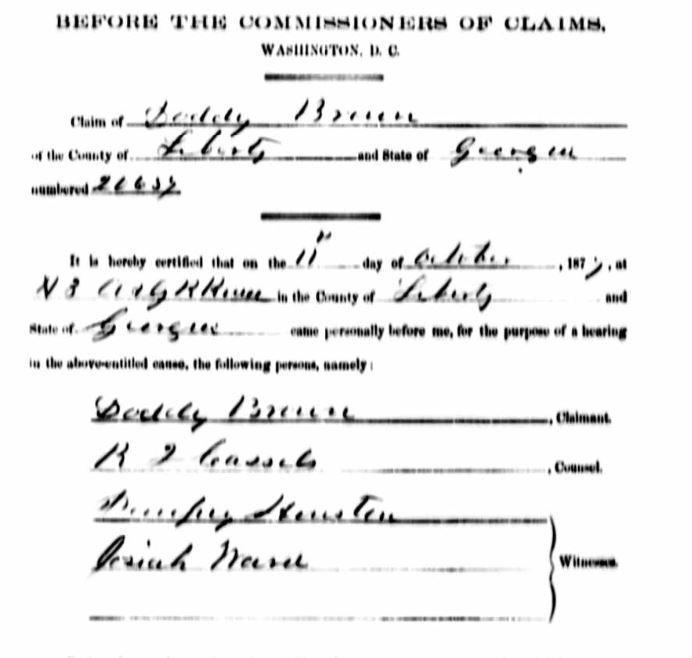
The Claim: Summary & Transcription
Find the digitized original of this claim file at this Ancestry.com link.
Summary
Claimant’s Name (Last Name, First Name): Brown, Doddy
Listed as “Colored”? (Y/N): Y
Amount of Claim: $438.00
Total Amount Allowed: N/A, disallowed
Nature of Claim: Stores for Genrl Sherman’s Army 1864
Claimant living in: Pleasant Hill, Liberty County, Ga
Incident occurred in: Midway
Claim #: 20637
Secondary Claim #:
Date Claim Submitted [YYYY-MM-DD]: 1877-10-01
Date Testimony taken [YYYY-MM-DD]: 1877-10-11; 1878-02-26
Claimant’s Attorney: Gilmore & Co, Washington, D.C.; James M. Simms [name crossed out], Hosmer & Co, Washington, D.C.
Property Removed to: Midway
Date property removed: 1864-12-12 to 1864-12-20
Army unit involved: Sherman’s Army commanded by General Kilpatrick
Date Submitted to Congress [YYYY-MM-DD]: N/A, disallowed
Post Office of Claimant: Stop No 2, A & G Railroad [Atlantic & Gulf]
Witnesses to be Called: |
Pompey Houston |
Plymouth Frazer Jr |
Edward J. Delegal |
Josiah Ward |
Items Claimed
Item # | Description | Amt Claimed |
1 | 1 roan horse | 125 |
2 | 1 buggy & harness | 50 |
3 | 1 milch cow & calf | 30 |
4 | 7 head hogs | 30 |
5 | 15 head chickens | 3.75 |
6 | 70 bush[els] rough rice | 105 |
7 | 70 bush[els] corn | 70 |
8 | 6 hives honey | 12 |
9 | Pots etc | 2.25 |
TOTAL | $428 |
Transcription
[NOTE: The remarks below are what the Commissioners of the Claims wrote at the time in 1877. Despite their offensiveness, they are transcribed here exactly as written as part of the historical record.]
Remarks: This is one of many claims of Negro slaves from Liberty Co Ga got up and [word] up by the same local attorney on a [word] plan. The witnesses are always the claimant and two fellow slaves. The answers are always short and furnish evidence that they are cut out by the same hand and not at all the [word] [word] proceeding from negro lips. There are no circumstances, no details of facts, no indications of a living witness observing with eyes and ears what is transpiring and speaking from his memory of the events. Many of the [word] questions are not answered in a manner to convey any information and the questions in regard to the ownership of the property and in what manner the claimant became owner are usually answered “owned it before the war” “bought it”. So in this case where the property was taken in December 1864 such as cow & calf hogs rice and corn and the like were bought before the war – such testimony, and it is all of that random character – is worthless. Besides it is not at all likely that slaves were the owners of stocks and heads of stock and crops of corn and rice requiring a considerable area of land to sustain and grow them.
[NOTE: The above statement is not at all true. In fact, enslaved people in Liberty County did own stock animals and cultivate crops for themselves, but it took time for the Commissioners of Claims to come to understand this.]
We are not satisfied with the sufficiency of the evidence in support of this claim and therefore reject it.
A.O. Aldis
J.B. Howell
O. Ferris } Comms [Commissioners] of Claims
In the claim the former owner of the slave says that he knows he owned such property as he claims compensation for, and he makes the same statement in regard to another of his slaves who claims a [word] larger amount. The witness was away in the Confederate Army and did not see the property taken. The facts or circumstances [word] detailed and there is something [several words] which is equivocal and unsatisfactory.
[Transcriber’s Comments: Included was a postcard dated April 20 [year hard to read, maybe 1878] signed by “D. Brown” saying “I have no recollection of signing such petition. I do not no Dr. Allen.” The postcard had Doddy Brown’s claim number (20637) on it. . Also, the first several pages of this claim were from an unrelated claim by Henry S. Brown of Emanuel County, Georgia, no claim # given.]
Testimony of Claimant
Testimony of Doddy Brown Liberty County on claim 20637
1. What is your name, your age, your residence, and how long has it been such, and your occupation?
Doddy Brown 53 years Liberty County all my life farmer
2. If you are not the claimant, in what manner, if any, are you related to the claimant or interested in the success of the claim?
am Claimant
66. Who was the owner of the property charged in this claim when it was taken, and how did such person become owner?
I was raised all
67. If any of the property was taken from a farm or plantation, where was such farm or plantation situated, what was its size, how much was cultivated, how much was woodland, and how much was waste land?
Plantation Liberty County Delegal plantation 5 or 600 acres 200 acres cultivated
68. Has the person who owned the property when taken since filed a petition in bankruptcy, or been declared a bankrupt?
no
[Question 69 only asked of women]
The following questions will be put to colored claimants:
70. Were you a slave or free at the beginning of the war? If ever a slave, when did you become free? What business did you follow after obtaining your freedom? Did you own this property before or after you became free? When did you get it? How did you become owner, and from whom did you obtain it? Where did you get the means to pay for it? What was the name and residence of your master, and is he still living? Is he a witness for you, and if not, why not? Are you in his employ now, or do you live on his land or on land bought from him? Are you in his debt? What other person besides yourself has any interest in this claim?
Slave at close of war Farming before freedom before war bought and raised bought horse from Father worked for it Edward J Delegal Liberty County living he is not because did not know would need him no no no no no one
[Question 71 not applicable]
72. Were you present when any of the property charged in this claim was taken? Did you actually see any taken? If so, specify what you saw taken.
I was saw it taken roan mare buggy and harness cow and calf 7 head hogs 15 chickens 70 bushels rice 70 bush[els] corn 6 hives pots
73. Was any of the property taken in the night time, or was any taken secretly, so that you did not know of it at the time?
day time openly
74. Was any complaint made to any officer of the taking of any of the property? If so, give the name, rank and regiment of the officer, and state who made the complaint to him, what he said and did in consequence, and what was the result of the complaint.
Complained to officer made complaint said they had the right to take it
75. Were any vouchers or receipts asked for or given? If given, where are the vouchers or receipts? If lost, state fully how lost. If asked and not given, by whom were they asked, who was asked to give them, and why were they refused or not given? State very fully in regard to the failure to ask or obtain receipts.
no was no use
76. Has any payment ever been made for any property charged in this claim? Has any payment been made for any property taken at the same times as the property charged in this claim? Has any payment been made for any property taken from the same claimant during the war, and if so, when, by whom, for what property and to what amount? Has this property, or any part of it, been included in any claim heretofore presented to Congress, or any court, department or officer of the United States, or to any board of survey, military commission, State commission or officer, or any other authority? If so, when and to what tribunal or officers was the claim presented; was it larger or smaller in amount than this claim, and how is the difference explained, and what was the decision, if any, of the tribunal to which it was presented?
no no no no
77. Was the property charged in this claim taken by troops encamped in the vicinity, or were they on the march, or were they on a raid or expedition, or had there been any recent battle or skirmish?
Troops were camped
78. You will please listen attentively while the list of items, but not the quantities, is read to you, and as each kind of property is called off, say whether you saw any such property taken.
[No answers recorded]
79. Begin now with the first item of property you have just said you saw taken, and give the following information about it. 1st.. Describe its exact condition, as for instance, if corn, whether green or ripe, standing or harvested, in shuck, or husked, or shelled; if lumber, whether new or old, in buildings or piled; if grain, whether growing or cut. 2d. State where it was. 3d. What was the quantity; explain fully how you know the quantity, and if estimated, describe your method of making the estimate.4th. Describe the quality to your best judgment. 5th. State as nearly as you can the market value of such property at the time in United States money. 6th. Say when the property was taken. 7th. Give the name of the detachment, regiment, brigade, division, corps, or army, taking the property, and the names of any officers belonging to the command. 8th. Describe the precise manner in which the property was taken into possession by the troops, and the manner in which it was removed. 9th. State as closely as you can how many men, animals, wagons, or other means of transport, were engaged in the removal, how long they were occupied, and to what place they removed the property. 10th. State if any officers were present; how you knew them to be officers; what they said or did in relation to the property, and give the names of any, if you can. 11th. Give any reasons that you may have for believing that the taking of the property was authorized by the proper officers or that it was for the necessary use of the army.
Mare was Roan color Delegals Plantation, Liberty County 1 mare gentle animal worth $25.00 taken about 10th or 12th December 1864 Kilpatrick Cavalry caught and saddled her and rode her off about one or two hours about 100 men 70 or 80 horses 8 or 10 wagons to camp no officer present said wanted horse to use in army 11th don’t know buggy and harness second handed Delegals plantation Liberty County 1 buggy and harness worth $50.00 taken about 10 or 12 December 1864 Kilpatrick Cavalry took it from buggy house carried it off about 100 men 70 or 80 horses 8 or 10 wagons about two hours to camp no officers present said nothing 11th don’t know cow and calf good milch cow Delegals plantation Liberty County 1 cow and calf worth $30.00 dollars taken 10th or 12th December 1864 Kilpatrick Cavalry drove them off 1 or 2 hours to camp no officer present said nothing 11th don’t know Hogs 1 Bacon rest stock hogs Delegals plantation Liberty County 7 head worth $5.00 a head December 10 or 12 1864 Kilpatrick Cavalry killed all right on the ground cut them up and carried to camp 100 men 70 or 80 horses 8 or 10 wagons about 2 hours to camp no officer present 11th don’t know Chickens all grown Delegals plantation Liberty County 15 head counted then worth 25 cts [cents] a head December 10 or 12 1864 Kilpatrick Cavalry shot them in yard carried to camp 100 men 70 or 80 horses 8 or 10 wagons about 2 hours to camp no officer present 11th don’t know The rice harvested and housed Delegal plantation Liberty County 70 bushels I measured it worth $1.50 bushel December 10th or 12th 1864 Kilpatrick Cavalry threw it on the ground and fed their horses with it carried balance to camp in sacks 100 men 70 or 80 horses 8 or 10 wagons about 2 hours to camp no officer present 11th don’t know Corn harvested housed Delegals plantation 70 bushels I measured it white corn worth $1.00 per bushel 10th or 12th December 1864 Kilpatrick Cavalry Took it off in sacks in wagon 100 men 70 or 80 horses 8 or 10 wagons 2 hours to camp no officer present 11th don’t know Hives were full of honey Delegals plantation Liberty County 6 hives worth $12.00 dollars December 10th or 12th 1864 Kilpatrick Cavalry Took them of [off] bench broke them took honey out carried in buckets and to camp 100 men 70 or 80 Horses 8 or 10 wagons 2 hours to camp no officer present 11th don’t know The Pots were good Delegals plantation Liberty County 2 large Pots 1 oven Spider $2.25 December 10th or 12th 1864 Kilpatrick Cavalry Took them out Kitchen put them in wagon carried off to camp 100 men 70 or 80 Horses 8 or 10 wagons 2 hours to camp no officer present 11th don’t know
Sworn to and Subscribed
Before me this 11th October
1874
Henry Way Special Comms [Commissioner]
[Signed] Doddy Brown [signed by his mark]
Testimony of Witness (Edward J. Delegal)
[Testimony taken at No. 3 A & G RR [Stop #3, Atlantic & Gulf Railroad] on February 26, 1878.]
Additional evidence in case of Doddy Brown Col[ored] Liberty Co[unty] Ga on claim 20637
Edward J Delegal witness for claimant answers the questions as follows
1. What is your name, your age, your residence, and how long has it been such, and your occupation?
Edward J Delegal aged 63 years Liberty County for forty five years Physician
2. If you are not the claimant, in what manner, if any, are you related to the claimant or interested in the success of the claim?
Not related to claimant not interested in success of this claim
52. In whose favor are you here to testify?
Doddy Brown
53. How long have you known that person altogether, and what part of that time have you intimately known him?
All his life he belonged to me
54. Did you live near him during the war, and how far away?
He lived on my place
55. Did you meet him often, and about how often, during the war?
Saw him every day
56. Did you converse with the claimant about the war, its causes, its progress, and its results? If so, try to remember the more important occasions on which you so conversed, beginning with the first occasion, and state, with respect to each, when it was, where it was, who were present, what caused the conversation, and what the claimant said in substance, if you cannot remember his words.
No
57. Do you know of anything done by the claimant that showed him to be loyal to the Union cause during the war? If you do, state what he did, when, where, and what was the particular cause or occasion of his doing it? Give the same information about each thing he did that showed him to be loyal.
No
58. Do you know of anything said or done by the claimant that was against the Union cause? If so, please state with respect to each thing said or done, what it was, when it was, where it was, and what particular compulsion or influence caused him to say or do it.
Nothing
59. If you have heard of anything said or done by the claimant, either for the Union cause or against it, state from whom you heard it, when you heard it and what you heard.
Heard nothing
60. What was the public reputation of the claimant for loyalty or disloyalty to the United States during the war? If you profess to know his public reputation, explain fully how you know it, whom you heard speak of it, and give the names of other persons who were neighbors during the war that could testify to this public reputation.
I believe he was loyal to the Union
61. Who were the known and prominent Union people of the neighborhood during the war, and do you know that such persons could testify to the claimant’s loyalty?
Don’t know
62. Were you, yourself, an adherent of the Union cause during the war? If so, did the claimant know you to be such, and how did he know it?
No
63. Do you know of any threats, molestations, or injury inflicted upon the claimant, or his family, or his property, on account of his adherence to the Union cause? If so, give all the particulars.
No
64. Do you know of any act done or language used by the claimant that would have prevented him from establishing his loyalty to the Confederacy? If so, what act or what language?
No
65. Can you state any other facts within your own knowledge in proof of the claimant’s loyalty during the war? If so, state all the facts and give all the particulars.
None
72. Were you present when any of the property charged in this claim was taken? Did you actually see any taken? If so, specify what you saw taken.
I was not present but know that he owned by my permission a horse and several head of cows hogs Poultry Buggy Provisions and other property
Sworn to and Subscribed
Before me this 26th Feby [February] 1878
Henry Way Special Comm[issioner]
[Signed] Edward J Delegal
Testimony of Witness (Pompey Houston)
Pompey Houston first witness for Claimant
The following questions will be put to every person who gives testimony:
1. What is your name, your age, your residence, and how long has it been such, and your occupation?
Pompey Houston 45 years Liberty County all my life Farmer
2. If you are not the claimant, in what manner, if any, are you related to the claimant or interested in the success of the claim?
Not claimant not related to claimant
52. In whose favor are you here to testify?
Doddy Brown
53. How long have you known that person altogether, and what part of that time have you intimately known him?
Over 35 years intimately all time
54. Did you live near him during the war, and how far away?
yes about 3 miles
55. Did you meet him often, and about how often, during the war?
every day
56. Did you converse with the claimant about the war, its causes, its progress, and its results? If so, try to remember the more important occasions on which you so conversed, beginning with the first occasion, and state, with respect to each, when it was, where it was, who were present, what caused the conversation, and what the claimant said in substance, if you cannot remember his words.
Talked about war during war Mr Mallards plantation Plymouth Fraser Simon Cassells because they took all our property claimant said they done him very badly
57. Do you know of anything done by the claimant that showed him to be loyal to the Union cause during the war? If you do, state what he did, when, where, and what was the particular cause or occasion of his doing it? Give the same information about each thing he did that showed him to be loyal.
always in favor of the Union
58. Do you know of anything said or done by the claimant that was against the Union cause? If so, please state with respect to each thing said or done, what it was, when it was, where it was, and what particular compulsion or influence caused him to say or do it.
No
59. If you have heard of anything said or done by the claimant, either for the Union cause or against it, state from whom you heard it, when you heard it and what you heard.
all I know is for the Union
60. What was the public reputation of the claimant for loyalty or disloyalty to the United States during the war? If you profess to know his public reputation, explain fully how you know it, whom you heard speak of it, and give the names of other persons who were neighbors during the war that could testify to this public reputation.
Every body knew him a Union man because heard him say many times he was Union Plymouth Fraser Simon Cassells
61. Who were the known and prominent Union people of the neighborhood during the war, and do you know that such persons could testify to the claimant’s loyalty?
Toney Golding Gus Law Brister Fleming I do
62. Were you, yourself, an adherent of the Union cause during the war? If so, did the claimant know you to be such, and how did he know it?
I was he did I told him so
63. Do you know of any threats, molestations, or injury inflicted upon the claimant, or his family, or his property, on account of his adherence to the Union cause? If so, give all the particulars.
No
64. Do you know of any act done or language used by the claimant that would have prevented him from establishing his loyalty to the Confederacy? If so, what act or what language?
don’t know
65. Can you state any other facts within your own knowledge in proof of the claimant’s loyalty during the war? If so, state all the facts and give all the particulars.
no
66. Who was the owner of the property charged in this claim when it was taken, and how did such person become owner?
Doddy Brown worked hard for it
67. If any of the property was taken from a farm or plantation, where was such farm or plantation situated, what was its size, how much was cultivated, how much was woodland, and how much was waste land?
Plantation Delegals Liberty County about 600 acres 175 or 200 acres cultivated rest woodland
68. Has the person who owned the property when taken since filed a petition in bankruptcy, or been declared a bankrupt?
No
[Question 69 only asked of women]
[Question 70 not applicable]
[Question 71 not applicable]
72. Were you present when any of the property charged in this claim was taken? Did you actually see any taken? If so, specify what you saw taken.
I was present saw it taken 1 roan mare cow and calf 7 head hogs buggy and harness 15 chickens 70 bush[els] rice 70 Bush[els] corn 6 hives Pots etc
73. Was any of the property taken in the night time, or was any taken secretly, so that you did not know of it at the time?
in day time openly
74. Was any complaint made to any officer of the taking of any of the property? If so, give the name, rank and regiment of the officer, and state who made the complaint to him, what he said and did in consequence, and what was the result of the complaint.
Complaint was made claimant made complaint said they had a right to take it
75. Were any vouchers or receipts asked for or given? If given, where are the vouchers or receipts? If lost, state fully how lost. If asked and not given, by whom were they asked, who was asked to give them, and why were they refused or not given? State very fully in regard to the failure to ask or obtain receipts.
none because we were all scared
76. Has any payment ever been made for any property charged in this claim? Has any payment been made for any property taken at the same times as the property charged in this claim? Has any payment been made for any property taken from the same claimant during the war, and if so, when, by whom, for what property and to what amount? Has this property, or any part of it, been included in any claim heretofore presented to Congress, or any court, department or officer of the United States, or to any board of survey, military commission, State commission or officer, or any other authority? If so, when and to what tribunal or officers was the claim presented; was it larger or smaller in amount than this claim, and how is the difference explained, and what was the decision, if any, of the tribunal to which it was presented?
no no no no
77. Was the property charged in this claim taken by troops encamped in the vicinity, or were they on the march, or were they on a raid or expedition, or had there been any recent battle or skirmish?
Troops were camped
78. You will please listen attentively while the list of items, but not the quantities, is read to you, and as each kind of property is called off, say whether you saw any such property taken.
[No answers recorded]
79. Begin now with the first item of property you have just said you saw taken, and give the following information about it. 1st.. Describe its exact condition, as for instance, if corn, whether green or ripe, standing or harvested, in shuck, or husked, or shelled; if lumber, whether new or old, in buildings or piled; if grain, whether growing or cut. 2d. State where it was. 3d. What was the quantity; explain fully how you know the quantity, and if estimated, describe your method of making the estimate.4th. Describe the quality to your best judgment. 5th. State as nearly as you can the market value of such property at the time in United States money. 6th. Say when the property was taken. 7th. Give the name of the detachment, regiment, brigade, division, corps, or army, taking the property, and the names of any officers belonging to the command. 8th. Describe the precise manner in which the property was taken into possession by the troops, and the manner in which it was removed. 9th. State as closely as you can how many men, animals, wagons, or other means of transport, were engaged in the removal, how long they were occupied, and to what place they removed the property. 10th. State if any officers were present; how you knew them to be officers; what they said or did in relation to the property, and give the names of any, if you can. 11th. Give any reasons that you may have for believing that the taking of the property was authorized by the proper officers or that it was for the necessary use of the army.
The mare was Roan color good condition Delegals plantation Liberty County worth $125.00 dollars taken between 10th and 15th December 1864 Kilpatrick Cavalry caught and saddled her and rode her off about 2 hours over 100 men 40 or 50 horses 7 or 8 wagons to camp no officer present Said they wanted them to use in Army I saw mare in use in Army Buggy and harness second handed Delegals plantation Liberty County worth about 45 or 50.00 dollars taken about 10th or 12th December 1864 Kilpatrick Cavalry took out Buggy House put a horse in and drove off with it about 100 men 40 or 50 horses 7 or 8 wagons to camp no officer present said they wanted them for army saw them using it camp cow was good milch cow calf about 6 months old Delegals plantation Liberty County 1 cow and calf worth 30 dollars taken December 10th or 12th 1864 Kilpatrick Cavalry drove them off to camp 1 or 2 hours to camp no officer present said they wanted them for army I saw them cooking the meat in camp the hogs 1 bacon hog rest were stock hogs Delegals plantation Liberty County 7 head worth 5 or 6 dollars a head 10th or 12th December 1864 Kilpatrick Cavalry killed them on the ground cut them up and carried them to camp 100 men 70 horses 7 or 8 wagons about 2 hours to camp no officer present I saw them cooking them in camp The chickens pretty much all grown Delegals plantation Liberty County 15 head did not count them then but know there were 15 head worth about 25 or 30 cts [cents] a head December 10th or 12th 1864 Kilpatrick Cavalry shot them in yard carried them to camp 100 men 60 or 70 horses 7 or 8 wagon about 2 hours to camp no officers present saw them cooking them in camp the rice harvested and housed Delegals plantation Liberty County 70 bushels saw it measured worth $150 per bushel December 10th or 12th 1864 Kilpatrick Cavalry threw it on ground and fed their horses and carried balance to camp in sacks 100 men 60 or 70 horses 7 or 8 wagons about 2 hours to camp no officer present – Saw them using it camp the corn was harvested and housed Delegals plantation Liberty County 70 bushels saw it measured white corn worth $100 per bushel December 10th or 12th 1864 Kilpatrick Cavalry took it off in sacks in wagon 100 men 60 or 70 horses 7 or 8 wagons 2 hours to camp no officer present saw them using corn in camp The hives were full of Honey Delegals plantation Liberty County 6 hives worth 10 or 12 dollars December 10th or 12th 1864 Kilpatrick Cavalry took them off bench broke them took honey out in Buckets-pans etc 100 men 60 or 70 horses 7 or 8 wagons 2 hours to camp no officer present did not see any in camp the pots 1 oven 2 large pots spider worth about 3 or 4 dollars December 10th or 12th 1864 Kilpatrick Cavalry took them out of kitchen carried them off in wagons 100 men 60 or 70 horses 7 or 8 wagons about 2 hours to camp no officer present. Saw them using the pots in camp
Sworn to and subscribed
Before me this 11th October
1877
Henry Way Special Comm[issioner]
[signed by his mark] Pompey Houston
Testimony of Witness (Josiah Ward)
Josiah Ward second witness for claimant
The following questions will be put to every person who gives testimony:
1. What is your name, your age, your residence, and how long has it been such, and your occupation?
Josiah Ward 40 years Liberty County all my life Farmer
2. If you are not the claimant, in what manner, if any, are you related to the claimant or interested in the success of the claim?
Not claimant not related to claimant
52. In whose favor are you here to testify?
Doddy Brown
53. How long have you known that person altogether, and what part of that time have you intimately known him?
All his life intimate with him all the time
54. Did you live near him during the war, and how far away?
Yes about 3 or 4 miles
55. Did you meet him often, and about how often, during the war?
About every day or two
56. Did you converse with the claimant about the war, its causes, its progress, and its results? If so, try to remember the more important occasions on which you so conversed, beginning with the first occasion, and state, with respect to each, when it was, where it was, who were present, what caused the conversation, and what the claimant said in substance, if you cannot remember his words.
Talked about the war
57. Do you know of anything done by the claimant that showed him to be loyal to the Union cause during the war? If you do, state what he did, when, where, and what was the particular cause or occasion of his doing it? Give the same information about each thing he did that showed him to be loyal.
heard him say often during war that he was a Union man
58. Do you know of anything said or done by the claimant that was against the Union cause? If so, please state with respect to each thing said or done, what it was, when it was, where it was, and what particular compulsion or influence caused him to say or do it.
no
59. If you have heard of anything said or done by the claimant, either for the Union cause or against it, state from whom you heard it, when you heard it and what you heard.
Never heard
60. What was the public reputation of the claimant for loyalty or disloyalty to the United States during the war? If you profess to know his public reputation, explain fully how you know it, whom you heard speak of it, and give the names of other persons who were neighbors during the war that could testify to this public reputation.
Every body knew him to be union heard him say so Plymouth Fraser Simon Cassells
61. Who were the known and prominent Union people of the neighborhood during the war, and do you know that such persons could testify to the claimant’s loyalty?
Toney Golding Gus Law Brister Fleming know they would
62. Were you, yourself, an adherent of the Union cause during the war? If so, did the claimant know you to be such, and how did he know it?
I was I told him so
63. Do you know of any threats, molestations, or injury inflicted upon the claimant, or his family, or his property, on account of his adherence to the Union cause? If so, give all the particulars.
no
64. Do you know of any act done or language used by the claimant that would have prevented him from establishing his loyalty to the Confederacy? If so, what act or what language?
no
65. Can you state any other facts within your own knowledge in proof of the claimant’s loyalty during the war? If so, state all the facts and give all the particulars.
no
66. Who was the owner of the property charged in this claim when it was taken, and how did such person become owner?
Doddy Brown labored for it
67. If any of the property was taken from a farm or plantation, where was such farm or plantation situated, what was its size, how much was cultivated, how much was woodland, and how much was waste land?
from Delegals plantation Liberty County 6 or 700 acres about 250 acres cultivated
68. Has the person who owned the property when taken since filed a petition in bankruptcy, or been declared a bankrupt?
no
[Question 69 only asked of women]
[Question 70 not applicable]
[Question 71 not applicable]
72. Were you present when any of the property charged in this claim was taken? Did you actually see any taken? If so, specify what you saw taken.
I was I did 1 mare buggy and harness 1 cow and calf 7 head hogs 15 chickens 70 bushels rice 70 bush[els] corn 6 hives pots
73. Was any of the property taken in the night time, or was any taken secretly, so that you did not know of it at the time?
in day openly
74. Was any complaint made to any officer of the taking of any of the property? If so, give the name, rank and regiment of the officer, and state who made the complaint to him, what he said and did in consequence, and what was the result of the complaint.
Did not hear any complaint
75. Were any vouchers or receipts asked for or given? If given, where are the vouchers or receipts? If lost, state fully how lost. If asked and not given, by whom were they asked, who was asked to give them, and why were they refused or not given? State very fully in regard to the failure to ask or obtain receipts.
none that I know of because we were all scared
76. Has any payment ever been made for any property charged in this claim? Has any payment been made for any property taken at the same times as the property charged in this claim? Has any payment been made for any property taken from the same claimant during the war, and if so, when, by whom, for what property and to what amount? Has this property, or any part of it, been included in any claim heretofore presented to Congress, or any court, department or officer of the United States, or to any board of survey, military commission, State commission or officer, or any other authority? If so, when and to what tribunal or officers was the claim presented; was it larger or smaller in amount than this claim, and how is the difference explained, and what was the decision, if any, of the tribunal to which it was presented?
no no no no
77. Was the property charged in this claim taken by troops encamped in the vicinity, or were they on the march, or were they on a raid or expedition, or had there been any recent battle or skirmish?
Troops were camped about ¼ mile off the mare was roan color Delegals plantation Liberty County 1 roan mare worth $125.00 dollars taken 10th or 12th December 1864 Kilpatrick Cavalry caught saddled her and rode her off about 2 hours to camp 100 men 70 or 80 horses 7 or 8 wagons no officer present Said they wanted her in army saw them using her in camp buggy and harness second hand Delegals plantation Liberty County 1 buggy and harness worth $50 dollars taken December 10th or 12th 1864 Kilpatrick Cavalry Took out buggy house and carried it to camp 100 men 70 or 80 horses 7 or 8 wagons about 2 hours to camp no officer present said nothing about buggy saw them using buggy in camp The cow was good Milch Cow [word] color calf about 6 months old Delegal Plantation Liberty County 1 cow and calf worth $35 or $40 dollars taken December 10th or 12th 1864 Kilpatrick Cavalry drove them off to camp 1 or 2 hours 100 men 70 or 80 horses 7 or 8 wagons no officer present said they wanted them to eat saw them cooking them in camp. Hogs 1 bacon the rest were stock hogs Delegal plantation Liberty County 7 Head counted them worth 5 or 6 dollars a head December 10th or 12th 1864 Kilpatrick Cavalry Killed them on the place cut them up and carried them to camp 100 men 70 or 80 horses 7 or 8 wagons about 2 hours to camp no officer present saw them cooking them in camp The chickens were grown Delegals plantation Liberty County 15 head did not count them worth 25 or 30 cts [cents] a head December 10th or 12th 1864 Kilpatrick Cavalry shot some and caught some and carried them to camp 100 men 70 or 80 horses 7 or 8 wagons about 2 hours to camp no officer present said they were obliged to have them to eat saw them eat them in camp Rice was harvested and thrashed Delegals plantation Liberty County 70 bushels saw it measured worth $1.50 per bushel December 10th or 12th 1864 Kilpatrick Cavalry fed horses on some wasted great deal and carried balance in sacks to camp 100 men 70 or 80 horses 7 or 8 wagons about 2 hours to camp no officer present said they wanted to feed their horses with saw them doing so the corn was harvested and housed Delegals plantation Liberty County 70 bushels guess so worth $100 per bushel December 10th or 12th 1864 Kilpatrick Cavalry carried it off in sack on wagons 100 men 70 or 80 horses 7 or 8 wagons 2 hours to camp no officer present said were obliged to have it to keep their horses from dying saw them using in camp The hives were full of honey Delegals plantation Liberty County 6 hives worth 2 or 3 dollars a piece December 10th or 12th 1864 Kilpatrick Cavalry took them off bench took them and took honey out in buckets pans etc to camp 100 men 70 or 80 horses 6 or 8 wagons about 2 hours to camp no officer present said nothing saw them eating it in camp The Pots 1 oven 2 large pots 1 spider Delegal plantation Liberty County worth $4.00 dollars December 10th or 12th 1864 Kilptrick Cavalry Took them out of Kitchen put them in wagon carried them to camp 100 men 70 or 80 wagons [mistake for “horses”] 8 or 9 wagons 2 hours to camp no officer present said they wanted them to cook with in camp
Sworn to and Subscribed
Before me this 11th October
1877
Henry Way Special Comm[issioner]
[signed by his mark] Josiah Ward
[END OF TRANSCRIPTION]