
Scroll down to see full transcript
About the Southern Claims Commission
The Southern Claims Commmission was set up by Congress in 1871 to adjudicate claims for property taken by U.S. federal troops during the Civil War. More than 140 Liberty County residents — both black and white — filed claims, mostly for property taken during December 1864 when a unit of Sherman’s Army commanded by General Kilpatrick camped at Midway Church and conducted foraging raids throughout Liberty County. Horses, cows, hogs, poultry, corn and rice were the most common items of property taken. In Liberty County, many slaveowners allowed their enslaved people to work on their own time and own small amounts of property, most of which was taken by the U.S. troops for use by the Army.
The claims files, which are held at the National Archives and Records Administration (NARA), have been digitized and are available at Ancestry.com or Fold3.com. For more information on these files, click here. A set of standard questions were used to take the testimony of claimants and witnesses. This set of questions was amended twice, in 1872 and 1874. The questions are not usually part of the digitized file, but we have included them to help make sense of the answers. The questions we used were provided online courtesy of the St. Louis County Library Special Collections, as taken from National Archives Microfilm Publication M87, Roll 1, Frames 104–105, Records of the Commissioners of Claims (Southern Claims Commission, 1871-1880), and can be found here.
About This Transcription
What you are seeing: The Southern Claims Commission files for each claimant included all forms filed for the claimant, including cover pages, standard forms with filled in information, a special agent’s report about the claim, remarks made by the Special Commissioner summarizing the case, testimony from the claimant and his or her witnesses based on a standard set of questions, and copies of other paperwork involved. Much of the information contained in the forms is repetitive. We have summarized that information into one block, and transcribed all testimony, the Special Commissioner’s remarks, the special agent’s report, and any other relevant text.
Methodology: The testimony of the claimant and the witnesses has been transcribed exactly as seen. Some of the files are faded and/or difficult to read. Any words that cannot be read are indicated by “[word]”, or, in the case of entire sections, “[section illegible]”. Alternative spellings of names are also indicated with brackets.
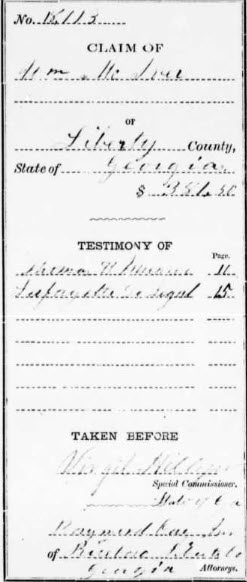
The Claim: Summary & Transcription
Find the digitized original of this claim file at this Ancestry.com link.
Summary
SCC Allowed Claim Liberty County – William McIver
Claimant’s Name (Last Name, First Name): McIver, William
Listed as “Colored”? (Y/N): Y
Nature of Claim: Supplies
Claimant living in: Riceboro
Incident occurred in: Riceboro
Claim #: 18113
Secondary Claim #: 436?9
Date Claim Submitted [YYYY-MM-DD]: 1872-12-19
Date Testimony taken [YYYY-MM-DD]: 1873-07-11
Claimant’s Attorney: J.C. Todd, Savannah, Ga; Raymond Cay, Jr.
Property Removed to:
Date property removed: 1864-12
Army unit involved: Sherman’s Army, commanded by Genl Kilpatrick
Date Submitted to Congress [YYYY-MM-DD]:
Post Office of Claimant: Riceboro, Liberty County, Georgia
Witnesses to be called |
LaFayette Delegal (colrd), Liberty Co. |
Thomas H. Monroe (colrd), Liberty Co. |
Robin Monroe (colrd), Liberty Co. [did not testify] |
Transcription
Items Claimed
Item # | Description | Amt Claimed | Amt Allowed | Amt Disallowed |
1 | 1 mare | 150 | ||
2 | 1 filly 3 yrs old | 100 | 100 | 150 |
3 | 1 wagon | 90 | 90 | |
4 | 2 hogs | 20 | 20 | |
5 | 1 sow | 12.50 | 8 | 4.50 |
6 | 6 bushels of corn | 9 | 6 | 3 |
TOTALS | 381.50 | 134 | 247.50 |
Amount of Claim: $381.50
Total Amount Allowed: $134
Remarks: The claimant was a slave. He worked at task work, & so got extra time to work for himself. “I don’t think”, he says, “anybody ought to object to a man going into the woods & cutting the wood for pails & tubs & piggins & selling them. This was the way I got my start.” “The first hogs I got by making tubs & piggins & selling them.” “I raised my hogs & sold them to Jo. Quarterman & bought my mare.” “From this mare I raised the colt.” Colt was 3 years old & broken to ride. But the old mare was “a poor old critter” & we think both together not worth over $100.00. The wagon we do not think was taken for Army use. The hogs were fat & worth $20. We allow $134.00.
The ownership fully proved. The claimant was a cooper. Property taken in Dec. ‘64 by Sherman’s troops. He lived on Dr. DeLegal’s plantation & worked for him – was his slave.
A.O. Aldis
O. Ferris
J.B. Howell } Comm’ers of Claims
[Transcriber’s Comments: Much of the testimony in this case was very badly faded.]
Testimony of Claimant
In answer to the First General Interrogatory, the Deponent says:
My name is William McIver, my age 60 or 70 years, my residence Liberty County, in the state of Georgia, and my occupation a farmer; I am the claimant and have a beneficial interest in the claim.
Revised Questions to be Answered by Claimants
1. What is your name, age, residence, and occupation?
My name is William McIver I was born in Liberty County a slave and made free by the Yankees when they came into the County. I am 60 or 70 years old as near as I can guess at it I am a hoe man every day I am the claimant in the case.
2. Where did you reside from the 1st of April, 1861, to the 1st of June, 1865? If on your own land, what is the size of your farm? How much of your farm was cultivated, and how much was woodland? Where is it situated? What was your occupation during that time? Did you change your residence or business during that time? if so, where was your new residence, and what [was] your new business?
From the 1st of April 1861 to the 1st of June 1865 I lived on Dr. DeLegal’s plantation. I belonged to him and worked at cotton raising and the farm work I did not go away or change my business I handle the hoe now when at home.
3. Did you ever pass beyond the military or naval lines of the United States and enter the rebel lines? If so, how often, when, where, and for what purpose, and how long did you stay within the Confederate lines on each occasion?
Irrelevant.
4. Did you ever take any oath or affirmation to bear allegiance to the so-called Confederate States, or to aid or support them in any way, or to “bear true faith,” or “yield obedience” to them? If so, when and where? State fully in regard to the same.
Irrelevant.
5. Have you ever taken any amnesty oath? If so, when, where, and under what condition? Have you been pardoned by the President? If so, when and where, and upon what conditions?
I took an oath before ? Mr. Campbell ? to stand for my country through thick and thin, that was when I went to give in my name to vote.
6 to the 28th inclusive having been read over to the claimant he answers “no”.
29. Did you ever do anything for the United States Government or its army, or for the Union cause, during the war? If so, state fully what you did.
I did all I could for them after they came into our county I had no chance to do anything before.
30 to 39 inclusive having been read over to the claimant he answers “no”.
40. At the beginning of the rebellion did you sympathize with the Union cause, or with the rebellion? What were your feelings and what your language on the subject? On which side did you exert your influence and cast your vote? What did you do, and how did you vote? How did you vote on ratifying the ordinance of secession? After the ordinance of secession was adopted in your State did you adhere to the Union cause, or did you “go with the State?”
At the beginning of the rebellion I sympathized with Union cause I felt delighted in the prospect of having my freedom I said to my colored friends all was in the hands of the Lord to trust him and all would come out right I did not change my feelings till freedom came, then only increased our work for good.
41. [Original Question 34.] In conclusion, do you solemnly declare that, from the beginning of hostilities against the United States to the end thereof, your sympathies were constantly with the cause of the United States; that you never, of your own free will and accord, did anything, or offered, or sought, or attempted to do anything, by word or deed, to injure said cause or retard its success, and that you were at all times ready and willing, when called upon, or if called upon, to aid and assist the cause of the Union, or its supporters, so far as you means and power and the circumstances of the case permitted?
In conclusion I solemnly declare that from the beginning of hostilities against the United States to the end my feelings were with their cause & that I never did or attempted to do anything against that cause; & that I was always ready & willing to aid that cause far as my means, & so far as the circumstances of the case permitted.
If the claimant be a female, ask the following questions: 42. Are you single or married? If married, when were you married? Was your husband loyal to the cause and Government of the United States throughout the war? Where does he now reside, and why is he not joined with you in the petition? How many children have you? Given their names and ages. Were any of them in the Confederate service during the war? If you claim that the property named in your petition is your sole and separate property, state how you came to own it separately from your husband; how your title was derived; when your ownership of it began? Did it ever belong to your husband? If the property for which you ask pay is wood, timber, rails, or the products of a farm, how did you get title to the farm? If by deed, can you file copies of the deeds? If single, have you been married? If a widow, when did your husband die? Was he in the Confederate army? Was he in the civil service of the Confederacy? Was he loyal to the United States Government throughout the war? Did he leave any children? How many? Are any now living? Give their names and ages? Are they not interested in this claim? If they are not joined in this petition, why not? State fully how your title to the property specified in the petition was obtained? If the claimant be a colored person, ask the following questions:
43. Were you a slave or free at the beginning of the war? When did you become free? What was your business after you became free? How and when did you come to own the property named in your petition? How did you get the means to pay for it? Who was your former master? Are you now in his employment? Do you live on his land? Do you live on land purchased of him? Are you indebted to your former master for land or property, and how much? Has anybody any interest in this claim besides yourself? State fully all the facts in your answers to these questions.
I was a slave from the first to the last to the last until I put the ??white family?? across the Altamaha & then I was delivered. After I was freed I turned in & put a crop of corn in the Delegal place & after I planted 2 crops of corn they ordered me off there. First I bought an old critter [two words] & I raised a colt from her. I raised hogs & sold them to buy the mare. From this mare I raised a colt & the Yankees took both the mare & filly from me. I was a cooper & made tubs, pails & sold them & bought my sow & raised pigs from her & the pigs grew to hogs & I ?had? enough to buy my mare. My wagon I bought with my hogs, he wanted hogs I sold him my hogs for the wagon. I have been raising hogs & poultry etc for 10 years before the war. My former master in old times was Mrs. Monroe, my next master was Dr. Delegal; he died before the raid came in. I don’t owe my old masters or their children anything. No one has any interest in this claim except me & my children.
[Revised Questions as the Taking or Furnishing of Property, to be Answered by Claimants and Witnesses.]
2nd set of int.
1. Were you present when any of the articles of property specified in the claimant’s petition were taken?
I was at home right in my house when they took this property from me.
2. Did you see any of them taken? If so, specify the articles you saw taken.
I saw this property taken.
3. Begin with the first article (Item No. —) which you have specified that you saw taken, and give a full account of all you saw and heard in connection with the taking of that article? [The special commissioner should require the witness to state all the circumstances; for it is only by a knowledge of all of them that the commissioners of claims can judge whether the taking was such a one as the Government is bound to pay for. The common phrase, “I saw the property taken by United States soldiers,” is not enough, for there was much lawless taking. The witness should be required to detail the facts as to each item, when the items were taken at different times; but if all, or more than one, were taken at the same time, that fact should appear, and then a repetition of the circumstances is needless. The special commissioner must be careful to elicit all the facts, as well those against as for the claim, especially as to those articles of property which were the special objects of pillage and theft, such as horses, mules, cattle, hogs, &c. Claimants must bear in mind that a neglect to observe these directions works to the prejudice of the claimant, and may defeat the claim.]
Whose horse is that they said, mine I said. Are you sure it is yours? Then one of them went up & took her & they took the young filly.
4. Where were the articles taken? When were they taken? Give the day, month and year, if you can? By whom were they taken? Did you see more than one soldier engaged in the taking? How many soldiers were present? State the number as near as you can? How many helped take the property? How long were they engaged in taking the property?
This property was taken at ?my house? on Delegal’s place just before Christmas when the Yankee army came here, I don’t remember the year. I don’t know the men’s who took this property but they were [words] they belonged to me [words]. It did not take them ?any? time ?hardly? to take my property there were so many of them [word].
5. Who were present other than soldiers when you saw them taken? Give the names of all you know?
There were present Willy McIver William McIver William Bacon Thomas Monroe & LaFayette Delegal & myself at the taking of this property.
6. Was any United States officer, either commissioned or non-commissioned, present at the taking? If so, state his name, rank, regiment, and the command to which he belonged. Did he order the property to be taken? Did he say anything about the taking?
There were officers there present I know because they told me so. They did not order the property taken. The officer sat on his horses under a big oak tree & let the men take the horse but I didn’t hear him give any orders.
7. Describe how the property was taken, and give a full account of all you saw done, or heard said, upon the occasion of the taking.
They catch the horse right by [words] & one took his horse & put it on the wagon under harness [words] rode the old mare. They shot the [word] right there. They [words] & then took the ?corn? & put it in my wagon & went off with it but they did not take all the corn.
8. How was the property removed—by soldiers or in wagons, or in what manner? State fully as to each article taken and removed.
They took all this property away in my own wagon.
9. To what place was it removed? Did you follow it to such place, or see it, or any portion of it, at any such place, or on its way to such place? How do you know the place to which it was removed?
[Section is too faded to read other than that they took the property to Midway.]
10. Do you know the use for which the property was taken? What was the use, and how do you know it? Did you see the property so taken used by the United States army? Did you see any part of the property so used? State fully all you know as to the property or any of it having been used by the army; and distinguish between what you saw and know, and what you may have heard from others, or may think, or suppose, or infer to be true.
I think they took it for their use [word] I saw them using my corn to feed their horses. I went down to the camp the next day & saw my wagon there with the corn in it.
11. Was any complaint made to any officer on account of such taking? If so, state the name, rank, and regiment of the officer. What did he say about it? State fully all that he said.
I made no complaint to any officer on account of the taking of this property.
12. Was any voucher or receipt for the property asked for? If so, of whom asked? State name, rank, and regiment. Was any receipt or paper given? If so, produce it, or state where it is, and why it is not produced. If no voucher or receipt was given, state why none was given, and if refused, why it was refused; state all that was said about it. State fully all the conversation between any officer or other person taking the property, and the claimant, or any one acting for him.
I did not ask any body for a voucher or receipt.
13. Was the property, or any of it, taken in the night-time? At what hour of the day (as near as you can tell) was it taken? Was any of the property taken secretly, or so that you did not know of it when taken?
This property was taken [words] time of day it was not taken at night. It was not taken [words].
14. When the property was taken, was any part of the army encamped in that vicinity? If so, state how far from the place where the property was taken, and what was the company, regiment, or brigade there encamped? How long had it been encamped there? How long did it stay there, and when did it leave? Had there been any battle or skirmish near there, just before the property was taken? Did you know the quartermasters, or any of them, or any other officers of the army for whose use the property is supposed to have been taken?
The army was encamped at Midway Church & some were at Sunbury. They had been there more than a day in camp when they came to take the property. They staid there in camp 3 weeks. They had [word] Taylor’s Creek [word] ? miles where I live. There had been no battles about there. I did not know any of the quartermasters or the other officers.
15. Describe clearly the condition of the property when taken, and all that tends to show its value at the time and place of taking? Thus, if corn, was it green or ripe? Had it been harvested? Was it in the shock, or husked, or shelled? Where was it? If grain, was it standing; had it been cut; was it in shocks, or in the barn or in stacks; had it been threshed? If horses, mules, or cattle, state when they were taken, how taken, and fully their condition, age, and value. Have you talked with claimant about their value?
This property was in good [word] condition when taken.
16. What means have you of knowing the quantity taken? State particularly how you estimate the quantity? Did you count or weigh the articles? Give us all your data. How much did you see taken and removed? What quantity was taken in your presence? As to quantity, distinguish carefully as to what you saw and know, and what you may think or believe from what you have heard from others.
[Transcriber’s Note: The detailed description of the property taken has been omitted due to the fading.]
Testimony of Witness (Thomas H. Monroe)
[Revised Questions as the Taking or Furnishing of Property, to be Answered by Claimants and Witnesses.]
My name is Thomas H. Monroe I was born in Liberty county a slave and was made free when the Union Army came into the county I am 30 or 35 years old I do not know my age it is all [word] work with me to know my age at all I live on Delegal’s plantation I am a farmer. I know the claimant I have known him as long as I have known anybody. Saw him often during the war I lived on the same place I know he was a good Union man one of the best among the colored people he was older and knew more than we young ones did.
2d set Interrogatories:
1. Were you present when any of the articles of property specified in the claimant’s petition were taken?
I was present when claimant’s property was taken.
2. Did you see any of them taken? If so, specify the articles you saw taken.
I saw it all taken by the Union soldiers.
3. Begin with the first article (Item No. —) which you have specified that you saw taken, and give a full account of all you saw and heard in connection with the taking of that article? [The special commissioner should require the witness to state all the circumstances; for it is only by a knowledge of all of them that the commissioners of claims can judge whether the taking was such a one as the Government is bound to pay for. The common phrase, “I saw the property taken by United States soldiers,” is not enough, for there was much lawless taking. The witness should be required to detail the facts as to each item, when the items were taken at different times; but if all, or more than one, were taken at the same time, that fact should appear, and then a repetition of the circumstances is needless. The special commissioner must be careful to elicit all the facts, as well those against as for the claim, especially as to those articles of property which were the special objects of pillage and theft, such as horses, mules, cattle, hogs, &c. Claimants must bear in mind that a neglect to observe these directions works to the prejudice of the claimant, and may defeat the claim.]
They said when they came up that they were the Yankees asked if we wanted to be free we told them yes then they said we would have a longer [word] [word] [word] we [word] had before they had been fighting a long time to set us all free wanted to know about our master and we told them he was dead died about one year before freedom. They went on then and took the property.
4. Where were the articles taken? When were they taken? Give the day, month and year, if you can? By whom were they taken? Did you see more than one soldier engaged in the taking? How many soldiers were present? State the number as near as you can? How many helped take the property? How long were they engaged in taking the property?
It was taken on Dr. Delegal’s Plantation from [word] [word] house in Dec. 1864 I do not remember the day now. It was taken by soldiers belonging to Kilpatrick’s army I so understood they were men on horses and riding through this county I suppose they were part of two days of course so many they could have taken it all in a few hours I don’t remember now just how long they were taking it I saw it all taken.
5. Who were present other than soldiers when you saw them taken? Give the names of all you know?
I was there Mr Robin Munroe Lafayette Delegal and others.
6. Was any United States officer, either commissioned or non-commissioned, present at the taking? If so, state his name, rank, regiment, and the command to which he belonged. Did he order the property to be taken? Did he say anything about the taking?
I saw officers there at the taking of the property. I did not hear them order the property taken but they were looking on and did not object. I suppose it was taken by [words] who had authority to take.
7. Describe how the property was taken, and give a full account of all you saw done, or heard said, upon the occasion of the taking.
The property was taken by the soldiers. They killed the hogs in the pen and one outside a “female sow” the wagon was in under the wagon shed they went there and took filled it with corn from the house and drove off.
8. How was the property removed—by soldiers or in wagons, or in what manner? State fully as to each article taken and removed.
They rode the horses away the hogs on horses the corn in the wagon claimant’s own wagon.
9. To what place was it removed? Did you follow it to such place, or see it, or any portion of it, at any such place, or on its way to such place? How do you know the place to which it was removed?
They removed it to the camp. I did not follow it they went out in that direction & I don’t believe they went anywhere else with it.
10. Do you know the use for which the property was taken? What was the use, and how do you know it? Did you see the property so taken used by the United States army? Did you see any part of the property so used? State fully all you know as to the property or any of it having been used by the army; and distinguish between what you saw and know, and what you may have heard from others, or may think, or suppose, or infer to be true.
I believe they took it for the use of the men and horses I don’t know what else they could want it for. I did not see any of the property taken from claimant’s house.
11. Was any complaint made to any officer on account of such taking? If so, state the name, rank, and regiment of the officer. What did he say about it? State fully all that he said.
I did not hear any complaint made by claimant on account of such taking.
12. Was any voucher or receipt for the property asked for? If so, of whom asked? State name, rank, and regiment. Was any receipt or paper given? If so, produce it, or state where it is, and why it is not produced. If no voucher or receipt was given, state why none was given, and if refused, why it was refused; state all that was said about it. State fully all the conversation between any officer or other person taking the property, and the claimant, or any one acting for him.
I did not hear any voucher or receipt asked for.
13. Was the property, or any of it, taken in the night-time? At what hour of the day (as near as you can tell) was it taken? Was any of the property taken secretly, or so that you did not know of it when taken?
The property was taken in the day time. I think early in the morning. I did not see any taken secretly.
14. When the property was taken, was any part of the army encamped in that vicinity? If so, state how far from the place where the property was taken, and what was the company, regiment, or brigade there encamped? How long had it been encamped there? How long did it stay there, and when did it leave? Had there been any battle or skirmish near there, just before the property was taken? Did you know the quartermasters, or any of them, or any other officers of the army for whose use the property is supposed to have been taken?
When the property was taken the army was encamped at Midway Church and some few at Sunbury. The commissary depot was at Midway it was Genl Kilpatrick army. They staid there about one month or more I did not know the quartermaster or any other officers.
15. Describe clearly the condition of the property when taken, and all that tends to show its value at the time and place of taking? Thus, if corn, was it green or ripe? Had it been harvested? Was it in the shock, or husked, or shelled? Where was it? If grain, was it standing; had it been cut; was it in shocks, or in the barn or in stacks; had it been threshed? If horses, mules, or cattle, state when they were taken, how taken, and fully their condition, age, and value. Have you talked with claimant about their value?
The property was all in prime condition when taken.
16. What means have you of knowing the quantity taken? State particularly how you estimate the quantity? Did you count or weigh the articles? Give us all your data. How much did you see taken and removed? What quantity was taken in your presence? As to quantity, distinguish carefully as to what you saw and know, and what you may think or believe from what you have heard from others.
Item No. 1: The mare I would think was 8 or 9 years old a good size not the largest size but just such as size as makes good [word] work horse the [words] and in good order I saw the soldiers ride her off I think he (the claimant) had owned the mare about 4 or 5 years before [word] his owner allowed him to own a horse and any other property he could get he always worked by task and a good deal of time he work for himself.
Item No. 2: This was a good [word] filly very nearly as big as his [SIC] mother. [word] [word] [word] the colt away [word] was in good order. I don’t know how old the filly was, old enough to ride.
Item No. 3: This was a wooden axle-tree Jersey wagon. I believe it had been used 3 or 4 years. They hitched one of their horses to it, filled it up with corn & drove off.
Item No. 4: He had 2 ?fat? hogs in the pen & one outside. I think the hogs in the pen would weigh [faded] each. They killed them & took them off on their horses.
Item No. 5: The hog outside was a female hog, a large sow [word] not very fat but in good eating order. They killed her & took her away as they did the others. I expect she would weigh ?125? lbs.
Item No. 6: They took [word] wagon load, they loaded up his wagon with his corn & took it off. I don’t know how much there was there in the wagon. It was [words] Jersey wagon with a box body.
17 18 passed.
This property all belonged to Mr. McIver. I know it was his because he was [word] [word] for it & got permission of his owners to buy it. He had been raising poultry & hots & had sold out the biggest [word] of them. He had done this ever since I knew him. By raising & selling hogs & poultry & things he got this property. He had a few poultry when the raid came through & they took all of that. They took all of his [word] & pots etc out of his house.
[Signed] T.H. Munroe [not indicated as signed by mark]
Sworn to and subscribed before me
Virgil Hillyer
Special Commissioner
State of Georgia
Testimony of Witness (LaFayette DeLegal)
My name is LaFayette Delegal I was born in McIntosh Co a slave & became free when the Yankees came through here. I was 47 last April I live at ?Mr. Jones? Place in Liberty Co. I am planting. I am no kin to the claimant at all. I have no [word] of interest in his claim. I have known the claimant over 20 years. I was with him all the time during the war on the plantation. ?We? belonged to Dr. Delegal. I talked with him about the war I told him I expect to get free if we do we must all try to get our living. He was a good Union man. I never saw him try to aid the rebellion in any way whatsoever. All the col’d people in the county so far as I know were good Union people.
2nd set of int[errogatories]:
[Revised Questions as the Taking or Furnishing of Property, to be Answered by Claimants and Witnesses.]
1. Were you present when any of the articles of property specified in the claimant’s petition were taken?
I was not exactly at his house but very near by when they took this property.
2. Did you see any of them taken? If so, specify the articles you saw taken.
I saw them take this property.
3. Begin with the first article (Item No. —) which you have specified that you saw taken, and give a full account of all you saw and heard in connection with the taking of that article? [The special commissioner should require the witness to state all the circumstances; for it is only by a knowledge of all of them that the commissioners of claims can judge whether the taking was such a one as the Government is bound to pay for. The common phrase, “I saw the property taken by United States soldiers,” is not enough, for there was much lawless taking. The witness should be required to detail the facts as to each item, when the items were taken at different times; but if all, or more than one, were taken at the same time, that fact should appear, and then a repetition of the circumstances is needless. The special commissioner must be careful to elicit all the facts, as well those against as for the claim, especially as to those articles of property which were the special objects of pillage and theft, such as horses, mules, cattle, hogs, &c. Claimants must bear in mind that a neglect to observe these directions works to the prejudice of the claimant, and may defeat the claim.]
They came up ?catching chickens & they got them [word] & they all run off into the woods but they [word] them [word] [word] shoot them. They said they would take everything but we wouldn’t lose by it Uncle Sam would [word] all back [word] [word] in time to [word] I asked a man who Uncle Sam was & he said Mr. Lincoln. They went on then & took everything.
4. Where were the articles taken? When were they taken? Give the day, month and year, if you can? By whom were they taken? Did you see more than one soldier engaged in the taking? How many soldiers were present? State the number as near as you can? How many helped take the property? How long were they engaged in taking the property?
These things were taken from Claimant’s house on Dr. Delegal’s place. They were taken in the ?latter part? of 1864 when the Union Army came here. I don’t know the company nor regiment but it was called Kilpatrick’s Army. The horses were taken [by] the cavalry mostly but the infantry took the chickens. There were a great lot of the soldiers came in squads about 20 or 30 came at a time when they took the property. They were about 2 or 3 [word] taking his property.
5. Who were present other than soldiers when you saw them taken? Give the names of all you know?
I was there at the taking of the property & Thomas Munroe & [rest faded]
6. Was any United States officer, either commissioned or non-commissioned, present at the taking? If so, state his name, rank, regiment, and the command to which he belonged. Did he order the property to be taken? Did he say anything about the taking?
I couldn’t tell whether there were officers there or not. Some of the soldiers seemed to be sitting on their horses & others were taking the [word].
7. Describe how the property was taken, and give a full account of all you saw done, or heard said, upon the occasion of the taking.
This property was taken in this way. They put their own horses into [word] wagon & loaded it up with corn & drove it off. They killed the hog and put it up on the horse & went off.
8. How was the property removed—by soldiers or in wagons, or in what manner? State fully as to each article taken and removed.
This property was removed on horses & some they [word] in wagons.
9. To what place was it removed? Did you follow it to such place, or see it, or any portion of it, at any such place, or on its way to such place? How do you know the place to which it was removed?
They went down to Midway [words] the property. I suppose they went to the camp with it.
10. Do you know the use for which the property was taken? What was the use, and how do you know it? Did you see the property so taken used by the United States army? Did you see any part of the property so used? State fully all you know as to the property or any of it having been used by the army; and distinguish between what you saw and know, and what you may have heard from others, or may think, or suppose, or infer to be true.
They took this property for the use of the Union Army for the soldiers they said. I saw none of the property used at all.
11. Was any complaint made to any officer on account of such taking? If so, state the name, rank, and regiment of the officer. What did he say about it? State fully all that he said.
I did not hear any complaint made on account of the taking of the property.
12. Was any voucher or receipt for the property asked for? If so, of whom asked? State name, rank, and regiment. Was any receipt or paper given? If so, produce it, or state where it is, and why it is not produced. If no voucher or receipt was given, state why none was given, and if refused, why it was refused; state all that was said about it. State fully all the conversation between any officer or other person taking the property, and the claimant, or any one acting for him.
I did not hear any voucher or receipt asked for.
13. Was the property, or any of it, taken in the night-time? At what hour of the day (as near as you can tell) was it taken? Was any of the property taken secretly, or so that you did not know of it when taken?
This property was taken in the day time about betwixt 10 & 11 o’clock. I did not know of them taking any of it secretly at all. It was all done openly.
14. When the property was taken, was any part of the army encamped in that vicinity? If so, state how far from the place where the property was taken, and what was the company, regiment, or brigade there encamped? How long had it been encamped there? How long did it stay there, and when did it leave? Had there been any battle or skirmish near there, just before the property was taken? Did you know the quartermasters, or any of them, or any other officers of the army for whose use the property is supposed to have been taken?
The Army were encamped at Midway & at Sunbury when the property was taken. They had been in camp about 3 or 4 days when they took this property. They staid at between a month & 3 weeks. There had been no battles near nor skirmishes there. I did not know any of the quartermasters and the other officers.
15. Describe clearly the condition of the property when taken, and all that tends to show its value at the time and place of taking? Thus, if corn, was it green or ripe? Had it been harvested? Was it in the shock, or husked, or shelled? Where was it? If grain, was it standing; had it been cut; was it in shocks, or in the barn or in stacks; had it been threshed? If horses, mules, or cattle, state when they were taken, how taken, and fully their condition, age, and value. Have you talked with claimant about their value?
This property was in very good condition when taken.
16. What means have you of knowing the quantity taken? State particularly how you estimate the quantity? Did you count or weigh the articles? Give us all your data. How much did you see taken and removed? What quantity was taken in your presence? As to quantity, distinguish carefully as to what you saw and know, and what you may think or believe from what you have heard from others.
Item No 1: This was a sorrel mare a good sized mare. I don’t know her age. It was a mare he got by trading with his master. His master wanted his horse & gave him I think the mare & colt for his horse. He had her between 3 & 4 years when the Yankees took her. I saw the soldiers take this mare from him. The cavalry took her, tied her & carried her off. I know the mare belonged to the claimant, because I was the foreman on the place & I know he worked & earned her. We were allowed to raise every thing but turkeys they scratched up things so were not allowed to raise them.
Item No 2: The filly was nearly as big as her mother [word] 3 & 4 years old: in good order & [word]. The field was harvesting & they had all they could eat. The soldiers killed all the [several words] horses they brought with them at Midway & took all the best horses they could get from Liberty Co. They rode the filly away.
Item No 3: One Jersey wagon with a wooden axle. It was not a very good wagon but [rest of sentence faded] pretty well worn. I did not see them take the wagon with [words] but the old [words] it was taken. I saw them putting the corn in a wagon but I couldn’t tell if it was his or not. They were taking all the wagons round there & when they got one they would just drive up & take things in them. The old man told me it was his I saw them loading up with corn I could see the horses & distinguish them from where I was at my house. It was about 50 or 60 yards off I reckon.
Item No 4 & 5: 3 hogs 2 of these were fat & in the pen. They were good sized fat hogs. I couldn’t tell their weight. The other one was a stock hog a sow. They were the 2 fat ones [rest of section very faded]
Item No 6: He had I reckon about 12 bus[hels] of corn. I think they took about half of it. I judged by the pile. He had about half an acre around the house & planted potatoes in the field where he could get it & get them to make it.
17-18-19 passed.
This property all belonged to the claimant. I know this property was his because I was foreman & he worked right there with me & I knew just what [words] him. The slaves always worked by task on my master’s place. My master could always ride round & give them the little pieces of land for them to work for themselves. My duty was to see that they did their task & then they could go & work for themselves. I had a thorough knowledge of what tasks [1-2 words] on the place [word] us. [Sentence unclear.] The slaves were generally worked by task throughout the county. For the spring it was [rest of sentence faded] & then they worked to a [word].
Witness
E.E. Adlington
LaFayette DeLegal [signed by mark]
Sworn to and subscribed before me
Virgil Hillyer
Special Commissioner
State of Georgia
——————————————————
Claim No. 43689
Sett No. 3315
William McIver of Ga
$ 134.00
Due him
Out of the appropriation for
“Claims of Loyal Citizens for Supplies
Furnished during the rebellion”
For amount allowed him
By the Southern Claims Commission
Reported: Mch 31, 1877
Returned: April 4th, 1877