
Claim transcribed by Stacy Ashmore Cole
Scroll down to see full transcript
About the Southern Claims Commission
The Southern Claims Commmission was set up by Congress in 1871 to adjudicate claims for property taken by U.S. federal troops during the Civil War. More than 140 Liberty County residents — both black and white — filed claims, mostly for property taken during December 1864 when a unit of Sherman’s Army commanded by General Kilpatrick camped at Midway Church and conducted foraging raids throughout Liberty County. Horses, cows, hogs, poultry, corn and rice were the most common items of property taken. In Liberty County, many slaveowners allowed their enslaved people to work on their own time and own small amounts of property, most of which was taken by the U.S. troops for use by the Army.
The claims files, which are held at the National Archives and Records Administration (NARA), have been digitized and are available at Ancestry.com or Fold3.com. For more information on these files, click here. A set of standard questions were used to take the testimony of claimants and witnesses. This set of questions was amended twice, in 1872 and 1874. The questions are not usually part of the digitized file, but we have included them to help make sense of the answers. The questions we used were provided online courtesy of the St. Louis County Library Special Collections, as taken from National Archives Microfilm Publication M87, Roll 1, Frames 104–105, Records of the Commissioners of Claims (Southern Claims Commission, 1871-1880), and can be found here.
About This Transcription
What you are seeing: The Southern Claims Commission files for each claimant included all forms filed for the claimant, including cover pages, standard forms with filled in information, a special agent’s report about the claim, remarks made by the Special Commissioner summarizing the case, testimony from the claimant and his or her witnesses based on a standard set of questions, and copies of other paperwork involved. Much of the information contained in the forms is repetitive. We have summarized that information into one block, and transcribed all testimony, the Special Commissioner’s remarks, the special agent’s report, and any other relevant text.
Methodology: The testimony of the claimant and the witnesses has been transcribed exactly as seen. Some of the files are faded and/or difficult to read. Any words that cannot be read are indicated by “[word]”, or, in the case of entire sections, “[section illegible]”. Alternative spellings of names are also indicated with brackets.
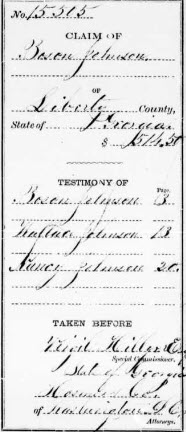
The Claim: Summary & Transcription
Find the digitized original of this claim file at this Ancestry.com link.
Summary
SCC Allowed Claim Chatham County – Boson Johnson
Claimant’s Name (Last Name, First Name): Johnson, Boson
Listed as “Colored”? (Y/N): Y
Amount of Claim: $514.50
Total Amount Allowed: $155.00
Nature of Claim: Provisions 1 horse, bacon, corn, hogs etc taken for use of the U.S. Army
Claimant living in: Liberty County, Georgia
Incident occurred in: Liberty County, Georgia
Claim #: 15505
Secondary Claim #: 43652
Date Claim Submitted [YYYY-MM-DD]: 1872-07-27
Date Testimony taken [YYYY-MM-DD]: 1873-03-22
Claimant’s Attorney: Hosmer & Co, Washington D.C.; M.G. O’Donoghue, Savannah
Special Commissioner: Virgil Hilyer
Property Removed to: the camp of the army
Date property removed: January 1865
Army unit involved: General Sherman’s Army commanded by Gen. Judson Kilpatrick
Date Submitted to Congress [YYYY-MM-DD]: 1876-12-04
Post Office of Claimant: Liberty County, Georgia
Witnesses to be Called: |
Jack Walker, Liberty County |
Wallace Johnson, Liberty County |
Nancy Johnson |
Transcription
Items Claimed
Item # | Description | Amt Claimed | Amt Allowed | Amt Disallowed |
1 | 1 young mare | 200 | 80 | 120 |
2 | 625 lbs bacon | 125 | 40 | 85 |
3 | 60 lbs lard | 12 | 5 | 7 |
4 | 12 bu[shels] corn | 24 | 10 | 14 |
5 | 8 bu[shels] rice | 16 | – | – |
6 | 7 meat hogs | 70 | – | – |
7 | 11 stock hogs | 55 | 20 | – |
8 | 25 chickens | 12.50 | – | – |
TOTALS | 514.50 | 155 | 359.50 |
Remarks: The claimant was a slave & belonged to one Baggs; worked by tasks & after his tasks were done had his time to himself; he appears to have been a hard working man.
Our special agent, Mr. Paine, has sent us the deposition of Rhesa Floyd, a white man, who testifies that the claimant did own the horse, & that he saw the horse after it was taken in the possession of a soldier. He says that the claimant was also allowed to own hogs & other property. We have no doubt he owned the horse & allow for it $80.00.
As to the other articles taken the proof comes from the claimant his wife & his son, but when we consider that he did own the horse, that he was a hard working man & that his own testimony & that of his wife seems given with a good deal of minuteness & fairness we think he must have owned some of the property charged in his petition. For the 7 hogs, which he calls bacon, (deducting what he must probably have used himself) we allow $40.00. Mr. Floyd says such hogs were worth $7.00 each. We have allowed for the other items what we think he had & was taken by the soldiers.
We allow $155.00
A.O. Aldis
O. Ferriss
W.B. Howell } Commrs of Claims
[Transcriber’s Comments: Claim was submitted and testimony taken in Chatham County]
Testimony of Claimant
In answer to the First General Interrogatory, the Deponent says:
My name is Boson Johnson, my age 56 years, my residence Liberty County, in the state of Georgia, and my occupation a farmer; I am the claimant and have a beneficial interest in the claim.
Deposition of Boson Johnson the claimant taken before Virgil Hillyer Esqr Special Commissioner for the State of Georgia of the Southern Claims Commission under Act of Congress of March 3, 1871 and May 11, 1872 to be used in the investigation of a claim now pending before the Commissioners of Claims in the name of Boson Johnson vs. United States in the present of M.G. O’Donoghue Claimant’s Counsel.
General Interrogatories by Special Commissioner
Testimony of Witness
1. What is your name, age, residence, and occupation?
My name is Boson Johnson. I was born in Tattnall County, State of Georgia a slave and remained so till the Yankee Army came to Savannah. I am about 56 years old I live in Liberty County Ga I am a farmer. I am the claimant in this case.
2. Where did you reside from the 1st of April, 1861, to the 1st of June, 1865? If on your own land, what is the size of your farm? How much of your farm was cultivated, and how much was woodland? Where is it situated? What was your occupation during that time? Did you change your residence or business during that time? if so, where was your new residence, and what [was] your new business?
From the 1st of April 1861 to the 1st of June 1865 I resided in Liberty County I lived on my masters land I worked at the saw & grist mill for my master that was my business there I did not change it till Genl Sherman Army came through.
3. Did you ever pass beyond the military or naval lines of the United States and enter the rebel lines? If so, how often, when, where, and for what purpose, and how long did you stay within the Confederate lines on each occasion?
I never passed beyond the military or naval lines of the United States and into the rebel lines.
4. Did you ever take any oath or affirmation to bear allegiance to the so-called Confederate States, or to aid or support them in any way, or to “bear true faith,” or “yield obedience” to them? If so, when and where? State fully in regard to the same.
I never took any such oath or affirmation for any such purpose.
Claimant answered in the negative to all the questions between 5 and 28.
29. Did you ever do anything for the United States Government or its army, or for the Union cause, during the war? If so, state fully what you did.
I never did anything for the United States Government or its army or for the union cause during the war except to feed the union prisoners and aid them in escaping that I did often, they used to come to my house I fed and took care of them and then I showed them the way to escape and get into the Union lines.
30.
I did not have any relatives in the Confederate Army I had a son in the Union Army after General Sherman army came to Savannah.
Claimant answered in the negative to questions 31-39.
40. At the beginning of the rebellion did you sympathize with the Union cause, or with the rebellion? What were your feelings and what your language on the subject? On which side did you exert your influence and cast your vote? What did you do, and how did you vote? How did you vote on ratifying the ordinance of secession? After the ordinance of secession was adopted in your State did you adhere to the Union cause, or did you “go with the State?”
At the beginning of the rebellion I sympathized with the Union cause I felt glad because I felt it would free us I said I was glad and by the help of God I said we would be free I cast my influence on the Union side. Being a slave I had no vote. When the state went out of the Union I was glad of it for I knew my freedom would come.
41. [Original Question 34.] In conclusion, do you solemnly declare that, from the beginning of hostilities against the United States to the end thereof, your sympathies were constantly with the cause of the United States; that you never, of your own free will and accord, did anything, or offered, or sought, or attempted to do anything, by word or deed, to injure said cause or retard its success, and that you were at all times ready and willing, when called upon, or if called upon, to aid and assist the cause of the Union, or its supporters, so far as you means and power and the circumstances of the case permitted?
In conclusion I do solemnly declare that from the beginning of hostilities against the United States to the end thereof my sympathies were constantly with the cause of the United States that I never of my own free will and accord did anything or offered or sought or attempted to do anything by word or deed to injure said cause or retard its success and that I was at all times ready and willing when called upon or if called upon to aid and assist the cause of the Union or its supporters so far as my means and power and the circumstances of the case permitted.
[Question 42 only asked of women]
If the claimant be a colored person, ask the following questions:
43. Were you a slave or free at the beginning of the war? When did you become free? What was your business after you became free? How and when did you come to own the property named in your petition? How did you get the means to pay for it? Who was your former master? Are you now in his employment? Do you live on his land? Do you live on land purchased of him? Are you indebted to your former master for land or property, and how much? Has anybody any interest in this claim besides yourself? State fully all the facts in your answers to these questions.
I was a slave at the beginning of the war and became free when General Sherman Army came to Savannah after I became free I hired to my old master and worked for him for two years and he then turned me off with less than I could hold in my hand. I got the property mentioned in my claim by working nights and after my task was done and some times I worked on Sunday frequently worked on Sunday I was allowed to raise all I could without being a [word] to [word]. I think my old master died last April. I do not owe the estate anything they owe me for two years work. I am the only person interested in the claim except my wife and children. They all helped me to make the property. They have no beneficial interest in it. I never have received any pay or any part of the account this is the only claim I have ever presented against the United States or any other parties.
2nd set of interrogatories by Special Commissioner
1. Were you present when any of the articles of property specified in the claimant’s petition were taken?
I was present when the articles specified in my account were taken.
2. Did you see any of them taken? If so, specify the articles you saw taken.
I saw them all taken.
3. Begin with the first article (Item No. —) which you have specified that you saw taken, and give a full account of all you saw and heard in connection with the taking of that article? [The special commissioner should require the witness to state all the circumstances; for it is only by a knowledge of all of them that the commissioners of claims can judge whether the taking was such a one as the Government is bound to pay for. The common phrase, “I saw the property taken by United States soldiers,” is not enough, for there was much lawless taking. The witness should be required to detail the facts as to each item, when the items were taken at different times; but if all, or more than one, were taken at the same time, that fact should appear, and then a repetition of the circumstances is needless. The special commissioner must be careful to elicit all the facts, as well those against as for the claim, especially as to those articles of property which were the special objects of pillage and theft, such as horses, mules, cattle, hogs, &c. Claimants must bear in mind that a neglect to observe these directions works to the prejudice of the claimant, and may defeat the claim.]
When the soldiers came they said, when they found the bacon, here is the reb meat, I said now it is my own meat, they said shut up your head or we will put a bayonet through you, they went ahead and stripped me of everything did not leave any thing but what I had on my back took all of my clothes and all of my womens they did not leave me a thing or them either except what I had on my back and what they had on.
4. Where were the articles taken? When were they taken? Give the day, month and year, if you can? By whom were they taken? Did you see more than one soldier engaged in the taking? How many soldiers were present? State the number as near as you can? How many helped take the property? How long were they engaged in taking the property?
The property was taken on my place in Liberty County on Mr. Baggs place (my old master). The articles of property were taken in Jany 1865 on their return of soldiers from Savannah they were taken by the Union soldiers. I can’t tell how many there were so many of them it did not take them long it was all taken in one day it took them but a short time – not an hour.
5. Who were present other than soldiers when you saw them taken? Give the names of all you know?
Eliza Baggs Colored [looks like Mirca] Baggs col’d my wife son and three daughters all crying because they had nothing to eat or to wear and some others – besides the officer & soldiers.
6. Was any United States officer, either commissioned or non-commissioned, present at the taking? If so, state his name, rank, regiment, and the command to which he belonged. Did he order the property to be taken? Did he say anything about the taking?
There was officers present I do not know their rank or command to which they belonged. I did not hear any order given to take the property by anyone.
7. Describe how the property was taken, and give a full account of all you saw done, or heard said, upon the occasion of the taking.
The soldiers came into the house and took the bacon piece by piece. They went to my crib and took the last ear of corn and rice all taken about in the same way.
8. How was the property removed—by soldiers or in wagons, or in what manner? State fully as to each article taken and removed.
The property was toted away by the soldiers some was used up right there on the ground.
9. To what place was it removed? Did you follow it to such place, or see it, or any portion of it, at any such place, or on its way to such place? How do you know the place to which it was removed?
The property was taken right there to the camps – did not have to take it any distance at all.
10. Do you know the use for which the property was taken? What was the use, and how do you know it? Did you see the property so taken used by the United States army? Did you see any part of the property so used? State fully all you know as to the property or any of it having been used by the army; and distinguish between what you saw and know, and what you may have heard from others, or may think, or suppose, or infer to be true.
I suppose it was taken for the use of the army I saw them using a part of it.
11. Was any complaint made to any officer on account of such taking? If so, state the name, rank, and regiment of the officer. What did he say about it? State fully all that he said.
I complained to one of the officers but it did no good I complained that there was nothing for me and my family but starvation.
12. Was any voucher or receipt for the property asked for? If so, of whom asked? State name, rank, and regiment. Was any receipt or paper given? If so, produce it, or state where it is, and why it is not produced. If no voucher or receipt was given, state why none was given, and if refused, why it was refused; state all that was said about it. State fully all the conversation between any officer or other person taking the property, and the claimant, or any one acting for him.
I did not ask for a voucher or receipt.
13. Was the property, or any of it, taken in the night-time? At what hour of the day (as near as you can tell) was it taken? Was any of the property taken secretly, or so that you did not know of it when taken?
The property was taken in the day time about 10 a.m.
14. When the property was taken, was any part of the army encamped in that vicinity? If so, state how far from the place where the property was taken, and what was the company, regiment, or brigade there encamped? How long had it been encamped there? How long did it stay there, and when did it leave? Had there been any battle or skirmish near there, just before the property was taken? Did you know the quartermasters, or any of them, or any other officers of the army for whose use the property is supposed to have been taken?
When it was taken the army was encamped about 150 yards from my house. I did not know the company or regiment it was said to be a part of General Sherman’s Army; they commenced taking the property before they got into camp. They staid there about one day. There had not been any battles or skirmishes that I know of just before they took the property. I did not know the quartermasters or any of them or any other officers of the army for whose use they took the property.
15. Describe clearly the condition of the property when taken, and all that tends to show its value at the time and place of taking? Thus, if corn, was it green or ripe? Had it been harvested? Was it in the shock, or husked, or shelled? Where was it? If grain, was it standing; had it been cut; was it in shocks, or in the barn or in stacks; had it been threshed? If horses, mules, or cattle, state when they were taken, how taken, and fully their condition, age, and value. Have you talked with claimant about their value?
The property was all in good condition and put away for our own use.
Item No 1 The horse was 4 years old fat and in splendid order was well broke to work – medium size – they went to my stable put the bridle on to him and led him away.
Item No 2 I did not weigh the bacon I estimated the quantity by the number of hogs – I killed seven they were fat and made good bacon it was caned [canned] and in barrels – one was a large whiskey barrel and the other a large syrup barrel. I know there was all of 625 lb they did not leave me a bit not enough to grease a [word].
Item No 3 I did not weigh the lard I had two packages one held half a barrel and the other a peck it was nice lard of my own rendering they took all of that did not leave me a spoon full.
Item No 4 I had 12 bu[shels] corn I did not measure it I guessed it by the pile and the land I had planted I had two acres planted in corn, the soldiers took it off in their sacks every bit of it.
Item No 5 I had about fifteen bushels of rough rice I did not measure that it was in barrels five of them all full but one the rice was taken away in sacks most all of it.
Item No 6 Is a mistake I had killed the 7 fat hogs I don’t know how my atty made the mistake the bacon I have told you about was from the 7 hogs.
Item No 7 I had eleven head of stock hogs about two years old they were [word] sows and barrows and in splendid order and all good meat hogs I think they would weigh 60 or 70 lbs apiece. The soldiers killed them and took them off as they did the meat from the other hogs they did not leave me one.
Item No 8 The chicken I did not count if I did I do not remember but I know I had 25 or 30 head they killed the chickens and took them off.
167, 17, & 18th Passed.
The property all belonged to me I saw it all taken by the Union soldiers.
Witness
Virgil Hillyer
Boson Johnson [signed by mark]
Sworn to and subscribed before me
Virgil Hillyer
Special Commissioner
State of Georgia
Testimony of Witness (Wallace Johnson)
Usual Interrogatories by Special Commissioner
My name is Wallace Johnson I was born in Liberty County a slave and staid one till Sherman Army came to Savannah I am 27 or 28 years old I reside in Liberty County I am a farmer and cut [word] during the winter. The claimant is my father I have no beneficial interest in this claim. I lived with my father during the war I belonged to the same man David L. Baggs he owned a good many slaves I can’t tell how many. I heard some of the white people talk to my father and tell him that freedom would come to him. I can’t remember much that was said but my father was always talking about the Yankees and the good times to come if they ever did get through. My father was like all the rest of the colored people a good Union man or as we always said a good Yankee man. I don’t know that he ever did anything for the Union cause except to help the Union prisoners when they came along. He had no chance to do anything else. He never did anything for the rebel officers or soldiers. I don’t think he would if he had a chance. I know I would not. I knew some white Union men. Mr. Hodges, Philip Moon and some others. The colored men were all Union men.
2nd set of interrogatories by Special Commissioner
1. Were you present when any of the articles of property specified in the claimant’s petition were taken?
I was present when the articles of property specified in my father’s account were taken.
2. Did you see any of them taken? If so, specify the articles you saw taken.
I saw the property taken.
3. Begin with the first article (Item No. —) which you have specified that you saw taken, and give a full account of all you saw and heard in connection with the taking of that article? [The special commissioner should require the witness to state all the circumstances; for it is only by a knowledge of all of them that the commissioners of claims can judge whether the taking was such a one as the Government is bound to pay for. The common phrase, “I saw the property taken by United States soldiers,” is not enough, for there was much lawless taking. The witness should be required to detail the facts as to each item, when the items were taken at different times; but if all, or more than one, were taken at the same time, that fact should appear, and then a repetition of the circumstances is needless. The special commissioner must be careful to elicit all the facts, as well those against as for the claim, especially as to those articles of property which were the special objects of pillage and theft, such as horses, mules, cattle, hogs, &c. Claimants must bear in mind that a neglect to observe these directions works to the prejudice of the claimant, and may defeat the claim.]
When the soldiers came to take the property they asked me where the old man was (my master) I told them he had gone up in the County. They asked me where his horses were I told them he had taken them with him. They wanted to know if he had any money I told them I did not know whether he had any or not. They went to work taking the property then and said nothing more.
4. Where were the articles taken? When were they taken? Give the day, month and year, if you can? By whom were they taken? Did you see more than one soldier engaged in the taking? How many soldiers were present? State the number as near as you can? How many helped take the property? How long were they engaged in taking the property?
The property was taken at my father’s house on master Baggs place in Jany 1865 when the army was returning from Savannah or that part of the army the property was taken by the Yankee soldiers belonging to Sherman Army I saw more than one there were thousands of them I could not count them the property was all taken in one day.
5. Who were present other than soldiers when you saw them taken? Give the names of all you know?
My father mother & sisters Jack Walker & others were present at the taking besides officer and soldier
6. Was any United States officer, either commissioned or non-commissioned, present at the taking? If so, state his name, rank, regiment, and the command to which he belonged. Did he order the property to be taken? Did he say anything about the taking?
I saw officers there at the taking I do not know their rank, regiment, or command to which they belonged I did not hear the officer give any command to take the property. It looked as if every man was helping himself to such as he could get there were officers looking on.
7. Describe how the property was taken, and give a full account of all you saw done, or heard said, upon the occasion of the taking.
They came then & went to the stable put the bridle on to the horse and led her away they came into the house and took the bacon out of the [word] to the corn house and took the corn the rice was in the crib too they went to the pen and killed the hogs to the coop and took the chickens.
8. How was the property removed—by soldiers or in wagons, or in what manner? State fully as to each article taken and removed.
The property was removed in sacks on horses and some was toted some one way and some another.
9. To what place was it removed? Did you follow it to such place, or see it, or any portion of it, at any such place, or on its way to such place? How do you know the place to which it was removed?
The property was removed to the tents I did not follow it but I could see from the house where they went with it.
10. Do you know the use for which the property was taken? What was the use, and how do you know it? Did you see the property so taken used by the United States army? Did you see any part of the property so used? State fully all you know as to the property or any of it having been used by the army; and distinguish between what you saw and know, and what you may have heard from others, or may think, or suppose, or infer to be true.
I do not know the use for which they took the property unless they took it for the use of the army. I did not see them using any of the property.
11. Was any complaint made to any officer on account of such taking? If so, state the name, rank, and regiment of the officer. What did he say about it? State fully all that he said.
I heard my father complain to one of the officers that he was ruined – they had taken all he had he told father to follow the army and they would ? free ? him father did not go I went with them and the [word] – I enlisted and went to Hilton Head.
12. Was any voucher or receipt for the property asked for? If so, of whom asked? State name, rank, and regiment. Was any receipt or paper given? If so, produce it, or state where it is, and why it is not produced. If no voucher or receipt was given, state why none was given, and if refused, why it was refused; state all that was said about it. State fully all the conversation between any officer or other person taking the property, and the claimant, or any one acting for him.
I did not hear any voucher or receipt asked for.
13. Was the property, or any of it, taken in the night-time? At what hour of the day (as near as you can tell) was it taken? Was any of the property taken secretly, or so that you did not know of it when taken?
The property was taken in the day time about 9 am and continue[d] till it was all gone.
14. When the property was taken, was any part of the army encamped in that vicinity? If so, state how far from the place where the property was taken, and what was the company, regiment, or brigade there encamped? How long had it been encamped there? How long did it stay there, and when did it leave? Had there been any battle or skirmish near there, just before the property was taken? Did you know the quartermasters, or any of them, or any other officers of the army for whose use the property is supposed to have been taken?
When the property was taken the army was encamped close by not more than two hund yards they commenced taking the property two or three hours after they commenced encamping they staid there three days before they all left – I left with them I don’t know whether they all left at that time or not I do not know that there was any battle or skirmish near there or not I did not know the quartermaster or any of them or any other officer of the army for whose use the property was taken.
15. Describe clearly the condition of the property when taken, and all that tends to show its value at the time and place of taking? Thus, if corn, was it green or ripe? Had it been harvested? Was it in the shock, or husked, or shelled? Where was it? If grain, was it standing; had it been cut; was it in shocks, or in the barn or in stacks; had it been threshed? If horses, mules, or cattle, state when they were taken, how taken, and fully their condition, age, and value. Have you talked with claimant about their value? 16. What means have you of knowing the quantity taken? State particularly how you estimate the quantity? Did you count or weigh the articles? Give us all your data. How much did you see taken and removed? What quantity was taken in your presence? As to quantity, distinguish carefully as to what you saw and know, and what you may think or believe from what you have heard from others.
The property was all in good condition.
Item No 1 The horse was about 4 years old – good size – in splendid order well broken to work in harness I saw the soldiers lead the horse off
Item No 2 My father had the bacon from seven hogs salted in two barrels one was a large whiskey barrel and the other was a large syrup barrel I dod not know how many pounds the barrels were full 1 soldier took it all away.
Item No 3 I do not know how much lard there was two or three packages of lard to the best of my recollection I saw that taken away by the soldiers.
Item No 4 I don’t know how much corn father had I think about 12 bus[hels] there was a pretty good pile of it in the crib. I saw it all taken by the soldiers.
Item no 5 I think father had 15 or 16 bushels of rice, in the rough in barrels & 5 of them, they were all full but one I think. I can’t say positively I saw the soldiers take the rice away in sacks.
Item No 6 The seven meat hogs are the seven hogs killed to make the 625 lbs bacon they should not be charged twice as it appears in my father’s account. We had but the 7 head and the 11 head.
Item No 7 The 11 hogs were good stock hogs would weigh from 50 up to 70 lbs they were fat enough for meat they were killed and taken off by the soldiers. I saw them do it.
Item No 8 I don’t know how many chickens we had 25 or 30 head I think – they were all taken by the soldiers. I saw all the property and it was taken by the Yankee soldiers.
They took all of our clothing. My father mother and sister and all of mine did not leave anything for any of us except what we ha on our backs. They took all of our pots and kettles. Cleared us out of everything we had nothing left.
Witness
Virgil Hillyer
Wallace Johnson [signed by mark]
Sworn to and subscribed before me
Virgil Hillyer
Special Commissioner
State of Georgia
Boson Johnson recalled and says he did not make his attorney understand when he gave him the account the 625 lbs of bacon was the meat of the 7 hogs he only had the 625 lbs bacon and the 11 stock hogs.
Witness Virgil Hillyer Boson Johnson [his mark]
Testimony of Witness (Nancy Johnson)
General Interrogatories by Special Commissioner
My name is Nancy Johnson. I was born in Ga. I was a slave and became free when the army came here. My master was David Baggs. I live in Canoochie Creek. The claimant is my husband. He was a good Union man during the war. He liked to have lost his life by standing up for the Union party. He was threatened heavy. There was a Yankee prisoner that got away & came to our house at night; we kept him hid in my house a whole day. He staid in my room. White people didn’t visit our house then. My husband slipped him over to a man named Joel Hodges & he conveyed him off so that he got home. I saw the man at the time of the raid & I knew him. He said that he tried to keep them from burning my house but he couldn’t keep them from taking everything we had. I was sorry for them though a heap. The white people came hunting this man that us kept overnight; my old master sent one of his own grandsons & he said if he found it that they must put my husband to death. I had to tell a story to save [his] life. My old master would have had him killed. He was bitter. This was my master David Baggs. I told him that I had seen nothing of him. I did this to save my husband’s life. Some of the rebel soldiers deserted & came to our house & he fed them. They were opposed to the war & didn’t own slaves & said they would die rather than fight. Those who were from white people who didn’t own slaves were some of them Union people. I befriended them because they were on our side. I don’t know that he ever did anything more for the Union; us were way back in the country but his heart was right & so was mine. I was served mighty mean before the Yankees came here. I was nearly frostbitten; my old mistress made me weave to make clothes for the soldiers till 12 o’clock at night. I was so tired & my own clothes I had to [word] over night. She never gave me so much as a bonnet. I had to work hard for the rebels until the very last day when they took us. The old man came to me then & said if you won’t go away & will work for us we will work for you; I told him if the other colored people were going to be free that I wanted to be. I went away & then came back & my old missus asked me if I came back to behave myself & do her work & I told her no that I came to do my own work. I went to my own house & in the morning my old master came to me & asked me if I wouldn’t go and milk the cows. I told him that my missus had driven me off – well said he you go and do it – then my mistress came out again & asked me if I came back to work for her like a nigger I told her no that I was free & she said be off then & called me a stinking bitch. I afterwards wove 40 yrds of dress goods for her that she promised to pay me for it but she never paid me a cent for it. I have asked her for it several times. I have been hard up [word] but thank God I am spared yet. I quit then only did a few jobs for her but she never did anything for me except give me a meal of victuals, you see I was hard up then. I was well to do before the war.
2nd set of interrogatories by Special Commissioner
1. Were you present when any of the articles of property specified in the claimant’s petition were taken?
I was present when this property was taken.
2. Did you see any of them taken? If so, specify the articles you saw taken.
I saw it taken.
3. Begin with the first article (Item No. —) which you have specified that you saw taken, and give a full account of all you saw and heard in connection with the taking of that article? [The special commissioner should require the witness to state all the circumstances; for it is only by a knowledge of all of them that the commissioners of claims can judge whether the taking was such a one as the Government is bound to pay for. The common phrase, “I saw the property taken by United States soldiers,” is not enough, for there was much lawless taking. The witness should be required to detail the facts as to each item, when the items were taken at different times; but if all, or more than one, were taken at the same time, that fact should appear, and then a repetition of the circumstances is needless. The special commissioner must be careful to elicit all the facts, as well those against as for the claim, especially as to those articles of property which were the special objects of pillage and theft, such as horses, mules, cattle, hogs, &c. Claimants must bear in mind that a neglect to observe these directions works to the prejudice of the claimant, and may defeat the claim.]
They said that they didn’t believe what I had belonged to me. I told them that I would swear that it belonged to me. I had tried to hide things. They found our meat, it was hid under the house & they took a crop of rice. They took it out & I had some cloth under the house too & the dishes & two fine bed quilts. They took them out. These were all my own labor & night labor. They took the bale of cloth under the house and the next morning they came back with it made into pantaloons. They were starved & naked almost. It was Jany & cold. They were on their way from Savannah. They took all my husband’s clothes except what he had on his back.
4. Where were the articles taken? When were they taken? Give the day, month and year, if you can? By whom were they taken? Did you see more than one soldier engaged in the taking? How many soldiers were present? State the number as near as you can? How many helped take the property? How long were they engaged in taking the property?
These things were taken from David Baggs’ place in Liberty County. The Yankees took them. I should think there were thousands of them. I could not count them. They were about a day & a night.
5. Who were present other than soldiers when you saw them taken? Give the names of all you know?
There were present my family myself & husband & this man Jack Walker. He is way out in Tatnall Co. & we can’t get him here.
6. Was any United States officer, either commissioned or non-commissioned, present at the taking? If so, state his name, rank, regiment, and the command to which he belonged. Did he order the property to be taken? Did he say anything about the taking?
There were what we called officers there. I don’t know whether they ordered the property taken. I put a pot on and made a pie & they took it to carry out to the head men. I went back where the officers camped & got my oven that I cooked it in back again. They must have ordered them or else they could not have gone so far & they right there. They said that they stood in need of them. They said that we ought not to care what they took for we would get it all back again; that they were obliged to have something to eat. They were mighty fine looking men.
7. Describe how the property was taken, and give a full account of all you saw done, or heard said, upon the occasion of the taking.
They took the mare out of the stable; they took the bacon under the house; the corn was taken out of the crib & the rice & the lard. Some of the chickens they shot & some they run down; they shot the hogs.
8. How was the property removed—by soldiers or in wagons, or in what manner? State fully as to each article taken and removed.
They took it by hand the camp was close by my house.
9. To what place was it removed? Did you follow it to such place, or see it, or any portion of it, at any such place, or on its way to such place? How do you know the place to which it was removed?
They carried it to their camps; they had lots of wagons there.
10. Do you know the use for which the property was taken? What was the use, and how do you know it? Did you see the property so taken used by the United States army? Did you see any part of the property so used? State fully all you know as to the property or any of it having been used by the army; and distinguish between what you saw and know, and what you may have heard from others, or may think, or suppose, or infer to be true.
They took it to eat, bless you! I saw them eating it right there in my house. They were nearly starved.
11. Was any complaint made to any officer on account of such taking? If so, state the name, rank, and regiment of the officer. What did he say about it? State fully all that he said.
I told one of the officers that we would starve & they said no that we would get it all back again come & go along with us; but I wouldn’t go because the old man had my youngest child hid away in Tatnall Co; he took her away because she knew where the gold was hid & he didn’t want her to tell. My boy was sent out to the swamp to watch the wagons of provisions. The soldiers took the wagons & the boy & I never saw him any more. He was [can’t read the age] old. I could have got the child back but I was afraid my master would kill him; he said that he would & I know that he would or else make his children do it. He made his sons kill 2 men big tall men like you. The Lord forgive them for the way they have treated me. The child couldn’t help them from taking the horses. He said that Henry (my boy) hallooed for the sake of having the Yankees find him but the Yankees asked him where he was going & he didn’t know they were soldiers & he told them that he was going to master’s mules.
12. Was any voucher or receipt for the property asked for? If so, of whom asked? State name, rank, and regiment. Was any receipt or paper given? If so, produce it, or state where it is, and why it is not produced. If no voucher or receipt was given, state why none was given, and if refused, why it was refused; state all that was said about it. State fully all the conversation between any officer or other person taking the property, and the claimant, or any one acting for him.
I didn’t ask for any receipt.
13. Was the property, or any of it, taken in the night-time? At what hour of the day (as near as you can tell) was it taken? Was any of the property taken secretly, or so that you did not know of it when taken? 14. When the property was taken, was any part of the army encamped in that vicinity? If so, state how far from the place where the property was taken, and what was the company, regiment, or brigade there encamped? How long had it been encamped there? How long did it stay there, and when did it leave? Had there been any battle or skirmish near there, just before the property was taken? Did you know the quartermasters, or any of them, or any other officers of the army for whose use the property is supposed to have been taken?
It was taken in the day time, not secretly. When they took this property the army was encamped. Some got there before the camp were up. Some was hung up in the house. Some people told us that if we let some hang up they would not touch the rest but they did. They were close by. They commenced taking when they first came. They staid there two nights. I heard a heap of shooting but I don’t think they killed anybody. I didn’t know any of the officers or quartermasters.
15. Describe clearly the condition of the property when taken, and all that tends to show its value at the time and place of taking? Thus, if corn, was it green or ripe? Had it been harvested? Was it in the shock, or husked, or shelled? Where was it? If grain, was it standing; had it been cut; was it in shocks, or in the barn or in stacks; had it been threshed? If horses, mules, or cattle, state when they were taken, how taken, and fully their condition, age, and value. Have you talked with claimant about their value? 16. What means have you of knowing the quantity taken? State particularly how you estimate the quantity? Did you count or weigh the articles? Give us all your data. How much did you see taken and removed? What quantity was taken in your presence? As to quantity, distinguish carefully as to what you saw and know, and what you may think or believe from what you have heard from others.
This horse was as fine a creature as ever was & the [word] etc were in good order.
Item No 1 I don’t know how old the mare was. I know she was young. She was medium sized. She was in nice order, us kept a good creature. My husband bought it when it was a colt, about 2 years old. I think he had been using it a year or a little better. Colored people when they would work always had something for themselves after working for their masters. I most forget whether he paid cash or swapped [word]. He worked & earned money, after he had done his masters work. They bridled & carried her off. I think they jumped right on her back.
Item No 2 We had 7 hogs & he killed them right there. It was [word] away in the barrels. Some was done & hung up to smoke but us took it down & put it into the barrel to keep them from getting it. He raised the hogs. He bought a few and raised his own pork [or pack] and that is the way he got them. He did his tasks & after that he worked for himself & he got some money & bought the hogs and then they increased. He worked Sundays [word] and that was for ourselves. He always was a hardworking man. I couldn’t tell how much these would weigh; they were monstrous hogs, they were a big breed of hogs. He had them up feeding. The others were some two years old & some more. It took two men to help hang them up. This was the meat from 7 hogs.
Item No 3 I had half a barrel of lard. It was in gourds that would hold half a bushel a piece. We had this hid in the crib. This was lard from the hogs.
Item No 4 I could not tell exactly how much corn there was but there was a right smart. We had 4 or 5 bushels ground up into meal & they took all the corn besides. They carried it off in bags and my children’s undershirts – tied them like bags & filled them up. My husband made baskets and they toted some off in that way. They toted some off in ?anners & big blue tubs.
Item No 5 I don’t know exactly how much rice there was but us made a good deal. They toted it off in bundles threshed out – it was taken in the sheaf. They fed their horses on it. I saw the horses eating it as I passed there. They took my tubles kettles etc. I didn’t get anything back but an oven.
Item No 7 [sic] We had 11 hogs. They were 2 or 3 years old. They were in pretty good order. We were intending to fatten them right next year. They killed them right there.
Item No 8 I had 30 or 40 head of chickens. They took the last one. They shot them.
This property all belonged to me and my husband. None of it belonged to Mr. Baggs. I swore to the men so but they wouldn’t believe I could have such things. [sentence] & they took them all. It didn’t look like a Yankee person would be so mean but they said if they didn’t take them the whites here would & they did take some of my things from their camp after they left.
Witness
Amey M. Adlington
Nancy Johnson [signed by mark]
Sworn to and subscribed before me
Virgil Hillyer
Special Commissioner
State of Georgia
Testimony of Witness (Rhesa Floyd)
State of Georgia
County of Liberty }
Rhesa Floyd (white) sworn in and to certain questions, he answers and says:
1– Rhesa Floyd 72 years old, the county of Liberty, State of Georgia: ever since 1817 occupation at present is a miller.
2– Is not related in any manner to claimant, and not interested in the claim.
72– was not present when the property charged in this claim was taken. During Sherman’s raid or rather his march, I was at my own house, and on the second day, two troopers of an Ohio regiment of Cavalry came to my house, and dismounted and tied their horses to the trees, and I noticed that one of the animals was a mare which belonged to Boson Johnson, or as we called him Boson Baggs, as he belonged to Baggs, and I said, “I see you have got Boson’s mare, do you know Boson, he said yes, I captured the mare yesterday, said he saw the mare and took it. I knew it was Boson’s mare, because I had seen him with it often; and it was known as the property of Boson, and he controlled and managed it, and offered to sell it. Boson’s master allowed his slaves privileges, and among the privileges, that of holding property. Witness says the mare was a fine little mare, and was worth between eighty and one hundred dollars. The trooper who had the mare remained at my house some hours, and I learned that his name was Thomas Curry, he told me his name and that he belonged to the 10th Ohio Cavalry. Witness knows nothing of the other property claimed to have been taken from Boson. Witness knows that he was allowed to raise hogs, heard his master say so. Stock hogs were worth about that time $8 per head. Meat hogs on an average were worth about six or seven dollars per head. Don’t recollect what bacon was worth at that time. And don’t know the value of the other property set forth in the claim.
Sworn to, and subscribed before me this 6th of July 1876.
W.W. Paine
Special Agent
——————————————————
Boson Johnson vs United States } Before Special Commissioner Virgil Hillyer Esqr, at Savannah, State of Georgie
There being no further testimony in the above case I submit it for the consideration and decision of the commissioners.
M.J. O’Donoghue
Attorney for Claimant
——————————————————
Claim No. 43652
Sett No. 3162
Boson Johnson of Ga
$ 155
Due him
Out of the appropriation for
“Claims of Loyal Citizens for Supplies
Furnished during the rebellion”
For amount allowed him
By the Southern Claims Commission
Reported: March 30th, 1877
Returned: April 2d, 1877
Requisition No. 3638, dated
Apr ? 1877, transmitted for
Warrant ?, 1877.
$155
————————————————————
The United States
To Boson Johnson of Ga
For the amount allowed him by Act of Congress, Private No. ?
Approved March 3, 1877, entitled “An act making appropriations for the payment of claims reported allowed by the Commissioners of Claims under the Act of Congress of March 3, 1871.”
The sum of one hundred and fifty five dollars $155
Payable in care of [word] Hosmer & Co Attys, Washington, D.C.
Treasury Department,
Second Comptroller’s Office
April 2, 1877
H. Spalding, Clerk
Treasury Department
Third Auditor’s Office
[date faded or missing], 1877
[name faded], Clerk