
In 1877, Jackson Williams testified before the Southern Claims Commission in an attempt to get compensation for property he said was taken from him by troops of the U.S. Army in December 1864 while he was enslaved in Liberty County, Georgia. The Commission disallowed his claim for $181.75 for a cow, 4 bacon hogs, 8 stock hogs, chickens, ducks, guinea fowls, hives of honey, corn, rice, and bacon, on the grounds that there was not sufficient evidence that he had actually owned property, despite testimony by a former slaveholder’s wife that he was allowed to own property.
For a full transcript of this claim, see: https://theyhadnames.net/2020/06/07/jack-williams-southern-claims-commission/.
Williams said that he was owned during the war by Ned Hines, who was dead by the time of the claim. Sarah J. Hines testified for Williams as the widow of his former owner (though it appears the Commission may have misunderstood the relationship). He said that at the time of the raid by the Sherman’s Army troops commanded by General Kilpatrick, he was on “Mr. Hines” plantation, and about 50 or 60 troops came with 25 wagons and took his property.
Prime Hargreaves, who said he was 75 years old and had lived in Liberty County all his life, testified for Williams as a witness who saw the property taken. He corroborated his account, and said he had known Williams for 20 years, and had lived on the same place he did during the war. He said that Will Bacon and Moses Wood could testify as to Williams’ loyalty to the Union cause, and that Tony Golding and Brister Fleming were prominent “Union people” in the area who could also so testify. He testified that Williams had complained to the troops taking his property but had not asked for a receipt because “we were all afraid of them.”
Thomas Miller also testified as a witness, saying he was 40 years old and had lived in Liberty County all his life. Both Hargreaves and Miller said they were not related to Williams; Miller said he had known Williams all his life and lived on the same place during the war so saw him all the time.
Sarah J. Hines, identified by the SCC officers as the widow of Williams’ former owner, testified that she was 50 years old and had lived in Liberty County all her life. She said she had known Williams since 1855, and that he lived on her husband’s place during the war and she saw him occasionally. She said she was not there when the property was taken but did know that he was allowed to own property and that his wife’s father who lived on her husband’s place did own property during the war.

Research on another Liberty County claimant, Augustus (Gus) Williams, revealed that Augustus and Jack Williams were brothers, and that their mother was probably Betsey. They were included in the 1841 inventory and division of Lewis Hines. The estate was divided several times after that as Hines’ minor children came of age; Jack was drawn in an 1855 division by Hines’ son Edward H. Hines, and Augustus was gifted to Edward Hines in 1859 by Edward’s mother Ann Hines. In 1860, Edward, 19, was living with Ann Hines near Way Station in Bryan County. Ned is a common nickname for Edward, explaining why Jack Williams had identified his slaveowner as Ned Hines.
Because Edward Hines was so young during the Civil War and did not have his own establishment, it is very likely that Jack and Augustus were loaned or hired out to other family members, which explains why Mrs. Sarah J. Hines, who was NOT Edward Hines’ widow, had testified that Jack was on her husband’s place during the war. The SCC officers appear to have misunderstood the testimony. In fact, Sarah J. Hines was the widow of Charlton Hines, who was Lewis Hines’ brother and who died around 1864. Note that it appears that Jack Williams’ wife’s father (and perhaps his wife) lived in Charlton Hines’ plantation, according to Sarah’s testimony.
In the 1870 census, Jack, said to be 30 years old with unspecified property worth $150, was living with wife Daphney, 25, and daughter Rebecca, 2, next to brother Gus and his family. Other surnames nearby were Holmes, Bacon, and Jenkins. The 1870 census unfortunately does not specify relationships, but also living in the household were Minty Pray, 23, children Sam Goulding (7), Ann Goulding (4), and Charley Goulding (1), plus Flora Pray (50).
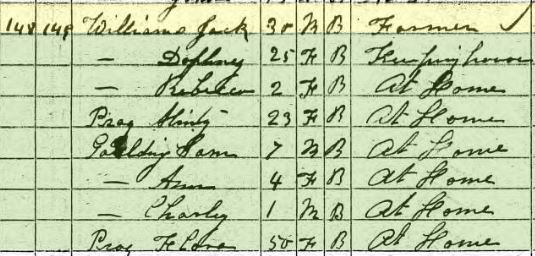
Given the ages, it seems possible that Minty Prey, who may have been mother of the children (based on the order in which the names were given) could have been Daphney’s sister and Flora their mother. That is just speculation, but in fact Charlton Hines’ May 1864 estate inventory listed a Flora and Daphne in order, with Flora’s value ($250) consistent with either an older woman or a young child, and Daphne’s ($1200) consistent with a woman in the prime of her life. Listed directly after Daphne is Moultrie ($250). This could not be Daphne’s son Moultrie, who was 3 in 1880. Remember that Sarah J. Hines testified that Jack’s wife’s father lived on her husband Charlton Hines’ plantation. Could he have been this Moultrie, since Daphne named her son after him? Or perhaps this Moultrie is her younger brother.

A Minty ($800) is listed farther down followed by a Sampson, who is listed as an infant (value $200), who is probably the Sam/Samson mentioned in the 1870 and 1880 censuses as being in Jack Williams’ household.

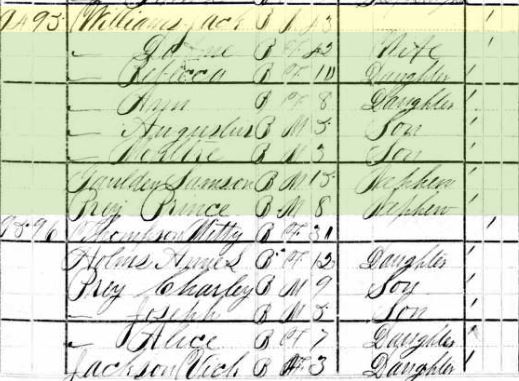
In the 1880 census, Jack and Daphne were living with daughter Rebecca, now 10, and children Ann (8), Augustus (5), and Moultre (3), as well as with Samson Gaulden (15) and Prince Prey, identified as nephews. Next door was Mitty Thompson (31), who presumably was the same woman who was identified as Minty Pray in the 1870 census, as she had living with her daughter Anne S. Holmes (12), sons Charley Prey (9) and Joseph Prey (5), and daughters Alice Prey (7) and Vicki Jackson (3). Jack Williams’ brother Augustus was living nearby.
By 1900, Jack Williams, now in his early 60’s, was listed as being a widower. Living in his household were James Williams (15) and Rebecca Williams (14), who were identified as his son and daughter, but given their ages and especially given the fact that Williams already had an older daughter named Rebecca, were perhaps more likely his grandchildren. Also in the household were his daughter Ann with her husband Fortune Anderson and their children, Jackson M. (3), William (2), and Abe (infant).
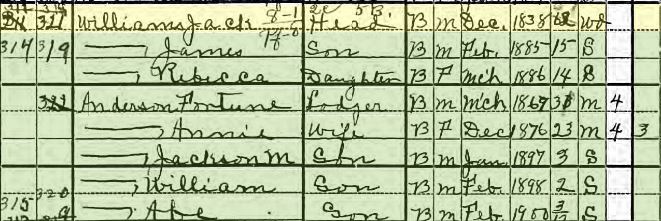
Unfortunately, no records were found for Jack Williams’ death date, but he does not seem to be listed in the 1910 federal census for Liberty County.
Citations
1870 U.S. Census, Liberty County, Georgia, population schedule, Subdivision 176, p. 23, dwelling #148, family #149, enumerated on November 19, 1870, by John E. Martin, Jack Williams, digital image, Ancestry.com (https://www.ancestry.com/interactive/7163/4263491_00311/1266990: accessed 6/7/2020).
1880 U.S. Census, Liberty County, Georgia, population schedule, Dictrict 15, enumeration district 67, p. 9, dwelling #94, family #95, Jack Williams; digital image, Ancestry.com (https://www.ancestry.com/interactive/6742/4240148-00409/8767662: accessed 6/7/2020).
1900 U.S. Census, Liberty County, Georgia, population schedule, Militia District 15, enumeration district 80, sheet #16, line number 78-85, digital image, Ancestry.com (https://www.ancestry.com/interactive/7602/4120071_00576/9154252: accessed 6/7/2020).
Liberty County Court of Ordinary, Book “C”, 1863-1873, p. 65, Estate Inventory and Appraisement of Charlton Hines; digital image, Ancestry.com, “Georgia Probate Records, 1743-1990,” Liberty County, within “Wills 1863-1942 vol C-D,” image #43. Record summarized and put online at TheyHadNames.net (https://theyhadnames.net/2020/06/02/augustus-williams-southern-claims-commission/)