
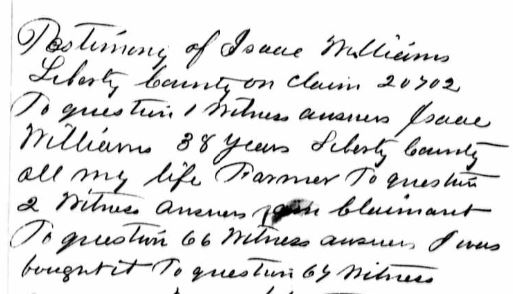
Isaac Williams’ 1877 Southern Claims Commission petition for compensation was rejected. Williams had claimed $320 for a “good bay horse,” 5 cows, and a buggy & harness he said were taken from him by U.S. soldiers from Sherman’s Army when they were foraging in Liberty County, Georgia, in December 1864.
For a full transcript of this claim, see: https://theyhadnames.net/2020/11/30/isaac-williams-southern-claims-commission/
The Commission pointed out contradictions in his testimony, noting that he was only in his early 20s when the Civil War started, but he said he had bought the property before the war. They thought it seemed odd that a young enslaved man would be able to own such property at such a young age.
It had been established in the Liberty County claims that enslaved people there did own small amounts of this kind of property, and Williams did have the testimony both of fellow formerly enslaved men Gideon Jackson and Samuel Winn, as well as of white man Gideon B. Dean, who said that Williams had been owned by his father. However, this was not enough to overcome the Commission’s doubts about the testimony, which were complicated by the fact that the SCC’s appointed Special Commissioner at the time, Henry Way, a former Liberty County slaveowner and a prominent judge, submitted such suspiciously similar-sounding and abbreviated testimony for these cases that the Commission reviewed each of his cases with a certain threshold of suspicion.
Whatever the truth, Williams’ claim revealed useful genealogical facts about his life. He first submitted a claim in 1872, and said that he was living at Woodland Plantation then, but had lived at Olive Hill Plantation when the soldiers came in 1864. His testimony was taken in October 1877 by Henry Way, with merchant Robert Q. Cassels present, at Stop #3 of the A&G Railroad in Liberty County. Williams testified that he was 38 years old, lived in Liberty County, and had done so all his life. He said that the property he was claiming had been taken from “Dean’s plantation” in Liberty County, which had about 3000 acres, though only 200 under cultivation, and that his owner, G.B. Dean, was not testifying for him because he was dead. He said he was present when the soldiers took the property.
Samuel Winn testified that he was 38 years old and had lived in Liberty County and known Isaac Williams all his life, and that they had lived on the same place and so he saw him all the time during the war. When asked how he knew that Williams was loyal to the United States, which was a requirement for compensation, he said that everyone knew it and that Williams had helped the soldiers drive the cattle and horse off. He said that Frank Dean and Madison Dean could testify to his loyalty. He testified that the soldiers were camped about two miles away.
Gideon Jackson testified that he was 60 years old, and had known Isaac Williams all Williams’ life and also lived on the same place. He gave essentially the same testimony Winn did.
The Commission normally tried to get testimony by a white man, especially one who had owned the claimant or a member of the owner’s family. In February 1877, Gideon B. Dean testified that he was 37 years old and had lived in (neighboring) McIntosh County all his life. He had known Isaac Williams all his life, he said, and saw him every day before he had belonged to his now deceased father and lived on his father’s place. He said he was not present when the property was taken, but he knew that Williams was allowed to and did own property before and during the war, and that he had owned a horse, buggy, and cattle in Liberty County.
Isaac Williams himself said he was 38 in 1877, which would put his birth year around 1839. The records naming him after that are a textbook case of how wildly birth years can vary in census records. In the 1870 U.S. federal census for Liberty County, an Isaac Williams was listed as being 40 years old, in household with Patsy Williams, 40. (The 1870 census did not specify relationships.) There were two other Isaac Williams in the 1870 Liberty County census, but one was only 10 months old and the other only 22, so this is most likely to have been Isaac. He was listed living near Sam Winn, who had testified for Isaac Williams’ SCC claim, a further indication that this is probably the right Isaac Williams, despite the variation in birth year.
In the 1880 census, this Isaac Williams, was listed as being 55 (birth year 1825). He is still in household with Patty, now listed as his wife and said to be 45, and there are five children: Isaac (18), Eddy (16), Letty (12), Willby (12), and Paul (7).
The 1890 census burned, but the 1900 census listed Isaac, now 60 (birth year 1840), with wife Patsey (59), living next door to son Isaac Williams and his wife Ella. The 1900 census collected additional details: Isaac and Patsey were said to have been married for 40 years, and Patsy had had 9 children, 5 of them living. Both Isaac and his son Isaac were listed as renting land, not owning it.
In the 1910 census, Isaac Williams Sr., listed as 75, and his wife Hattie (70) were living with son Isaac and his now wife Cornelia. It is likely that “Hattie” was a mistake for “Patsy” as the census recorded that they had been married for 50 years and had had 10 children, 4 of them living.
No record was found that Isaac Williams Sr. ever owned land, but Liberty County Superior Court records do have details about his life. On April 20, 1885, Williams mortgaged personal property to local white merchant Robert Q. Cassels in return for $15 in groceries. The loan had to be paid off at 8 per cent annual interest by October 15. He listed the personal property as “one Horse & Buggy – white mare. My corn – rice & cotton.”
On April 11, 1891, Williams made a similar promissory note to J.W. Parker for $25, due on January 1 with 8 per cent annual interest. He mortgaged “one yellow road cart with coil springs in front also one pony stallion horse four years old, color bay, with star in face.”
Patsy Williams, his wife, may have inherited land. On March 30, 1904, Jinks Fabian and Patsey Williams, both of Liberty County, sold to the Hilton and Dodge Lumber Company, Darien, McIntosh County, for $30 all the timber rights to a 30-acre plot of land in Liberty County’s 17th District, bounded north by land of Jinks Fabian “to his field including the little running spring branch,” east and south by land belonging to Samuel Kennedy, and west by the public road leading to Savannah. The lease was to last 10 years. It would be worth investigating whether there are any indications that Jinks (or Jenks) Fabian was a relative of Patsy’s.
Isaac Williams Jr did purchase land. On November 8, 1900, Abram Fraser sold to Isaac Williams, Jr, both of Liberty County, for $22 10 acres of land bounded north by Walthourville Road, east by the estate of Prince LeConte, south by lands of Seaborn Gordon, and west by lands of Abram Fraser.
No records were found for Isaac Williams Sr after the 1910 census, probably indicating that he died between 1910 and 1920. Isaac Williams Jr. was listed in both the 1920 and 1930 census records, and those pages were searched in case Isaac Williams Sr had been misindexed, but no record was found.
Slavery
This claim highlighted a question about other claims. Gideon B. Dean testified for other formerly enslaved people in Liberty County, usually saying that his father had “controlled” them during the Civil War. Most of those other claimants were enslaved by the LeConte family, and many actually took the surname LeConte at Emancipation. This was the first claim found in which the claimant said he had been on Dean’s plantation. Why would Gideon B. Dean Jr. have such a connection with the enslaved of the LeConte family?
Saying his father “controlled” them suggests that he was a plantation overseer, and in fact, William LeConte’s (1838-1920) unpublished 1900 memoir says, “Often the overseer, Mr. Dean – whose visits were two or three times a week, he having several other of the LeConte farms under his charge – would take me in front of him in riding out upon the farm to inspect the work then going on and seeing that his instructions to the negro foreman were being carried out.” Gideon B. Dean Sr. thus was apparently both an overseer for various LeConte properties and also owned his own property. In the 1850 federal census, he was listed as a “planter” whose real estate was worth $2000, the same value given to his neighbor Valentine Grest’s property. Grest owned the Isle of Wight in Liberty County.
According to Isaac Williams’ claim, he himself was owned by Gideon B. Dean Sr and lived on his plantation. According to the 1850 slave census, Dean did own two young enslaved boys of about the right age to have been Isaac.
One confounding factor is that Isaac Williams said in his initial 1872 SCC application that he was living on Woodland Plantation in 1872, and had lived on Olive Hill Plantation at the time of the 1864 raid. Woodland plantation belonged to the LeConte family, and Olive Hill plantation had also belonged to the LeConte family. Thus the question of whether Gideon B. Dean Sr was Williams’ owner or merely the overseer of the plantation remains open for further research.
Williams’ Southern Claims Commission petition mentioned that a Madison Dean could testify as to Williams’ loyalty to the Union. No Madison Dean was found in the 1870 census, so it is worth mentioning here that in 1830, Gideon B. Dean used an enslaved boy named Madison, said to be about 13, as collateral on a promissory note. In 1832, he used him again for the same purpose, now saying he was about 16, along with Abraham, about 30. In both cases the notes were paid off, and Madison would not have changed hands. #TheyHadNames
Surname
Why did Isaac Williams take the surname Williams at Emancipation? Often the answer to this question also sheds light on the individual’s family heritage, because newly freed people in Liberty County sometimes adopted a surname of an early enslaver of their family. In this case, Gideon Dean married Miss Elizabeth Williams in 1833. Elizabeth evidently died, because in 1860, Gideon Dean (Sr) married Susan Williams, whose maiden name was Thorpe. She had been previously married to Francis Williams. It is likely that Elizabeth Williams and Francis Williams were related. Although a quick research attempt could not prove this definitively, it is likely there was a connection with the Cornelius Williams family of Liberty County. Allied family names were Thorpe, Hendley and Farrar (Farrow). For anyone interested in exploring this further, please contact me at jnscole@yahoo.com.
Citations
Census Records for Isaac Williams Sr.
1870 U.S. Census, Liberty County, Georgia, population schedule, Subdivision 180, p. 45, dwelling #434, family #434, enumerated on December 14, 1870, by Robert Q. Baker, Isaac Williams household, digital image, Ancestry.com (https://www.ancestry.com: accessed 11/30/2020).
1880 U.S. Census, Liberty County, Georgia, population schedule, District 15, enumeration district 67, p. 26, dwelling #278, family #279, Isaac Williams household; digital image, Ancestry.com (https://www.ancestry.com: accessed 11/30/2020).
1900 U.S. Census, Liberty County, Georgia, population schedule, Militia District 15, enumeration district 81, sheet #14, line number 15-17, digital image, Ancestry.com (https://www.ancestry.com: accessed 11/30/2020).
1910 U.S. Census, Liberty County, Georgia, population schedule, Militia District 15, enumeration district 114, p. 11, line number 95-100, house #228, dwelling #236, digital image, Ancestry.com (https://www.ancestry.com: accessed 11/30/2020).
Deed Records for the Williams Family
Liberty County Superior Court, “Deeds & Mortgages v. U 1884-1885” p. 530-31, Isaac Williams to Robert Q. Cassels; digital image, FamilySearch.org, “Deeds & Mortgages, v. T-U 1882-1885” within “Deeds and mortgages, 1777-1920; general index to deeds and mortgages, 1777-1958,” image #548, (https://www.familysearch.org/ark:/61903/3:1:3Q9M-C3QP-R9ZZ-S?i=547&cat=292358, accessed 11/26/2020)
Liberty County Superior Court, “Deeds & Mortgages v. Y 1890-1891” p. 446-7, Isaac Williams to A.W. Parker; digital image, FamilySearch.org, “Deeds & Mortgages, v. Y-Z 1890-1892” within “Deeds and mortgages, 1777-1920; general index to deeds and mortgages, 1777-1958,” image #548, (https://www.familysearch.org/ark:/61903/3:1:3Q9M-C3QP-5123?i=271&cat=292358, accessed 11/26/2020)
Liberty County Superior Court, “Deeds & Mortgages v. AF 1903-1904” p. 424-6, Patsey Williams and Jinks Fabian to the Hilton and Dodge Lumber Company; digital image, FamilySearch.org, “Deeds & Mortgages, v. AE-AF 1901-1904” within “Deeds and mortgages, 1777-1920; general index to deeds and mortgages, 1777-1958,” image #631, (https://www.familysearch.org/ark:/61903/3:1:3Q9M-C3QP-59W6-L?i=630&cat=292358, accessed 11/26/2020)
Liberty County Superior Court, “Deeds & Mortgages v. AD 1898-1901” p. 522, Abram Fraser to Isaac Williams Jr; digital image, FamilySearch.org, “Deeds & Mortgages, v. AC-AD 1896-1901” within “Deeds and mortgages, 1777-1920; general index to deeds and mortgages, 1777-1958,” image #615, (https://www.familysearch.org/ark:/61903/3:1:3Q9M-C3QP-5918-Q?i=614&cat=292358, accessed 11/26/2020).
Deed Records for Madison Dean
Liberty County Superior Court, “Deeds & Mortgages v. I 1822-1831,” p. 390-1, Gideon B. Dean to Uriah Wilcox, mortgage of slaves; digital image, FamilySearch.org, “Deeds & Mortgages, v. H-I 1816-1831” within “Deeds and mortgages, 1777-1920; general index to deeds and mortgages, 1777-1958,” image #503, (https://www.familysearch.org/ark:/61903/3:1:3Q9M-CS42-SSTR-B?cat=292358, accessed 11/30/2020)
Liberty County Superior Court, “Deeds & Mortgages v. K 1831-1838,” p. 33, Gideon B. Dean to R & W King, mortgage of slaves; digital image, FamilySearch.org, “Deeds & Mortgages, v. K-L 1831-1842” within “Deeds and mortgages, 1777-1920; general index to deeds and mortgages, 1777-1958,” image #51, (https://www.familysearch.org/ark:/61903/3:1:3Q9M-C3QP-T9KQ-X?i=50&cat=292358, accessed 11/30/2020)
Unpublished memoir of William LeConte, “Some of the Events of my life, Jotted down as they were reviewed by Memory, and all of the Badness left out,” written around 1900, copy in possession of Stacy Cole (jnscole@yahoo.com).
Olive Hill Plantation belonging to William LeConte
“Early History and Excavation of the LeConte-Woodmanston Plantation,” by Jennifer M. Hamilton, a thesis presented to the Graduate Council of the University of Florida, 1980. Accessed online at https://ufdc.ufl.edu/AA00026475/00001/1, 11/30/2020.