
Jack Walker “cried like a child” as the U.S. soldiers confiscated his property for Sherman’s Army in January 1865 in Liberty County, Georgia, according to his claim for compensation to the Southern Claims Commission. He was so angry that he did not notice which units the soldiers came from, he told the Commission.
For a full transcript of this claim, see: https://theyhadnames.net/2020/12/26/jack-walker-southern-claims-commission/
At the time, Walker was being held in slavery by David S. Baggs (1792-1872) on his plantation in Liberty County’s 1132d District, which is in the Taylors Creek area. Walker first applied for compensation in July 1872, two days before he testified for Baggs in Baggs’ own application for compensation, which was denied because Baggs had died just before the testimony was taken, and his widow Isabella could not prove his loyalty to the United States, a requirement for compensation and a problem for most white Southerners, who were assumed to have supported the war in one way or another. Former slaves, however, were assumed to have been in favor of the U.S. government, and with proper proof that he owned property, Walker’s claim could have been more successful. For an unknown reason, however, his case did not move into the testimony phase until February 1879, right before the March 1879 deadline for submission.
In 1872, Walker had testified that he saw the soldiers take some of Baggs’ property. He said that he himself had been born in McIntosh County, but was living in Liberty County, and was 52.
In 1879, when Walker finally testified in his own case, he said that he was then 60 years old, and had lived in Liberty County’s 1132d district for 50 years. He had not mentioned owning property in his testimony for Baggs, but in his own testimony, he stated that he had lost to the soldiers one horse, a saddle and bridle, 20 hogs, 2000 lbs fodder, 150 pounds sugar, 50 bushels of corn, and 50 chickens. This was a large amount of property for an enslaved man, and the Commission denied the claim on the basis that “we do not feel justified in allowing claims for persons formerly slaves without more satisfactory proof that they owned the property than this [claimant] has furnished.” Walker had only testified that he had earned the property by working at nights and weekends, and the Commission normally wanted more detail; not providing it was the fault of the Special Commissioner taking the testimony and Walker’s lawyer, M.J. O’Donoghue.
Walker’s wife Phillis testified on his behalf, but she said that they had not lived in the same place — seeing each other on Saturday nights and all day Sundays — and so she had not witnessed the property being taken. She said she was 47 years old (in 1879) and that she had known Walker about 40 years, and intimately for 22 years. When asked whether he had a public reputation as a loyalist for the Union cause, she answered, “The white people were so strict no colored person had a chance to make a reputation.” She testified that Matthew Kirkland, Henry Tompson [alt: Thompson], and Archy Tompson were Union men themselves and could testify that Walker was also.
Walker’s only other witness was Bowson (or Boson) Johnson, who testified that he was about 63 years old and had lived in Liberty County for 40 or 50 years. He said he had known Walker for about 50 years and “intimately all the time he was a slave.” They lived on the same place, he said, about 150 yards apart. Johnson testified, “Old master used to tell us if the Yankees whipt we should all be free and we used to wish to be free, thought it was a great thing to be free.” When asked if Walker had ever been bothered because of his pro-Union sentiments, Johnson said, “I know that some white men whipped him because he talked about what he would do if he was free, he talked in favor of the Yankees.”
Presumably because Walker’s case came so close to the deadline for submitting cases, a Special Commissioner was appointed specially to hear his testimony. This Special Commission was J. Sloeman Ashmore, the clerk of the Liberty County Superior Court. Normally the Special Commissioners did not venture an opinion as to the veracity of the claim, but Ashmore included this statement with the case file: “Claimant was a slave and there can be no question of his loyality. Witnesses appeared to be conscientious and sincere in giving their testimony and i believe they lost the property claimed.” In the end, his conclusion did not help Walker’s case, however.
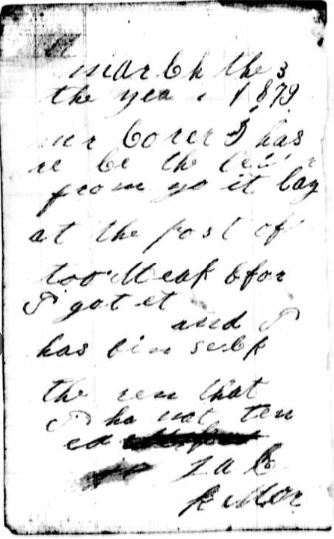
The case file also contained a piece of correspondence that appears to have been from Jack Walker himself. It is hard to read, but is dated March 3, 1879, and appears to say that something had been at the post office for two weeks before he got it and that he had been sick.

Jack Walker was a bit of a challenge to research. Normally a Liberty County Southern Claims Commission claimant would be found in the 1870 U.S. federal census for Liberty County and in the 1867 voter registration rolls, but he was not. (More on that below.) However, he was found in the 1880 federal census in Liberty County’s 1132d district. He was listed as a widowed 62-year-old black farmer living with Richard Walker, 16. The other entries on the page listed relationships (wife, daughter, son), but Richard was not listed with a relationship, leaving the possibility that he was possibly even a grandson.
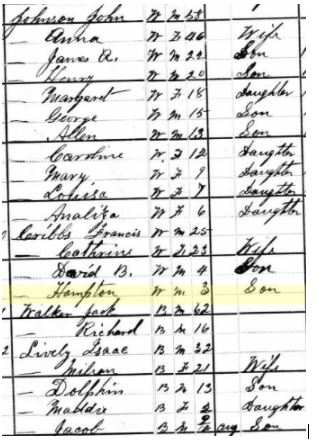
Twenty years later, however, in the 1900 U.S. census for the 1132d district, Jack, now an 80-year-old widowed man listed as born in March 1820, was listed as Richard’s father, and was living in his household. Richard, listed as born in June 1864, had been married to wife Lavena, born September 1863, for 16 years, and they had eight children, all of them living. The children were Richard (15), Drusie (13), Minnie (11), Lee E. (9), Margret (7), Anna R. (4), Gabriella (2), and Mattie M. (6 months).
Jack was not in the 1910 census, and probably had died in the meantime, but no record was found of his death. Wife Phillis had evidently died before 1880.
Why were Jack and Phillis Walker not found in the 1870 census? It’s possible that they simply were not in Liberty County. Many people, white and black, scattered at the end of the Civil War; some returned and some did not. However, they were not found in a census record elsewhere. Interestingly, their witness Boson Johnson was also not found in the 1870 census. A Boson Johnson of about the right age was found in the 1870 and 1880 census records for Beaufort, South Carolina, and it is certainly not impossible that an enslaved man in Liberty County would have gone to Beaufort as the Civil War was ending, but Jack Walker’s witness Boson Johnson stated that he lived in Liberty County.
An alternative possibility and one to keep in mind when researching formerly enslaved people is that the name could have been mistranscribed in the 1870 census or even that they could have changed their surnames. There are many different methods that can be used to check for these possibilities. Since I found Jack Walker in the 1880 census, I recorded the names of people listed near him, then looked for them in the 1870 census.
I then looked on the same and surrounding pages for a Jack and a Phyllis living together. I did find a Jackson and Phyllis Baggs. How old were they? He was 50 and she was 40 (in 1870). In 1872, Jack Wallace had testified that he was 52, and in 1879, Phyllis Walker had said she was 47. So the ages are right. Let’s look at the names near them on the page:
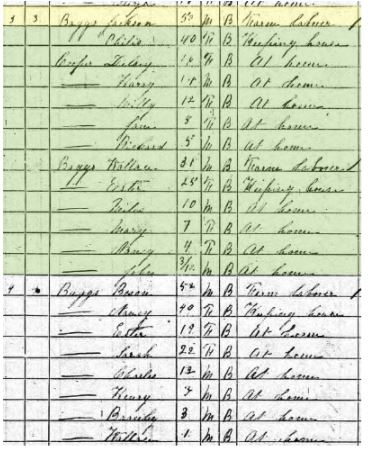
They are living in the same household with a group of Cooper children, starting with Delsy (16) and ending with Richard (5). Remember that in 1880, Jack Walker was living with his son Richard Walker, 16 years old. In the same household is also Wallace Baggs, a 31-year-old man living with presumable wife Ester (25), and children Miles (10), Mary (7), Nancy (4) and John (3 months).
Who is listed next? Boson Baggs (52), with presumable wife Nancy (40), and children Ester, Sarah, Charles, Henry, Branley and Wallace. Remember that I could not find Walker’s witness Boson Johnson in the 1870 census.
Bearing in mind that both Jack and Boson had testified that they were enslaved by David S. Baggs, it now appears that they both initially took the surname Baggs after the Civil War. Why did the children in Jack’s household bear the surname Cooper? A mystery for further research.
Because Jack and Wallace were apparently living in the same household, with Boson nearby, and Boson had named one of his children Wallace, and one Ester (presumably after Wallace’s wife Ester), one also wonders if they were all related. (Of course, sharing the same surname just after slavery, and in this case the surname of their last enslaver, does not necessarily indicate a relationship, so one has to look for other clues.)
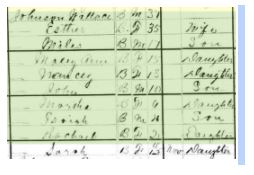
Flipping forward to the 1880 census, we search for the first name Wallace, and we find Wallace Johnson, age 37, with wife Esther (35) and children Miles (17), Mary Ann (15), Nancy (13), John (10), Martha (6), Isaiah (4), Rachel (2), and Sarah (11 months). This is clearly Wallace Baggs, who has changed his name to Johnson. He is no longer living near Jack. Remember that Boson used the surname Johnson in the Southern Claims Commission petition.
What about Boson? It was a fairly unusual name, and yet he was not found in the 1880 census. Let’s try searching for his wife Nancy, and let’s use Johnson as her surname, because we know he was using Johnson around that time.
There they are. Boatswain Johnson (64), wife Nancy (6), and daughter Esther (26), in household with grandchildren Wallace Wilson (10), Brantley Wilson (11), and Henry Hendry (12). What about the name Boatswain? It is a term used for a “deck boss” on a boat…and the shortened version of it is Bos’n or Bosun.
So there we have it. Jack Baggs, Wallace Baggs, and Boson (Boatswain) Baggs all took the surname of their last enslaver, David S. Baggs, after the Civil War, but during the years following David S. Baggs’ death in 1872, they changed surnames: Jack to Walker, Wallace to Johnson and Boson to Johnson.
What about the fact that both Boson Johnson and Jack Walker said in their Southern Claims Commission testimony that they had lived in Liberty County all but about the first 10 years of their lives? David S. Baggs was born in 1792, and they were born in the 1820s, so this could indicate that he had purchased them when they were children.
However, a clue in another record sends us in a different direction. Boson Johnson testified in another Southern Claims Commission petition in 1872. It was a claim made by a white man, Joel Hodges, who had acted as an overseer for “old man Baggs.” In his testimony, Boson Johnson said that he had been born in Tattnall County but was living in Liberty County. David S. Baggs had plantations in both Tattnall County and Liberty County. So it is likely that Boson had been with him in Tattnall prior to coming to Liberty County, but why did he take the surname Johnson?
In researching why a formerly enslaved person took a particular surname that was not the name of the last enslaver, it is often fruitful to research the maiden names of the women in the enslaver’s family line. In this case, we find that David S. Baggs married Isabel Johnson in 1819. Since Boson and Wallace were not born at that time, it appears likely that Isabel’s father or grandfather may have died sometime after that, and she may have inherited them from him at a young age.
[NOTE: Something worth noting is that there was a different formerly enslaved man named Boston Baggs in Liberty County.]
Jack Walker, however, said that he had been born in McIntosh “Co” [County]. And why did he take the surname Walker later, when Boson and Wallace took the surname Johnson?
In this case, the fact that Jack took a different surname, and that he said he was born in McIntosh County, likely means that he has a different back-story. It would be worth researching planter-class families named Walker who lived in McIntosh County. Unfortunately, McIntosh County court and probate records were mostly burned during the Civil War.