
Caesar Roberts’ Southern Claims Commission claim — for property taken from him by U.S. soldiers in December 1864 — is illustrative of the status of enslaved “drivers” (foremen) in antebellum Liberty County, Georgia. Caesar’s wife Linda submitted the claim in 1873 as administrator of her husband’s estate, he having died about five years earlier.
For a full transcript of this claim, see: https://theyhadnames.net/2020/12/20/caesar-and-linda-roberts-southern-claims-commission/
Her application stated that the soldiers had taken 1 gray mare, a buggy, a saddle & bridle, 20 cows, 30 hogs, 40 beehives, 18 ducks, 50 chickens, 20 bushels of corn, and 100 bushels of rice, which she valued at $1159. Based on the testimony of two white men, and their own perception of what an enslaved couple could have owned, the Commissioners approved the claim but awarded her only $154. The Commissioners, who were northerners and based in Washington, D.C., made their preconceptions plain in their remarks: “That he owned the property claimed is highly improbable. 20 cows would make a good large dairy for a northern farmer; and as her husband “was a driver – did not work in the field but just overlooked” it is not easy to see how he could manage & take care of the 20 cows.”
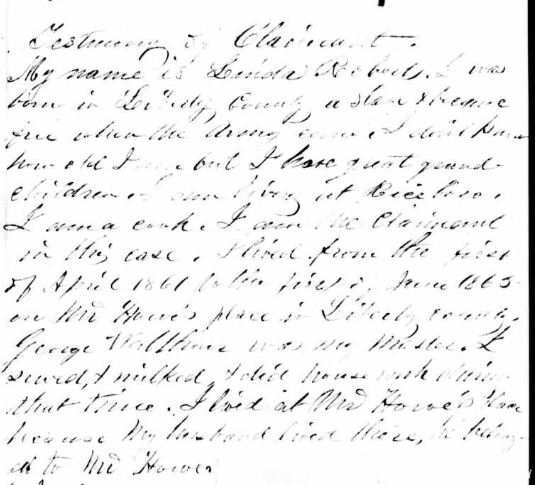
In fact, Linda Roberts and both the formerly enslaved and white witnesses explained clearly that being a driver/foreman was a position of (relatively) great privilege in Liberty County. Linda Roberts testified in 1873 that she was too old to know her age, but that she had great-grandchildren and was still cooking for a living. She said she was owned by George Walthour but lived at Dr. George Howe’s place because her husband, Caesar, was owned by Howe. Caesar, as a driver, did not work in the fields himself, but instead supervised, and she herself never did field work until after she became free, when she rented land and learned to use a hoe.
William A. Golding, a formerly enslaved man who became a Georgia state legislator after the war, testified that the planters in Liberty County assigned task work to their enslaved people, and when their tasks were done, they could raise crops and stock for themselves. About Roberts, Golding said, “I can swear to it that there was more stock property owned by slaves before the war than are owned now by both white and black people together in this county. He was living just like a white man except his color. His credit was just as good as a white man’s because he had the property to back it, and he had his master to back him too.”
Toney Law, a formerly enslaved man who was also owned by Dr. Howe, testified, “The way they come to have so many cattle he was a driver and his master allowed him so much privilege to raise all he wanted to. There were 37 working hands on the “Home place” over 100 big and little. Mr George W. Walthour was the manager of the place. Mr Walthour had 4 plantations with the one Caesar lived on. He had about 600 hands I think on all the 4 places. He gave them tasks and in summer he wanted them to be through with their tasks by the time he got down from Walthourville, which was about 5 miles to average it round, to all the plantations. He got there about 10 a.m. or before; he came as soon as he had done breakfast. He allowed us besides the time we got by task work 6 days a piece in the year to work for ourselves. None of the other slaves on the Howe place owned cattle but Caesar Roberts, the claimant’s husband, but others owned horses.”
He also testified, “The rice belonged to Claimant and her husband. The hands worked for them in making their crop. These hands worked for them in the white people’s time. The master allowed him to take the hands and work his crops and the hands harvested it too. He sold the rice and used some for his family; he shipped it to town by Capt Charley. The same one who runs a vessel to Riceboro. Caesar took the money Mr Walthour wouldn’t take his money. There is no doubt that all this property belonged to the claimant and her husband…He had privilege to do just as any white overseer would have had. He could plant all he chose. The drivers had the privilege of planting 2 or 3 acres of rice and some corn and having it worked by the slaves on the place the same as the white master had his worked.”
Samuel Luton, also a formerly enslaved man who had belonged to George Howe, testified that he had known Roberts all his life, and gave details about his owning the property and how he came to own it.
The Southern Claims Commission often assigned a special agent to investigate cases, and in this case it was W.W. Paine, who went to Liberty County in 1876 and interviewed Raymond Cay Sr and W.S. Norman. Paine acknowledged that Cay Sr was the father of the attorney in the case, Raymond Cay Jr, but said he was an “old and respectable citizen of Liberty County” and he did not think the relationship influenced his testimony. Cay testified that Caesar was a “favorite slave” of Dr. Howe’s and was allowed many privileges, including the right to own property. He said that Roberts had indeed owned a gray mare, and had ridden in a buggy, though he could not swear that Roberts owned the buggy. He also testified that he did not know for sure that Roberts had owned cattle and hogs, but that he could have, and he thought he did.
“Judge W.S. Norman, a highly respectable citizen of Liberty” told Paine that he did think that Roberts had owned some property but that the values in the claim were entirely too high.
The Commissioners evidently were conflicted about how to value the property in this and other cases in which formerly enslaved people submitted claims for property taken by Sherman’s Army in Liberty County. There could be no doubt from the testimony that the Roberts’s had in fact owned property, but of course the Commissioners did not know how much such property would have been worth in the local market. One of Special Agent Paine’s duties was to evaluate this, and he submitted a report for them to use as a guide:
For horses owned by negroes from $40 to $80.00
For cattle owned by negroes from $7 to 10.00
(a good cow sometimes worth more)
Rice & corn per bus[hel] from .80 cents to $1.00
Stock hogs $2.00 to $3.00
Fine sow $7.00 to $8.00
Buggies from $15.00 to $50.00
After the Commissioners awarded Linda Roberts’ $154 of her claim, the money was sent payable to James Atkins, Collector of Customs in Savannah, Georgia, to be paid to her. Because most of the claimants did not have bank accounts, the awarded money was sent via an intermediary. Previous awards were sent via the attorney Raymond Cay, Jr; however, after he was caught charging exorbitant fees that ate up most of the meager awards, he was barred from receiving the awards and they were sent instead to Atkins.
Caesar was said to have died about 5 years before Linda Roberts’ 1873 SCC testimony. He did live until at least 1867, because he registered to vote in Liberty County on August 1, 1867. The registry recorded that he had lived in the county for 65 years, presumably his age. He appears to have died before November 15, 1870, when Linda Roberts was recorded in the 1870 U.S. federal census without him. Her age was listed as 60 years and her occupation as a farmer. She was also listed in the 1870 agriculture schedule as working 3 acres of land.
In her 1873 testimony, Linda Roberts said that she had two sons living, and some grandchildren. Samuel Luton testified that both of the Roberts’ sons were present when the property was taken; unfortunately, he did not name them, nor did Roberts when she described who was present. Instead she named her husband’s sister, whose name unfortunately was illegible, Isaac Golden, Sam Howe, and Tony Law. Tony Law named Mary Dryer, Rosanna Baker, Sam Luton, Middy Winn, Sarah Clay and Susan Golding as being present (other than himself and Caesar and Linda Roberts).
Who were Ceasar and Linda Roberts’ two sons? Unfortunately, since they were not named in the claim, and were not living with them in the 1870 U.S. census, we cannot be certain. However, there may have been a clue in the 1870 census. The 1870 census did not list relationships, but Linda Roberts had in her household Frances Roberts, 19, and Benjamin Roberts 11, presumably her grandchildren. Her household was enumerated on November 15, 1870 by Robert Q. Baker. On November 25th, Baker enumerated the household of Joseph Roberts, 41, and his wife Rebecca, 30, listing Benjamin Roberts, age 9. It is certainly possible that these were two different children, but it is also possible that Benjamin was at his grandmother’s house on the 15th and at his parents’ house on the 25th.
However, there is also another possibility. In Linda Roberts’ initial SCC application, she stated that she intended to call Elijah and John Roberts as witnesses. However, neither testified. Could they have been her sons? Neither were found in the 1870 U.S. census for Liberty County.
No record was found that either Caesar or Linda Roberts bought or sold land after the Civil War.
Slavery
Linda Roberts and her witnesses testified that she had belonged to George W. Walthour, but had lived on Dr. George Howe’s plantation because her husband Caesar had been owned by him. Tony Law testified that he had known Linda Roberts for a long time and they had both lived on Dr. Howe’s plantation for over 30 years.
William A. Golding provided the most specific testimony in this regard. He said that Dr. Howe had married “the Claimant’s mistress and he had been an overseer from a boy and Dr Howe let him go on in the same business.”
George W. Walthour (1799-1859) was the son of Andrew Walthour (d. 1824). His sister, Sarah Ann Walthour (1803-1885) married first Robert McConnell (d. 1826) and second George Howe (1802-1883). Of these individuals, three — George Walthour, Andrew Walthour, and Robert McConnell — died before the end of the Civil War and might have probate records that would name enslaved people, including Caesar and Linda.
Andrew Walthour wrote his will in 1822. He named 23 enslaved people in the will, loaning some to his wife for her lifetime and leaving the others to his son George and his daughter Sarah Ann, but Caesar and Linda/Lindy were not named. His estate was inventoried in February 1825 after his death. There was both a Caesar ($350) and a Lindy ($350) named and valued. These were fairly common names, and Walthour had a large estate, but given the circumstances, it seems likely that these were Caesar and Linda Roberts.
In 1829, the part of Andrew Walthour’s estate that he had loaned to his wife for her lifetime was inventoried and divided among his heirs. Caesar and Linda were not named. Thus it appears likely that they were in the part of the estate inherited directly by the children George and Sarah Ann, and based on W.A. Golding’s testimony, that Caesar went to Sarah and Linda went to George.
Sarah married Robert McConnell, and presumably took Caesar into that marriage, but Walthour had stipulated in his will that her inheritance was not to be subject to her husband’s debts, and there was most likely a marriage contract that protected her rights. McConnell died in 1826; Caesar was not named in either his 1827 or his 1837 estate inventories, which makes sense because he was Sarah’s property. (There was a Caesar named in the 1837 inventory, but he was specified to be a child, and thus could not have been Caesar Roberts, who would have been about 35 at the time.) Sarah Walthour McConnell married George Howe on December 19, 1836. William A. Golding stated in his testimony that Caesar had already been acting as a driver/foreman since his youth, and that Howe maintained him in that role. Howe was a professor at the Columbia Theological Seminary in Columbia, South Carolina, at the time of their marriage and maintained that position until his death in 1883. It is likely that the Howes’ land in Liberty County was land that Sarah had inherited from her father, and thus familiar to Caesar.
Both Sarah and George Howe lived until the 1880s, so there would be no probate records for them that would name Caesar.
Andrew Walthour’s son — Sarah’s brother — George W. Walthour died in 1859. His November 1859 estate inventory listed the enslaved people at his three plantations: Homestead, Richland and Westfield. There was a Lindy, described as 50 years old and worth $350, at the Homestead Plantation. This fits with the age that Linda Roberts would have been at the time. There was also a Lindy, described as 40 years old and worth $500, at the Richland plantation, which would have been too young to be Linda Roberts. A third Lindy, described as 13 and worth $375, at the Richland plantation was also too young. At the time of his death, George Walthour left a widow and four minor children, meaning that the estate would take some time to be fully distributed, and the Civil War and Emancipation likely intervened before that happened.
Both Caesar and Lindy were members of the North Newport Baptist Church in Riceboro, Liberty County, when Rev. Charles Colcock Jones made a census of the African Americans who were church members in 1846. Interestingly, 25 enslaved people belonging to George Howe attended that church, even though Howe himself was a prominent Presbyterian minister and professor. His and Columbia Theological Seminary’s complicity in being supported by slavery has been documented by the Seminary’s Archives in “A Window Into the Breach: Theology and the Economy of Slavery at Columbia Theological Seminary, 1824-1899.”
The North Newport Baptist Church had both Black and White members until the white members moved the church Walthourville in 1854. The Black members continued to use the church building in Riceboro and formed their own church, the First African Baptist Church, which is now the oldest African American church in Liberty County.
Citations:
1870 U.S. Census, Liberty County, Georgia, population schedule, Subdivision 180, p. 6, dwelling #56, family #56, enumerated on November 15, 1870, by Robert Q. Baker, Linda Roberts household, digital image, Ancestry.com (https://www.ancestry.com: accessed 12/20/2020).
1870 U.S. Census, Liberty County, Georgia, population schedule, Subdivision 180, p. 37, dwelling #350, family #350, enumerated on November 25, 1870, by Robert Q. Baker, Joseph Roberts household, digital image, Ancestry.com (https://www.ancestry.com: accessed 12/20/2020).
U.S. Selected Federal Census Non-Population Schedules, 1850-1880, 1870, Liberty County, Georgia, Subdivision 180, Linda Roberts; digital image, Ancestry.com, “U.S., Selected Federal Census Non-Population Schedules, 1850-1880,” Georgia, Liberty County, Subdivision 180, image #1, (www.ancestry.com: accessed 12/20/2020)
“Georgia, Returns of Qualified Voters and Reconstruction Oath Books, 1867-1869,” registered in Precinct no. 1, Liberty County, for the 2d Election District. Digital Image, Ancestry.com (https://www.ancestry.com: accessed 12/20/2020).
Caesar and Linda attending North Newport Baptist Church:
Jones, Charles Colcock, 1846 Census of African American Church Members in Liberty County’s 15th District, held in the Charles Colcock Jones papers, Louisiana Research Collection, Tulane University. Transcribed at: https://theyhadnames.net/1846-c-c-jones-census/.
Andrew Walthour’s 1825 estate inventory:
“Georgia Probate Records, 1742-1990,” database with images, FamilySearch (https://familysearch.org/ark:/61903/3:1:3QS7-L93L-P91?cc=1999178&wc=9SYT-PT5%3A267679901%2C268032901 : 20 May 2014), Liberty > Wills, appraisements and bonds 1790-1850 vol B > image 446 of 689
George W. Walthour 1859 estate inventory:
”Georgia Probate Records, 1742-1990,” database with images, FamilySearch (https://familysearch.org/ark:/61903/3:1:3QS7-993T-XTF2?cc=1999178&wc=9SB7-6T5%3A267679901%2C268014801 : 20 May 2014), Liberty > Miscellaneous probate records 1850-1863 vol C and L > image 231 of 703