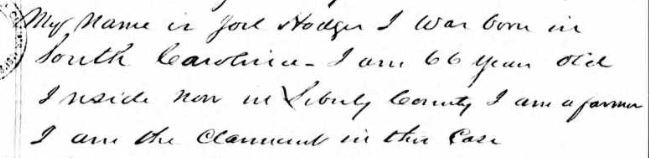
During the Civil War, Joel Hodges of Liberty County slept with a gun beside his bed…not out of fear of the U.S. Army but because he had been so outspoken against the war, he thought his neighbors might attack him. Hodges was white, poor and owned little property, but his pro-Union sentiments did not save him when Sherman’s Army came foraging through Liberty County in December 1864. The soldiers took all he had. In the 1870s, Hodges applied for compensation through the Southern Claims Commission, which interviewed various witnesses to determine both his loyalty to the United States and whether he actually owned the property he claimed to have lost.
For a full transcript of this claim, see: https://theyhadnames.net/2020/07/31/joel-hodges-southern-claims-commission/.
The interviews conducted by the Commission reveal the complexity of the situation in Liberty County during the Civil War, and the difficulty of relying on eyewitness testimony. Hodges himself testified that he had sympathized with the Union cause from the beginning, mainly because he felt it would be the South’s ruin. A friend and relative by marriage of his, Thomas B. Lee, who was a Savannah policeman after the War, said that Hodges used to say that the South was fighting to keep its slaves and the other side to keep the Union together, and he was for keeping the Union together at any cost. Hodges apparently did not hesitate to speak his mind on the subject, and was generally unpopular with his neighbors and the authorities, but witnesses agreed that people who might otherwise have harmed him were afraid of “old Hodges,” who must have been quite a character and was said not to be afraid to shoot.
There was disagreement about Hodges’ feelings toward enslaved people. One formerly enslaved man, Boson Johnson, testified on his behalf. Johnson said he had been born into slavery in Tattnall County and was farming in Liberty County by the time of his testimony. He said that Hodges had owned one slave some years previously, whom he had sold, and had acted as an overseer for “old Mr. Baggs” for about two years. He said he was considered a very kind overseer because he did “not cut and slash the slaves as some did.” Johnson also said that Hodges had helped three Union prisoners escape the County by carrying them 30 miles away.
On the other hand, the Commission’s Special Agent went into the Taylors Creek community and interviewed people who knew Hodges, including Mr. N. Brown and his wife, P.J. Stanfield, and James M. Smith, at least one of whom said that the reason Hodges was not attacked for his very vocal anti-Confederacy views, even though the Confederate authorities considered him a thorn in their sides, was that “he was considered an enemy to the slaves, and a very severe overseer…” It’s hard to reconcile this with Boson Johnson’s testimony that Hodges was considered a friend to the enslaved people, and the only one who would tell them the truth about how the war was going. Either Johnson was attempting to help Hodges’ claim, or maybe he considered Hodges a kind overseer only in comparison with others.
Perhaps most interesting was Hodges’ connection with Col. William B. Gaulden. James M. Smith, who the Special Agent considered an extremely respectable man who knew everyone in the county, said that Hodges had worked for Gaulden off and on, and that Gaulden had hired Hodges specifically because of his pro-Union sentiments, which is surprising on the surface, because Gaulden was in charge of the Georgia Coast Guard Battalion, which served as a Home Guards for the Georgia coast during the Civil War. He had also previously been a Justice of the Liberty County Inferior Court, Solicitor General of the Eastern Circuit, and was a Georgia state senator at the time of the Civil War. James Smith said that Gaulden’s anti-secession views were no secret, and that he continued to make speeches against secession even after Georgia seceded, with his entire audience hooting and hissing at him. Gaulden, who died in 1873, had accurately predicted the outcome of the war, Smith said ruefully, adding that even though Gaulden was put into militia service, he “never did anything.” Records from the time show that Gaulden was also quite a character.
Hodges had moved to Bradford County, Florida, by the time his claim was investigated. He ended up getting $350 out of his $625 claim. The Commission believed his loyalty to the United States was proven, and that he did own property but said that it had been over-valued in the claim.