In 1877, Jacob Dryer, described as a “very prosperous and thrifty man,” made a claim against the U.S. government for $485 in property taken by Sherman’s Army from his home on George W. Walthour’s Westfield plantation, Liberty County, Georgia, in December 1864. Witness Samuel Maxwell testified that he saw Dryer every day and knew that he had property; he said that Israel James, Jupiter James, Toney Golden, and Brister Fleming could also testify to his loyalty to the Union. The Claims Commission Special Agent reported that Dryer was “the only really prosperous one among the Liberty County claimants. He is said to have feared the slavery of debt as much as he did the old slavery.” He added, “My own impression, unproved, is that Jacob Dryer came out of the war better off than he had ever been.”
See the full transcript of this claim at: https://theyhadnames.net/2020/05/16/jacob-dryer-southern-claims-commission/
Dryer had been enslaved by Walthour probably all of his life, as Walthour’s son Russell, born in 1841, testified that he had known Dryer all his life and that Walthour did allow his enslaved people to own property. Dryer had also testified that the horse that had been taken by the U.S. troops had been bred from a horse he had received from his father, again probably indicating that he had been on the Walthour plantation his whole life.
Dryer was only allowed $152 for his claim, the Special Agent having concluded that the corn, rice, cloth and clothing had been furnished to him by his slaveowner and thus did not belong to him. His lawyers argued unsuccessfully that had these items not been taken from him by the soldiers, he would have owned them after he became free and so they were for all intents his property. “To say that this property belonged to the master and that therefore it should not be paid for does not look very well from the high moral anti-slavery standpoint,” they added.
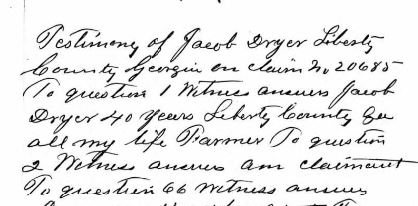
Jacob Dryer testified in his 1877 Southern Claims Commission petition that he was 40 years old. Census records from 1870, 1880, and 1900 gave his birth year variously as 1820, 1821 and May 1830, which is not unusual; it does appear that he was likely older than 40 in 1877 [1]. In the inventory of George W. Walthour’s estate in 1861, there were two Jacobs listed on Westfield plantation, one 45 years old and the other, probably Jacob Dryer, 28 years old and valued at $1000. (According to the inventory, Walthour had three plantations: Richland, Homestead and Westfield.) [2]
According to the 1900 census, Dryer married Maria in 1860, and their first son, Lancaster, was born in 1866. They appear to have had four more children, Lindy (1867), Delia (1868), James (1876), and Henrietta (1879).
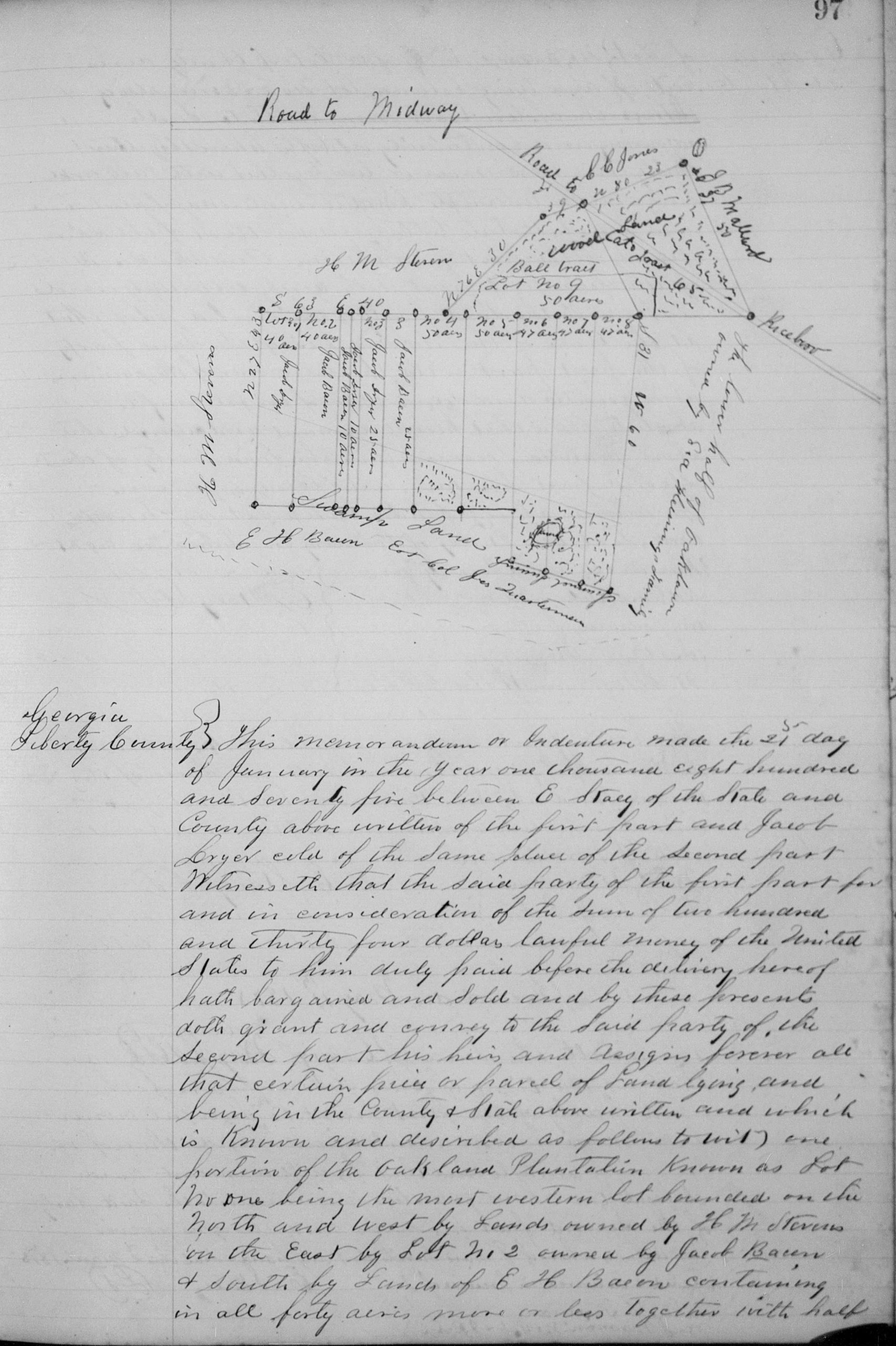
Dryer obviously continued his industrious and thrifty ways after the Civil War, as he made multiple land purchases. On January 21, 1875, he purchased 35 acres from E. Stacy for $234, described as “one portion of the Oakland Plantation known as Lot No one being the most western lot bounded on the north and west by lands owned by H.M. Stevens, on the east by Lot No 2 owned by Jacob Bacon & south by lands of E.H. Bacon containing in all forty acres more or less together with half of Lot No 3 and half of a lot of 20 acres cut off and lying between lot no 2 & 3 running through the entire tract from north to south adjoining and containing in both halves together thirty five acres more or less…” The deed also specified that “the said Jacob Dryer is entitled in addition to the land specified in the above deed five acres of the wooded land which is known as No. 10 not yet divided, and used in common by the lot holders.” [3]
On January 29, 1879, John L. Hardee sold to Jacob Dryer (both of Liberty County) for $150 land “known as lot no. 9 by a survey of H.W. Mattox of the Plantation formerly owned by H.M. Stevens & bounded as follows on the north by land known as the Arcadia place, on the south by lands known as the Oakland place on the east by lot no. 10 of this survey on the west by lot no. 8 of this survey.” [4]
On January 14, 1885, Henry Williams sold to Jacob Dryer (both of Liberty County) for $80 “fifty acres of land in said county bounded east by the Sunbury Road west lands of John L. Hardee north by lands of Frank Elliot south by lands of John L. Hardee said property being in my own name and unincumbered.” [5]
On December 11, 1891, Mary Ann Fletcher sold to Jacob Dryer (both of Liberty County) for $150 land “known as Lot Number (4) four of the Oakland Plantation Tract one seventh of Lot Number 10 of the Cato Tract containing in all sixty acres more or less and bounded as follows: on east by lands of William Wilson, said tract formerly occupied by Windsor Thomas.” [6]
The only time Dryer was recorded as selling land was in 1901, when he sold Chloe Golding 2 acres bounded north by Jacob Bacon, east by the road leading from Riceboro to Hinesville, south and west by his own land. [7]
Dryer’s death date was not found and there is some ambiguity. His wife Maria was listed as a widow in the 1910 census, and was living with four grandchildren next to son Lancaster, still in Liberty County [8]. However, it was not until June 29, 1918, that she applied to the Liberty County Court of Ordinary (probate court) for 12 months support from his estate [9]. The probate judge assigned Strap West, R.F. Cassels, and Isaac Morrison to come up with an appropriate amount of support, and they granted her $500 for the year, including 50 acres land in the 15th District, bounded north by lands of Caroline Elliott, east by lands of W.M. Stevens, south by lands of Henry Powell, west by lands of Delia Allen. They also included another tract of land in 15th District bounded north by Henry Powell, east by William Wilson, south by Henry Powell, and west by Henry Powell, plus one cane mill and 3 head stock cattle. They also allowed use of the household furniture by her and unnamed children.
Before the Civil War
For research into Jacob Dryer’s family lineage before the Civil War, dating back to the 1790s, click here.
Sources
[1] 1870 U.S. Census, Liberty County, Georgia, population schedule, Subdivision 180, p. 9, dwelling #92, family #92, enumerated on November 16, 1870, by Robert Q. Baker, Jacob Dryer, digital image, Ancestry.com (https://www.ancestry.com: accessed 5/16/2020); 1880 U.S. Census, Liberty County, Georgia, population schedule, Dictrict 17, enumeration district 67, p. 3, dwelling #26, family #26, Jacob Dryer; digital image, Ancestry.com (https://www.ancestry.com: accessed 5/16/2020); 1900 U.S. Census, Liberty County, Georgia, population schedule, District 15, enumeration district 88, sheet #13, line number 67-72, digital image, Ancestry.com (https://www.ancestry.com: accessed 5/16/2020).
[2] Liberty County Court of Ordinary, Old General Book “C”, 1850-1853, p. 365-372, Estate Appraisement of George W. Walthour; digital image, Ancestry.com, “Georgia Probate Records, 1743-1990,” Liberty County, within “Miscellaneous Probate Records 1850-1853 vol C and L,” image #231-235. Record summarized and put online at TheyHadNames.net (https://theyhadnames.net/2019/11/13/liberty-county-estate-inventory-geo-george-w-walthour/)
[3] Liberty County Superior Court, “Deeds & Mortgages v. R 1874-1877,” p. 97-8, E. Stacy to Jacob Dryer; digital image, FamilySearch.org, “Deeds & Mortgages, v. R 1874-1877” within “Deeds and mortgages, 1777-1920; general index to deeds and mortgages, 1777-1958,” image #336-7, (https://www.familysearch.org/ark:/61903/3:1:3Q9M-C3QP-59SQ-F?i=335&cat=292358, accessed 5/16/2020)
1879
[4] Liberty County Superior Court, “Deeds & Mortgages v. S 1877-1882,” p. 318-9, John L. Hardee to Jacob Dryer; digital image, FamilySearch.org, “Deeds & Mortgages, v. S 1877-1882” within “Deeds and mortgages, 1777-1920; general index to deeds and mortgages, 1777-1958,” image #201, (https://www.familysearch.org/ark:/61903/3:1:3Q9M-C3QP-RSVD-3?cat=292358, accessed 5/16/2020)
1885
[5] Liberty County Superior Court, “Deeds & Mortgages v. U 1884-1885,” p. 376-7, Henry Williams to Jacob Dryer; digital image, FamilySearch.org, “Deeds & Mortgages, v. T-U 1882-1885” within “Deeds and mortgages, 1777-1920; general index to deeds and mortgages, 1777-1958,” image #469, (https://www.familysearch.org/ark:/61903/3:1:3Q9M-C3QP-R9D1-1?cat=292358, accessed 5/16/2020)
1891
[6] Liberty County Superior Court, “Deeds & Mortgages v. Z 1891-1892,” p. 319, Mary Ann Fletcher to Jacob Dryer; digital image, FamilySearch.org, “Deeds & Mortgages, v. Y-Z 1890-1892” within “Deeds and mortgages, 1777-1920; general index to deeds and mortgages, 1777-1958,” image #494, (https://www.familysearch.org/ark:/61903/3:1:3Q9M-C3QP-5TNN?i=493&cat=292358, accessed 5/16/2020)
[7] Liberty County Superior Court, “Deeds & Mortgages v. A-D 1901,” p. 100, Jacob Dryer to Chloe Golding; digital image, FamilySearch.org, “Deeds & Mortgages, v. AC-AD 1896-1901” within “Deeds and mortgages, 1777-1920; general index to deeds and mortgages, 1777-1958,” image #399, (https://www.familysearch.org/ark:/61903/3:1:3Q9M-C3QP-5SSZ-K?cat=292358, accessed 5/16/2020)
[8] 1910 U.S. Census, Liberty County, Georgia, population schedule, 15th District, enumeration district 114, sheet 10B, line number 60-64, family #210, dwelling #202, digital image #20, Ancestry.com (https://www.ancestry.com: accessed 5/16/2020).
[9] Liberty County Court of Ordinary, Widows’ twelve months support 1874-1927, p. 299-300, Petition of Mariah Dryer; digital image, Ancestry.com, “Georgia Probate Records, 1743-1990,” Liberty County, within “Widows’ twelve months support 1874-1927” image #348. (https://www.familysearch.org/ark:/61903/3:1:3QS7-893L-5V6V?i=347&wc=9SYY-SP8%3A267679901%2C268034301&cc=1999178, accessed 5/16/2020)