
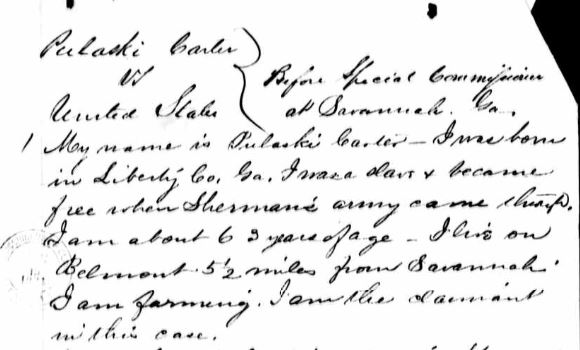
“At the beginning of the rebellion, I sympathized with the Union party. My feelings were all for the Union party for they were for our benefit. I cast my influence on the Union side what I had – I was in favor of the Yankees all through the war.” Pulaski Carter, 1873
Pulaski Carter, a 63-year-old formerly enslaved man living near Savannah, submitted a claim to the Southern Claims Commission in 1873 saying that Sherman’s Army had taken his property when they raided the plantation he was living on in Liberty County at the end of 1864. His claim totalled $752.50, for a horse, 20 hogs, 70 chickens, 15 ducks, 80 bushels of corn, and 40 bushels of potatoes.
For the full transcript of this claim, see: https://theyhadnames.net/2020/09/01/pulaski-carter-southern-claims-commission/.
Carter said he was born into slavery in Liberty County and that at the time of the Civil War, he was owned by Alex Quarterman. Because Liberty County used the task system on its plantations, he worked for himself when he finished his assigned task for the day; he raised hogs and poultry and sold them, then got enough money to buy a horse, which he had owned for about four years when the soldiers took it. He said he had been a driver — a foreman — for slaveowner Alex Quarterman, and that the property that was taken was his own private property, and neither his owner nor anyone else had any claim to it. .
When Sherman’s Army came to Liberty County in December 1864, Carter said, fellow enslaved people Phebe Bryan, Mary Morrison, and (his wife) Phebe Carter were there. He was the only man on the place at the time. The soldiers said they had come to take everything, and when he protested that he had done nothing to them, they said the army needed to take from rich and poor and that he would get it back from the government. Carter said he complained to a Captain Blake about it but to no avail. He said he ended up going with the U.S. troops to Savannah when they went back there.
Phoebe Ann Morrison testified on Carter’s behalf, saying that she had known him since he was a young man and that she also had been owned by “Mr. Quarterman.” She did not know how old she was, but said she had grown grandchildren. Like Carter, she was also living at Belmont in Chatham County when she gave her testimony. Mary Morrison, who said she was 20 or 21 years old and also lived on Belmont, also testified about Carter’s loyalty to the U.S. government, saying, “We were treated so hard that we were obliged to like the Yankees.”
Phoebe Ann Morrison remembered that it was Christmas time when the soldiers came, she said, because “we cooked them Christmas dinner.” She also said that Mary Morrison, Phebe Carter, Bessie Baker, and Kezia Frazier and her husband were present near Carter’s house when it happened, in addition to Samuel Morris, who had since died. She described the taking of Carter’s property in detail, and confirmed that he had been Quarterman’s “driver” [a term for foreman] for about five years.
When Mary Morrison described the scene, she called Bessie Baker “Aunt Bessie,” and Kezia Frazier and her husband “Aunt Kezia and Uncle Charles.” [NOTE: This could be a term of respect, but she did not use it for others who were present.] She said that her mother-in-law had cooked for the soldiers, which appears to indicate that Phoebe Ann Morrison was Mary’s mother-in-law.
Pulaski Carter’s petition indicates that he had planned to call on his son Isaac and wife Phebe as witnesses, as well as Phoebe Bryan and Stephen Carter. No reason was given why they did not testify, but it was unfortunate, because despite Carter’s detailed account of how the property was taken and how he came to own it, the Commission denied his petition, saying that he should have presented witnesses who would have testified that he actually owned the property, not just that they saw it taken. The Commission also expressed concern that over the large number of enslaved people owned by Quarterman who had submitted claims and at the amount of Carter’s claim.
According to the records found for Pulaski Carter, his birth year was between 1810 and 1816. He himself gave the 1810 year during his testimony. A record was found of his taking the Reconstruction Oath in Chatham County on June 29, 1867, and in the 1870 U.S. federal census, he, wife Phebe, and children Isaac (22), Lydia (11), and Jack (7) were with them. [NOTE: Ancestry.com had misindexed his 1870 census record, but the correct record was found in FamilySearch.org.] He was living near Mary Morrison, with her husband Samuel and her 60-year-old mother-in-law Phebe Morrison.
In the 1880 U.S. federal census, Pulaski and Phebe Carter were back in Liberty County’s 15th District. Son Jack was with them, and also Isaac Lumpkin, listed as their grandson. A Henry and Margaret Lumkin were living near Pulaski and Phebe in Savannah in the 1870 census. Possibly Margaret was Pulaski’s and Phebe’s daughter?
No record was found of Pulaski Carter purchasing land in Liberty County. In the 1870 U.S. agricultural census, he was listed as working 20 acres in Savannah, and in the 1880 U.S. agricultural census, he was listed as renting 15 acres in Liberty County. Between 1878 and 1885, he paid property tax on personal property in Liberty County, but not on land.
No record of Carter’s death was found, but no record of him was found in the 1900 census, and he would have been in his late 80s by then. His son Jack Carter died at about 75 years old on September 1, 1928, in Screven, Georgia (presumably the Screven in Wayne County), and is buried in what was listed on his death certificate as the “Screven Colored Cemetery.” George Carter, his son, listed Jack Carter’s parents as “Plasky and Febia” Carter.
Slavery
Pulaski Carter said that his slaveowner at the time of the Civil War was Alex Quarterman. Alexander S. Quarterman’s father, Thomas Quarterman, had died in 1857. Thomas Quarterman’s 1857 estate inventory listed a Pulaski, valued at $1000. In 1858, Thomas Quarterman’s estate was divided, and Pulaski, valued at $1000, was put in lot #3, which was drawn by Alexander S. Quarterman. In that estate division, Pulaski was listed first, where the driver (foreman) was usually listed, and it appears to be in family order, because after Pulaski was listed Phiboe ($700), Isaac ($300), Peggy ($225), Nelly ($150), and little Pulaski ($100). [NOTE: The values are shown because the descending order supports the conclusion that this was a family with parents listed first and children in descending order by age. Also, Peggy is a nickname for Margaret; above it was speculated that Margaret Lumpkin, living near Pulaski and Phoebe in the census record, was their daughter.] All six of them were in lot #3, and went to Alexander S. Quarterman.
In the 1860 slaveowners census, Alexander S. Quarterman was listed as owning four enslaved men between the ages of 36 and 40, three women between the ages of 30 and 36, five children under the age of 10, and one 50-year-old woman. As for where Pulaski and Phoebe might have been during the Civil War, in Thomas Quarterman’s 1857 will he gave his sons Alexander and I.K.A. Quarterman “his Newport plantation lying on and west of the Barrington road plus his old Pleasant Valley plantation – to be appraised and drawn by them.” Alexander Quarterman’s 1907 obituary also said that his old family home was in Walthourville.
Why did Pulaski choose the surname Carter after Emancipation? A possible explanation was discovered.
In May 1840, Sarah Amanda Mara sold to Thomas William Quarterman for $2500 “the following five Negroes (to wit) Nancy aged fifty years, and her son Edward, also Titus, Pulaski and Stephen…” Ann Earle, Sarah’s mother, attested that Sarah had reached the age of 21 and was thus “legally competent for the transaction of any business; to buy or sell, and convey at her own discretion.” Thomas W. Quarterman then transferred his title to them to Thomas Quarterman on December 14, 1840.
However, on January 10, 1839, T.W. Quarterman, Liberty County, had used as collateral on a promissory note to Thos. [Thomas] Quarterman, also of Liberty County, “the following eight Negroes to wit, Jacky, Nancy, Edwin, Titus, Barrack, Cate, Pulaski & Steven…” Pulaski was not a common name in Liberty County, so it is hard to explain how this could have happened the year before Sarah Mara sold Pulaski to Quarterman, if in fact that Pulaski was Pulaski Carter. One possible explanation is that Sarah had actually sold Pulaski to Quarterman previously, and that the sale was just finalized in 1840 because she had turned 21 and was thus of legal age to do so.
But still, why the surname Carter? In 1819, Lewis McTair, a tailor of Liberty County, left in his will three enslaved people to his friend, Morgan Mara, Sarah Amanda Mara’s father: Lily, Daphne and Pulaski. Lewis McTair also left $400 to John Carter, “the son of my friend Hepworth Carter.” Pulaski, Daphne and Lily were all named in Morgan Mara’s 1833 estate inventory, and it appears they went to his daughter Sarah Amanda Mara, who later sold Pulaski to Quarterman.
On March 29, 1806, Lewis McTair had used as collateral to Morgan Mara “a certain negro woman Slave named and called Lilly” for $305, to be paid at a later date, indicating that Lily was certainly alive in 1806. Since McTair left Lilly to Mara with Pulaski and Daphne, it appears likely Lilly was Pulaski’s mother. Where did McTair get Lily or possibly her parent that might have been associated with a Carter?
In 1791, a white planter/slaveowner named Hepworth Carter had gotten into financial difficulties, and court records show that the Liberty County sheriff, Lachlan McIntosh, was ordered to seize and auction off Carter’s property to pay a debt. At the time, John Baker of the company Baker and Troup asserted that he had a claim to five named enslaved people (Fanny, Tenor or Tenah, Nestor, Chloe, and Guy) so they could not be sold, which indicates that other enslaved people belong to Carter were possibly sold at that time. In addition, Hepworth Carter’s 1812 will directed that, except for certain named people, “it is my will and desire that all my slaves not herein named or bequeathed shall be sold to the best advantages,” and the proceeds divided among his surviving children.
It is noteworthy that McTair described Hepworth Carter in his will as his friend, indicating that there was a connection. So although we do not have the bill of sale, it is certainly very possible that McTair bought Lilly from Carter.
So it is possible that Pulaski’s mother, and possibly Pulaski himself, had belonged to Hepworth Carter, and were sold to Lewis McTair either when Carter died or when he got into financial trouble, and then they were left to Morgan Mara, who left them to his daughter Sarah Amanda, who sold Pulaski to the Quartermans. (Sarah Amanda Mara married Elijah Chapman in 1842, and they moved to Massachusetts between 1850 and 1853.)
Pulaski’s given name probably came from Count Casimir Pulaski, a Polish nobleman and soldier who fought on America’s side in the American Revolution and died at the Battle of Savannah in 1779.
Citations
Census Records
1870 U.S. Census, Chatham County, Georgia, population schedule, District 7, p. 104, dwelling #976, family #989, enumerated on June 29, 1870, Pulaski Carter household, digital image, FamilySearch.org (https://www.familysearch.org/ark:/61903/3:1:S3HT-682S-PTT?i=60&cc=1438024: accessed 9/1/2020).
1880 U.S. Census, Liberty County, Georgia, population schedule, District 15, enumeration district 67, p. 21, dwelling #218, family #219, Pulaski Carter household; digital image, Ancestry.com (https://www.ancestry.com: accessed 9/1/2020).
Slavery Probate Records
Thomas Quarterman’s 1857 estate inventory
”Georgia Probate Records, 1742-1990,” database with images, FamilySearch (https://familysearch.org/ark:/61903/3:1:3QS7-993T-XT21?cc=1999178&wc=9SB7-6T5%3A267679901%2C268014801 : 20 May 2014), Liberty > Miscellaneous probate records 1850-1863 vol C and L > image 183 of 703.
Thomas Quarterman’s 1858 estate inventory and division
”Georgia Probate Records, 1742-1990,” database with images, FamilySearch (https://familysearch.org/ark:/61903/3:1:3QSQ-G93T-XBQ1?cc=1999178&wc=9SB7-6T5%3A267679901%2C268014801 : 20 May 2014), Liberty > Miscellaneous probate records 1850-1863 vol C and L > image 197 of 703.
Thomas Quarterman 1849 use of Pulaski as collateral
Family Search.org. Liberty County Superior Court “Deeds and mortgages, 1777-1920; general index to deeds and mortgages, 1777-1958,” Film: Deeds & Mortgages, v. M-N 1842-1854,” Record Book N, pp. 141-2. Image #481-2 (Link: https://www.familysearch.org/ark:/61903/3:1:3Q9M-C3QP-5W6P?i=480&cat=292358)
Sarah Amanda Mara deed of sale
Family Search.org. Liberty County Superior Court “Deeds and mortgages, 1777-1920; general index to deeds and mortgages, 1777-1958,” Film: Deeds & Mortgages, v. K-L 1831-1842,” Record Book L, 1838-1842, pp. 273. Image #465 (Link: https://www.familysearch.org/ark:/61903/3:1:3Q9M-C3QP-T9KR-8?i=464&cat=292358)
T.W. Quarterman’s 1839 use of Pulaski as collateral
Family Search.org. Liberty County Superior Court “Deeds and mortgages, 1777-1920; general index to deeds and mortgages, 1777-1958,” Film: Deeds & Mortgages, v. K-L 1831-1842,” Record Book L, 1838-1842, pp. 85-6. Image #370 (Link: https://www.familysearch.org/ark:/61903/3:1:3Q9M-C3QP-T928-B?i=369&cat=292358)
Morgan Mara’s 1833 estate inventory
Family Search.org. Liberty County Superior Court “Deeds and mortgages, 1777-1920; general index to deeds and mortgages, 1777-1958,” Film: Deeds & Mortgages, v. K-L 1831-1842,” Record Book K, p. 100. Image #88 (Link: https://www.familysearch.org/ark:/61903/3:1:3Q9M-C3QP-T9VB-M?i=87&cat=292358)
Lewis McTair’s 1819 will
“Georgia Probate Records, 1742-1990,” images, FamilySearch (https://familysearch.org/ark:/61903/3:1:3QSQ-G93L-P98W?cc=1999178&wc=9SYT-PT5%3A267679901%2C268032901 : 20 May 2014), Liberty > Wills, appraisements and bonds 1790-1850 vol B > image 137 of 689; county probate courthouses, Georgia.
Lewis McTair’s 1806 deed using Lilly
Liberty County Superior Court, “Deeds & Mortgages v. F 1804-1809,” p. 127-8, Lewis McTair to Morgan Mara; digital image, FamilySearch.org, “Deeds & Mortgages, v. E-G 1801-1816” within “Deeds and mortgages, 1777-1920; general index to deeds and mortgages, 1777-1958,” image #229-230,* https://www.familysearch.org/ark:/61903/3:1:3Q9M-C3QL-J98Y-2?i=228&cat=292358, accessed 8/31/2020)
Hepworth Carter’s 1812 will
“Georgia Probate Records, 1742-1990,” images, FamilySearch (https://familysearch.org/ark:/61903/3:1:3QSQ-G93L-P9VW?cc=1999178&wc=9SYT-PT5%3A267679901%2C268032901 : 20 May 2014), Liberty > Wills, appraisements and bonds 1790-1850 vol B > image 123 of 689; county probate courthouses, Georgia.
Hepworth Carter’s 1791 financial difficulties
“Georgia Probate Records, 1742-1990,” database with images, FamilySearch (https://familysearch.org/ark:/61903/3:1:3QS7-89QW-T38N?cc=1999178&wc=9SBJ-PTP%3A267679901%2C267950501 : 20 May 2014), Liberty > Estates 1775-1892 Cole, James; Carter, H.-Clubb, George Cobb, Japeheth-Cook, John > image 30 of 1103.
Property Tax Records
Georgia, Property Tax Digests, 1793-1892, Liberty County, Georgia, 1878-1885, Militia District 15, Pulaski Carter; digital image, Georgia, Property Tax Digests, 1793-1892, Liberty County, Georgia, 1878-1885, Militia District 1359, Image #525, (https://www.ancestry.com: accessed 9/1/2020).
Georgia, Property Tax Digests, 1793-1892, Liberty County, Georgia, 1878-1885, Militia District 15, Pulaski Carter; digital image, Georgia, Property Tax Digests, 1793-1892, Liberty County, Georgia, 1878-1885, Militia District 1359, Image #293, (https://www.ancestry.com: accessed 9/1/2020).
Agriculture Schedules
1870 U.S. Census, Chatham County, Georgia, agriculture schedule, District 19, p. 16, line #21, Pulaski Carter, digital image #8 of 17, Ancestry.com (https://www.ancestry.com: accessed 9/1/2020).
1880 U.S. Census, Liberty County, Georgia, agriculture schedule, District 15, p. 15, line #10, enumerated on June 12, 1880, Pulaski Carter, digital image #2 of 16, Ancestry.com (https://www.ancestry.com: accessed 9/1/2020).
Jack Carter’s Death Record
Georgia Department of Health and Vital Statistics, Atlanta, Georgia, Death Certificate for Jack Carter, died September 1, 1928 in Screven, Georgia, File #25568; digital image, “Georgia, Deaths Index, 1914-1940,” image #912 of 1033, Ancestry.com (https://www.ancestry.com/imageviewer/collections/2562/images/004335853_00912?pId=60739148, accessed 9/1/2020)