
For years, I’ve thought I’d found every will and estate inventory in Liberty County’s probate record books that named enslaved people, after going through the digitized books on FamilySearch page by page. But I just added 34 “new” 1780s and 90s wills and estate inventories naming 280+ enslaved people!
How did I find them?
Court clerks recorded the original wills and estate inventories brought to them by copying them into record books. These “new” documents don’t appear to have ever been recorded that way. It’s not clear why they weren’t, but Liberty County – rather, the area that became Liberty County – experienced great turbulence during the Revolutionary War. Control over the local government flipped back and forth and it wasn’t until 1783 that the courts really got underway again with the new U.S. government.
Book A, the earliest will/appraisement/bond book, begins in 1790. It includes a handful of documents for earlier estates, but not these.
So where were they? In the courthouse’s “loose” files. On FamilySearch you’ll find record sets labeled “Estate Records,” organized by surname — for example, “Estate Records 1775-1892, Mell, James – Perry, John.” Those are the loose files. Altogether, 25 sets of these run more than 20,000 images, and paging through them all felt overwhelming.
I’d looked through some of them before, and noticed something odd: despite the “Estate Records” label, they’re mostly court cases. That mystery is now solved. I visited the Probate Court last week, and they explained that during a basement flood of the old courthouse, these records were moved to the Probate Court for safekeeping, and stayed there.
Both the loose files and the original record books are now sealed for preservation and inaccessible to the public. The record books were copied and are available in the court vault; the loose files exist publicly only in digitized form, via FamilySearch and Ancestry.
So how did I find 34 documents within 20,000+ images without paging through all of them? FamilySearch’s full-text search was the answer, but it took the right search terms.
During this period, wills always began with “In the name of God, amen,” and estate inventories were called “appraisements.” Estate inventories were preceded by warrants ordering the selected appraisers to do an inventory, and those appraisers had to give a bond committing them to carry it through. So the word “appraisement” found the warrants, bonds, and actual inventories (and later divisions). I searched for the words “amen” and “appraisement.”
FamilySearch also lets you limit a search to a specific record set, which allowed me to skip the books I’d already gone through page by page. To do that, I used the unique “DGS” film number assigned when these digitized records were microfilms.
So this is what my search for wills in the “Estate records 1775-1892 Mell, James – Perry, John” record set looked like.
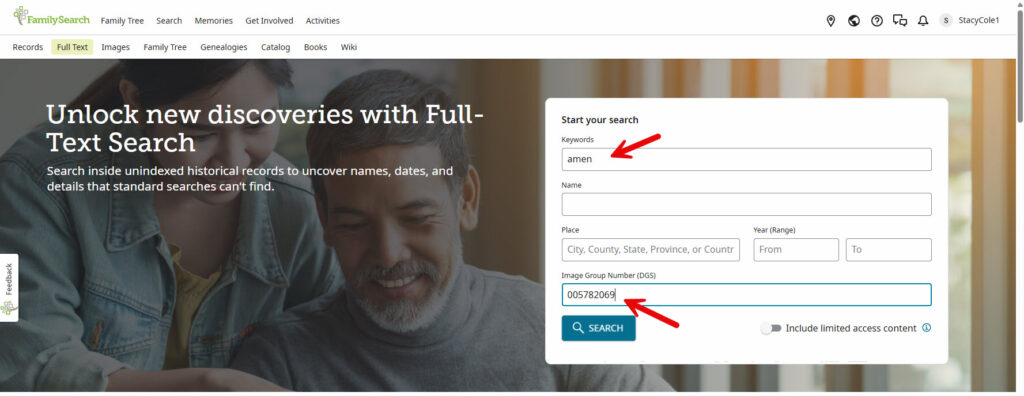
I searched 25 record sets this way, once for the word “amen” and once for “appraisement.” From the 1790s onward, I found almost nothing I didn’t already have, which reassured me that my original page-by-page search hadn’t missed much, if anything. But the documents from the early 1780s through the early 1790s were a real surprise.
I had noticed that the earliest record book, Book A, was thinner than expected, but thought that must be due to the unsettled nature of the area after the War.
It appears instead that they just had not been recorded. Perhaps there is an earlier record book that is missing, but then it would seem odd that the existing record books start with Book A if there was an earlier book.
Why do these old records matter? Because the They Had Names website now has these additional 280+ names of people for whom the promise of the American Revolution was not fulfilled. I hope their living descendants may find these records useful as they research their family histories.
To find these records on the website:
Look at the section titled “Recent Additions”: https://theyhadnames.net/recent-additions/; or
See all the wills on the website in order by the testator’s surname: https://theyhadnames.net/wills/; or
Search for an estate inventory by the name of the enslaver: https://theyhadnames.net/will-or-estate-inventory-primary-search/; or
Search all records: https://theyhadnames.net/using-this-site/.