
Silva Walthour was in her 70s in late 1864 when Sherman’s Army appeared at her Liberty County home on Raymond Cay Sr’s plantation and told her she was free. The first time she appeared in a U.S. federal census was in 1870. She was in a household on her own, with only 12-year-old Prince McIver, possibly a grandchild.[1]
In the 1880 census, she was living in the household of Prince and Patsy Cumming, and was identified as Prince’s mother-in-law, so Patsy could have been her daughter.[2]
Did she have other children? What about her life before freedom?
Because of Silva Walthour’s age at freedom, the usual records genealogists rely on to learn about her family life do not exist.
But in 1873, she submitted a claim against the U.S. government through the U.S. Southern Claims Commission program, set up by Congress to compensate “loyal Southerners” (loyal to the Union) for property taken by the soldiers for Army use. When she and her witnesses testified about her property loss, the floodgates of information opened.
For a full transcript of her claim and a link to the original, see: https://theyhadnames.net/2026/01/04/silva-walthour-southern-claims-commission/.
As a slave, why did Silva have property to lose? In her testimony, she explained that her husband, Charles Walthour, was a blacksmith held in slavery by George W. Walthour. He died in January 1870 so was not in the census with her.[3]
On the day the soldiers came, she said, her children were with her, and she named them: Pattie, Lydia, Charles, James & Simeon. So Patsy Cumming, married to Prince Cumming, was in fact her daughter but there were no other records from after or before the Civil War that would have shown the others were her children. Raymond Cay Sr, her enslaver, died after the Civil War so his estate inventory did not list enslaved people, and he did not use Silva or her children as collateral on promissory notes the way he did to other people he held in slavery so this testimony is the only easily accessible way to find information on her family.[4]
George W. Walthour, her husband’s enslaver, died in 1859, and his estate inventory did name “Charles Smith,” 65 years old, held on Richland Plantation.[5] In this case, “Smith” was not a surname; it was a description. Charles was a blacksmith. Because he and Silva were held by different owners, and their children were with her, as was customary, there was no indication in this inventory of their existence.

Silva’s son Simeon Walthour testified for her about the property, and said he was about 37 years old in 1873 when he testified, which helps in distinguishing him from other men with similar names after the War.
Raymond Cay Sr’s son of the same name also testified for Silva. He was 26 and said he had known her all his life. His testimony revealed aspects of their lives. He knew her husband had owned the horse the soldiers took because he had borrowed it and he knew he had a wagon and harness because Charles used to drive it to the plantation every Saturday to see Silva. He recalled that Charles used to make arrowheads for the schoolboys, including Cay, and the boys used to pay him 50 cents a piece. Silva had not worked since he could remember because of her age but always had lots of children and grandchildren around her. However, he knew that she used to raise rice, as was allowed by his father, because on the plantation were ponds named “Old Brister’s Pond” and “Old Silva’s Pond” after the slaves who used to plant them.
As for the hogs Silva said were taken from her, Cay said his father never owned any hogs before the War because he would just buy them from his enslaved people, who raised them. All his father’s enslaved people were allowed to raise crops and stock on their own time, he said, and their rations did not depend on how much they raised (which answered the Commissioners’ question about whether the enslaved people had actually owned the property they raised).
Silva’s petition also named other enslaved people who had been there that day, which identifies them as having been held in slavery by Cay: William Roberts, George Bacon, Brister Bacon and possibly August King.
The Commissioners of Claims denied her claim on a technicality. The claim was for a large amount — $1705 — and included large amounts of corn, fodder, hogs, chickens, peas, rice, and sweet potatoes that it was clear Silva could not have raised on her own at her age. It also included her husband’s blacksmithing tools, which she said belonged to her as his widow. She was submitting the claim as the head of the family, but the Commissioners had always struggled with how to assess property claimed to be owned by enslaved people, and now how to handle property said to have been inherited by them.
In this case, they decided: “That she is an honest conscientious old woman is highly probable and if she had sufficient capacity to understand the nature & extent of her claim she would be astonished at the amount & value of the property taken from her & her husband by the Federal Army as set forth in her petition. Slaves by law could own no property. They were permitted by their owners to raise to hold & retain in special cases certain kinds of property – dispose of it – using the proceeds for their pocket money & their private use. It was a [type] of ownership recognized by the master to encourage faithful & family servants. In some instances & under peculiar circumstances we have recognized such title so far as to regard the interest of the slave an equitable one for which he should be compensated. This is not such an instance.”
Though her claim was denied, the testimony reveals her family life to her descendants. The property had been taken three miles from the plantation to the Midway Church, which had been established in 1754 by white planter families from South Carolina and the enslaved people they brought with them. Enslaved and free African Americans had been members of this church since 1756, when Scipio and Judy were admitted to membership. More than 1100 African Americans belonged to the Church between 1756 and 1867, when the Church was turned over to the African American members after most of the white members had left the area.[6]
Not surprisingly, there was separation between the black and white members of the church. Some black members sat in the “slave gallery,” while others had services on the grounds. The Church was a center of life for both black and white, though, and fortunately, records were kept and remain.
Charles and Silva Walthour were members of the Midway Church.[7] Charles Walthour was chosen by the Church to perform marriages among the enslaved people in 1856.[8]

He was also a Selectman on Rev. Charles C. Jones’ Watchman’s Committee, which Jones had established to report to him on the state of spiritual life among the County’s plantations.[9]
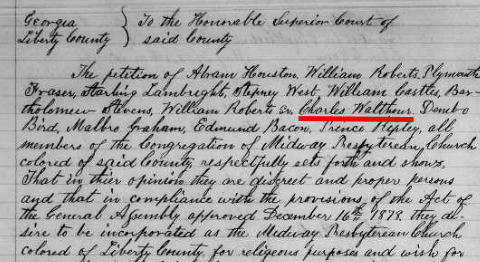
This focus on spiritual matters continued down the generations. Charles Walthour, Charles’ and Silva’s son, was one of the Midway Presbyterian Church trustees who purchased four acres of land for the Church and applied to incorporate it in 1880.[10] The Midway Presbyterian Church was established by the freedmen who took over the Midway Church building in 1867 and it still exists down the road from the Midway Church on Highway 17.
What happened to them all after the soldiers left? Freedpeople were pushed by the Freedmen’s Bureau to sign labor contracts with their former enslavers, and this is just what they did. On April 2, 1866, John D. Cay, son of Raymond Cay Sr, signed a contract agreeing to pay 18 freedpeople, presumably all from his father’s plantation, ⅔ of the crop for one year’s work.[11] The 18 freedpeople were: William Roberts, Nannie Roberts, George Law, Liddy Law, Lucy Roberts, Leah Roberts, Prince Cumming, Patty Cumming, York Stevens, Isaac Graham, Lucy Graham, Laura Graham, James Walthour, Amy Walthour, Abram Walthour, Charles Walthour, Mary Walthour, Matilda Walthour. James Walthour, Silva’s son, was married to Amy, and Charles Walthour, also her son, was married to Mary. Daughter Patty was married to Prince Cumming. Liddy Law was probably Silva’s daughter Lydia.
Although freedpeople were often taken advantage of in these contracts, the Walthours did not hesitate to assert their new rights. Via the Freedmen’s Bureau, in November 1865 Charles Walthour, Peter Way, and Billy Gilman (probably Gilmore) took Raymond Cay to court to establish ownership of the horses they said they had owned during slavery.[12] They won.
Charles Walthour (Jr) also banded together with other freedmen to own their own land. In October 1875, he bought ½ of Limerick Plantation with Richard Livingston, Titus Harris, Moses Quarterman, Russell Dunwoody and Nilla Harden.[13] They bought it together but later in 1883 quit-claimed individual pieces to each other.[14] Charles Walthour’s piece was 49 acres that were bounded by Richard Livingston, W.R. Shave, and one Newman, and “lot #4 of marsh land.”
In 1885, Simeon and Annie Walthour mortgaged a very similar piece of property to James Clark for a promissory note: 50 acres bounded north by land belonging to W.R. Shave, west by land belonging to Richard Livingston, and South and East by land belonging to John Axtell.[15]
Silva Walthour died sometime after 1880, when she was recorded living with Prince and Patty Cumming. Death records were not kept in Georgia until the 1920s.
Much hardship was suffered by freedpeople in Liberty County after the War, but Silva at least had her family around her. Because she and her family had the courage to claim their property before the U.S. Southern Claims Commission, her descendants also have invaluable information about their heritage.
-
1870 U.S. census, Liberty County, Georgia, population schedule, Subdivision 180, page 14, dwelling 142, family 142, enumerated on November 16, 1870, by Robert Q. Baker, entry for Silvy Walthour household; digital image, Ancestry (https://www.ancestry.com/imageviewer/collections/7163/images/4263491_00394 : accessed 1/6/2025). ↑
-
1880 U.S. Census, Liberty County, Georgia, population schedule, District 15, enumeration district 66, page 37, dwelling 338, family 344, entry for Prince and Patsey Cummings household; digital image, Ancestry (https://www.ancestry.com/imageviewer/collections/6742/images/4240148-00393 : accessed 1/6/2026). ↑
-
U.S. Federal Census Mortality Schedules, 1850-1885 -> 1870 -> Georgia -> Liberty, entry for Charles Walthour, black male, died at 80 years of age, in January 1870, a blacksmith, died of typhoid fever; digital images, Ancestry.com (https://www.ancestry.com/imageviewer/collections/8756/images/GAT655_9-0376 : accessed 1/6/2026), image 7 of 18. ↑
-
The conclusion about Raymond Cay not using Silva as collateral on promissory notes is based on the research documented on TheyHadNames.net. ↑
-
”Georgia Probate Records, 1742-1990,” database with images, FamilySearch (https://familysearch.org/ark:/61903/3:1:3QS7-993T-XTF2 : 20 May 2014), Liberty > Miscellaneous probate records 1850-1863 vol C and L > image 231 of 703. ↑
-
For more information on the Midway Church records and churches in Liberty County, see https://theyhadnames.net/churches/. ↑
-
In 1846, Rev. Charles C. Jones conducted a census of all African Americans in Liberty County’s 15th District who were church members. Charles, belonging to G.W. Walthour, and Silva, belonging to Raymond Cay, were listed as members of the Midway Church. ↑
-
“Midway Congregational Church Records,” quarterly session records, Liberty County, Georgia, 1762-1867, Charles belonging to G.W. Walthour chosen to perform marriages among “the colored people,” August 1856; digital images, FamilySearch (https://www.familysearch.org/ark:/61903/3:1:3QSQ-G9XF-HNF7 : accessed 1/6/2025); image 591 of 694. Note: Records abstracted at https://theyhadnames.net/midway-church-records/. ↑
-
For more information about the Watchmen’s Committee and a transcription of the surviving records, see https://theyhadnames.net/midway-church-watchmens-meeting/. ↑
-
Liberty County, Georgia, Superior Court Minutes, deed record dated May 15, 1880, pp 320-1; digital images, FamilySearch.org, Liberty Court Minutes 1859-1876, 1876-1884 (https://www.familysearch.org/ark:/61903/3:1:3Q9M-C3H3-49MZ-P : accessed 1/6/2025), image 511 of 661. Also, Liberty County, Georgia, Deeds & Mortgages, 1877-1882, Book S, page 551; digitized microfilm accessed through catalog, FamilySearch (https://www.familysearch.org/ark:/61903/3:1:3Q9M-C3QP-RSJ1-1 : accessed 1/6/2025), Family History Library microfilm 008564335, image 319 of 531; citing original records of Liberty County Superior Court, Georgia. ↑
-
Records of the U.S. Bureau of Refugees, Freedmen & Abandoned Lands, Field Office Records for Georgia, Liberty County, 1866 Labor Contract between John D. Cay and freed people; digital database, Ancestry (https://www.ancestry.com/imageviewer/collections/62309/images/004139868_00275), U.S., Freedmen’s Bureau Records, 1865-1878 -> Records of the Field Offices -> M1903 > 83, images 152-155; citing National Archives Microfilm Publication M1903, Roll 83. See a transcript of the contract at https://theyhadnames.net/2023/04/09/post-war-labor-contract-john-d-cay-freed-people-1866/. ↑
-
Bell, Karen Cook, “Claiming Freedom: Race, Kinship, and Land in Nineteenth-Century Georgia,” (University of South Carolina Press: 2018), citing “Raymond R. Kay v. Charles Walthour, Peter Way, and Billy Gillman, November 1865,
Contracts, Savannah, Georgia, Records of A. P. Ketchum, BRFAL, RG 105, NAB.” ↑
-
Liberty County, Georgia, Deeds & Mortgages, 1874-1877, Book R, page 187-8; digitized microfilm accessed through catalog, FamilySearch (https://www.familysearch.org/ark:/61903/3:1:3Q9M-C3QP-59SY-Z : accessed 1/6/2026), Family History Library microfilm 008564334, “Deeds & Mortgages, v. Q-R 1870-1877,” image 382 of 607, item 3 of 3; citing original records of Liberty County Superior Court, Georgia. ↑
-
Liberty County, Georgia, Deeds & Mortgages, 1882-1884, Book T, page 453-4; digitized microfilm accessed through catalog, FamilySearch (https://www.familysearch.org/ark:/61903/3:1:3Q9M-C3QP-R9D6-N : accessed 1/6/2025), Family History Library microfilm 008564336, image 247 of 593, item 1 of 2; citing original records of Liberty County Superior Court, Georgia. ↑
-
Liberty County, Georgia, Deeds & Mortgages, 1885-1886, Book W, pages 370-1; digitized microfilm accessed through catalog, FamilySearch (https://www.familysearch.org/ark:/61903/3:1:3Q9M-C3QP-GNRV : accessed 1/6/2026), Family History Library microfilm 008564337, image 416 of 525; citing original records of Liberty County Superior Court, Georgia. ↑