
Claim transcribed by Stacy Ashmore Cole
About the Southern Claims Commission
The Southern Claims Commmission was set up by Congress in 1871 to adjudicate claims for property taken by U.S. federal troops during the Civil War. More than 140 Liberty County residents — both black and white — filed claims, mostly for property taken during December 1864 when a unit of Sherman’s Army commanded by General Kilpatrick camped at Midway Church and conducted foraging raids throughout Liberty County. Horses, cows, hogs, poultry, corn and rice were the most common items of property taken. In Liberty County, many slaveowners allowed their enslaved people to work on their own time and own small amounts of property, most of which was taken by the U.S. troops for use by the Army.
The claims files, which are held at the National Archives and Records Administration (NARA), have been digitized and are available at Ancestry.com or Fold3.com. For more information on these files, click here. A set of standard questions were used to take the testimony of claimants and witnesses. This set of questions was amended twice, in 1872 and 1874. The questions are not usually part of the digitized file, but we have included them to help make sense of the answers. The questions we used were provided online courtesy of the St. Louis County Library Special Collections, as taken from National Archives Microfilm Publication M87, Roll 1, Frames 104–105, Records of the Commissioners of Claims (Southern Claims Commission, 1871-1880), and can be found here.
About This Transcription
What you are seeing: The Southern Claims Commission files for each claimant included all forms filed for the claimant, including cover pages, standard forms with filled in information, a special agent’s report about the claim, remarks made by the Special Commissioner summarizing the case, testimony from the claimant and his or her witnesses based on a standard set of questions, and copies of other paperwork involved. Much of the information contained in the forms is repetitive. We have summarized that information into one block, and transcribed all testimony, the Special Commissioner’s remarks, the special agent’s report, and any other relevant text.
Methodology: The testimony of the claimant and the witnesses has been transcribed exactly as seen. Some of the files are faded and/or difficult to read. Any words that cannot be read are indicated by “[word]”, or, in the case of entire sections, “[section illegible]”. Alternative spellings of names are also indicated with brackets.
The Claim: Summary & Transcription
Find the digitized original of this claim file at this Ancestry.com link.
Summary
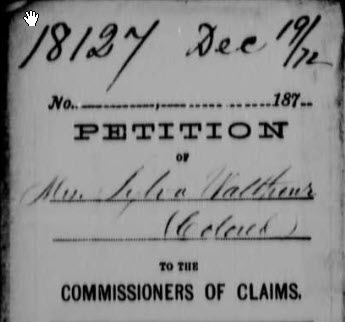
SCC Disallowed Claim Liberty County – Silva Walthour (Mrs)
Claimant’s Name (Last Name, First Name): Walthour, Silvia [alt: Sylvia] (Mrs)
Listed as “Colored”? (Y/N):
Amount of Claim: $1705.00
Total Amount Allowed: N/A, disallowed
Nature of Claim: Supplies
Claimant living in: Savannah, Ga
Incident occurred in: Walthourville, Liberty County, Georgia
Claim #: 18127
Secondary Claim #: N/A, disallowed
Date Claim Submitted [YYYY-MM-DD]: 1872-10-05
Date Testimony taken [YYYY-MM-DD]: 1873-06-12
Claimant’s Attorney: J.C. Todd (Savannah)
Special Commissioner: Virgil Hillyer
Property Removed to: Midway Church
Date property removed: December 1864
Army unit involved: Sherman’s Army commanded by Major General Sherman
Date Submitted to Congress [YYYY-MM-DD]: N/A, disallowed
Post Office of Claimant:
Witnesses to be Called: |
Charles Walthour (colored) |
Simeon Walthour (colored) |
George Bacon |
Transcription
Items Claimed
Item # | Description | Amt Claimed |
1 | One horse | 160 |
2 | Wagon harness saddle | 250 |
3 | 100 bushels corn | 150 |
4 | 1000 lbs fodder – 2000 lbs – 3000lbs | 45 |
5 | 16 head meat hogs 200 lbs @ 60=320.00 | 320 |
6 | 16 head stock hogs | 80 |
7 | 30 head chickens 60 [word] | 30 |
8 | 1 chest of tools her husband’s | 300 |
9 | Fencing on 3 acres land | 100 |
10 | 15 bu. Shelled peas & 60 bu in the pod | 150 |
11 | 50 bu rice (rough) | 100 |
12 | 20 bu sweet potatoes | 20 |
Total | 1705 |
Remarks:
This claimant is a colored woman – a widow & one 86 years of age. She was a slave & lived with her husband also a slave, on her master’s plantation in Liberty Co. Ga. throughout the war. Her husband died in 1869 leaving several sons & daughters of age. The widow files the claim in her own name. That she is an honest conscientious old woman is highly probable and if she had sufficient capacity to understand the nature & extent of her claim she would be astonished at the amount & value of the property taken from her & her husband by the Federal Army as set forth in her petition. Slaves by law could own no property. They were permitted by their owners to raise to hold & retain in special cases certain kinds of property – dispose of it – using the proceeds for their pocket money & their private use. It was a [word] of ownership recognized by the master to encourage faithful & family servants. In some instances & under peculiar circumstances we have recognized such title so far as to regard the interest of the slave an equitable one for which he should be compensated. This is not such an instance. The proofs do not show that the widow & heirs of claimant’s husband should be paid for the property taken by the Union soldiers. The claim is disallowed.
A.O. Aldis
J.B. Howell
O. Ferris } Commrs of Claims
Testimony of Claimant
In answer to the First General Interrogatory, the Deponent says:
My name is Silvia Walthour, my age ?? years, my residence Savannah, in the state of Georgia, and my occupation a [left blank]; I am related to the claimant and have a beneficial interest in the claim.
Testimony of Claimant
Case of
Silvia Walthour (colored)
vs
United States
State of Georgia
County of Liberty
Before the Commissioner of Claims under act of Congress May 3, 1871 & May 11, 1872
S.S.
The Deposition of Silvia Walthour the claimant taken before Virgil Hillyer Esq. Special Commissioner of the Southern Claims Commission to be used in the investigation of a claim now pending before the Commissioners of Claims against the United States under act of Congress May 3, 1871 and May 11, 1872 in the case of Silvia Walthour vs the United States, with the presence of [faded name] Claimant’s Counsel.
General interrogatories by the Commissioner
1. What is your name, age, residence, and occupation?
My name is Sylvia Walthour I was born in Liberty Co. Ga and I was a slave and became free when Sherman’s army came to Liberty Co. I am about 85 yrs old. I live in Sav. I am the claimant in this case.
2 Where did you reside from the 1st of April, 1861, to the 1st of June, 1865? If on your own land, what is the size of your farm? How much of your farm was cultivated, and how much was woodland? Where is it situated? What was your occupation during that time? Did you change your residence or business during that time? if so, where was your new residence, and what [was] your new business?
From the 1st of April 1861 till the 1st of June 1865 I resided in Liberty Co on my master’s land.
3 Did you ever pass beyond the military or naval lines of the United States and enter the rebel lines? If so, how often, when, where, and for what purpose, and how long did you stay within the Confederate lines on each occasion?
I never passed beyond the military or naval lines of the United States and entered the Rebel lines.
4 Did you ever take any oath or affirmation to bear allegiance to the so-called Confederate States, or to aid or support them in any way, or to “bear true faith,” or “yield obedience” to them? If so, when and where? State fully in regard to the same.
I never took any such oath or affirmation.
5 Have you ever taken any amnesty oath? If so, when, where, and under what condition? Have you been pardoned by the President? If so, when and where, and upon what conditions?
I never took the amnesty oath. I have not been pardoned by the President, I have never done anything to be pardoned for.
6 Were you ever directly or indirectly, or in any manner, connected with the civil service of the so called Confederate States? If so, how, when, and where, in what capacity, and for what periods? Was any oath required of you for such service; and if so, what?
I never was directly or indirectly so connected,
7 Did you ever hold any office or place of trust, honor, or profit under the Confederate Government, or under any of the States or Territories subordinate thereto? If so, state the nature and character of the office, the place at which, and the period for which you held it?
I never held any office of trust, honor or profit.
8 Did you hold any clerkship or have any agency or employment of any kind, for, or under, or for the benefit of the so-called Confederate States? If so, state fully in regard to the same.
I never held any such clerkship, agency or employment of any kind,
9 Were you ever, in any capacity, in the military or naval service of the so-called Confederate States, or of any State or Territory subordinate thereto?
I never was in any capacity in the military or naval service of the so-called Confederate States, nor of any State or territory subordinate thereto.
10 Were you ever an officer or soldier in the Confederate army? If yea, when, where, how long, and when did you leave such service?
[Each one of these questions must be fully answered.]
I never was an officer or soldier in the Confederate army.
11 Were you ever in the State militia of any State while subordinate to the Confederacy? If yea, state when, where, how long, and when you left the service?
I never was in the State militia of any State while subordinate to the Confederacy.
12 Were you ever in the home guard, or upon any vigilance committee, or committee of safety, which subject to the Confederacy? If yea, state when, where, and how long?
I never was in the home guard, nor upon any vigilance committee or committee of safety while subject to the Confederacy,
13 If you claim that you were conscripted into the rebel service, state fully all the circumstances.
I never was conscripted into the rebel services.
14 Did you ever furnish a substitute for the rebel army? If yea, state fully all the circumstances.
I never furnished a substitute for the rebel army
15 Were you directly or indirectly, or in any way, connected with or employed in the quartermaster’s department of the Confederate service or the commissary’s department, or the medical department, the engineers’ department, the ordnance department, the impressment service, the provost-marshal’s department, or any other branch of the Confederate service?
I never was directly nor indirectly in any way connected or employed in any of the departments, or in any branch of the Confederate service.
16 Were you employed on any railroad in the service of the Confederate government? Did you aid in the transportation of soldiers, munitions of war, or supplies for the Confederate government? If yea, state fully all the circumstances. If you claim that what you did was not “giving aid or comfort” to the rebel cause, state fully all the facts and reasons for such your claim.
I never was so employed. I never furnished any arms or transportation.
17 Did you at any time have charge of any stores or supplies for the use of the Confederate army, navy, or government, or the charge or care of trains, team or teams, wagon or wagons, vessels, boats, or other craft, or munitions of war, for the use of the Confederate army or navy? If so, state fully in regard to the same.
I never at any time had any stock, care or charge.
18 Were you ever in any service, employment, or business of any kind whatsoever for the Confederate government, or its army or navy? Did you ever furnish any aid, or any supplies or stores, or property of any kind, to or for the so called Confederate States, or any State in rebellion, or to the army, navy, militia, home guards, armed forces, or military organizations thereof, or for any officer, soldier, or sailor thereof? If so, state fully in regard to the same. Did you ever give any information to any officer, soldier, or sailor of the Confederate army or navy, or to any person employed by or for the so-called Confederate States, or acting on their behalf, or for their benefit, which might aid in any way any military or naval operations carried on against the United States? State fully in regard to the same.
I never was in any service, employment or business of any kind whatsoever for the Confederate government or its army or navy. I never furnished any such aid, stores or supplies or property of any kind. I never gave any such information.
19 Were you in any manner employed in the manufacture of munitions of war, of clothing, of boots, shoes, saddles, harness, or leather; of equipment for soldiers, or of any stores or supplies for the use of the Confederate army or navy; or were you in any way employed by, or did you aid or assist, others engaged in such manufacture? If so, state when and where, and by or for whom you were so employed, and for what period of time?
I never was in any manner so employed.
20 Were you ever, directly or indirectly, employed in the collection, impressment, or purchase, or the sale of stores, supplies or any property for the use or benefit of the Confederate government, or any State in rebellion, or the army, navy, or other forces thereof? Did you have any interest or share in contracts with, or purchases for, the Confederate government, or its army or navy, or any State in rebellion, or its forces? If so, state fully all particulars.
I never was directly nor indirectly in any manner employed. Never had any such interest or share.
21 Were you ever engaged in blockade running, or illicit traffic or intercourse between the lines, or were you ever in any way interested therein? Did you ever have any interest or share in any goods, wares, merchandise, stores, or supplies brought into or exported from the so-called Confederate States during the war? If so, state fully all particulars.
I never was so engaged. I never had any interest or share in any such property.
22 Did you leave the so-called Confederate States between the 19th of April, 1861, and 19th of April, 1865? If so, when and how did you leave; where did you go; for what purpose; how long were you absent; in what business were you engaged while absent, and when and to what place did you return in the so-called Confederate States?
I never left the so called Confederate States between those dates.
23 Were you the owner, or part owner, or in any way interested in any vessel used in navigating the ocean to or from any port in the Confederacy, or upon any waters in the Confederacy? If so, what vessels, when and where employed, and in what business?
I never was owner, nor had owner nor in any way interested in any such vessel.
24 Were you ever arrested by the Confederate government, or by any officer, soldier, or other person professing to act therefor, or for any State in rebellion? If so, when, where, by whom, and how long were you kept under arrest? How did you get released? Did you, for the sake of being released, or upon release, take any oath of any kind to the Confederate government? If so, what? [Put the same questions as to arrest by the United States Government, etc.]
I never was so arrested by either the United States or Confederate Government.
25 Was any of your property ever taken by the Confederate authorities, or by any officer, soldier, or other person acting or assuming to act on their behalf, or in behalf of any State in rebellion? If so, what property, when and for what use, and have you received pay therefor?
None of my property was ever so taken.
26 Were you ever threatened with damage or injury to your person, family, or property on account of your Union sentiments? If so, state when, by whom, and what the threats were?
I never was so threatened.
27 Were you ever molested or in any way injured on account of your Union sentiments? If so, state fully all the particulars.
I never was so molested.
28 Did you ever contribute anything—any money or property—in aid of the United States Government, or in aid of the Union army or cause? If so, state fully as to the same.
I never did so contribute, I never had an opportunity.
29 Did you ever do anything for the United States Government or its army, or for the Union cause, during the war? If so, state fully what you did.
I cooked and provided for the Union army while it was in the neighborhood.
30 Had you any near relatives—any husband, son, brother, or nephew—in the Confederate army? If yea, state his name, whether he is now living, and where he resides. Did you furnish him with any military equipments, any clothing, or any money? Did you contribute in any way to aid or support him while in the rebel service?
I had no relations in the Confederate army.
31 Have you owned any Confederate bonds or any interest or share therein; or had any share or interest in any loans to the Confederate government; or did you in any way contribute to support the credit of the so-called Confederate States during the late rebellion?
I have never owned any Confederate bonds nor any interest or share therein, nor any share or interest in any loand to the Confederate government, nor did I ever in any way contribute to support the credit of the so-called Confederate States.
32 Have you ever given aid and comfort to the rebellion? If so, state fully all the circumstances.
I have never given any aid or comfort to the rebellion.
33 Were you ever engaged in making raids into the United States from Canada, or engaged in destroying the commerce of the United States in the lakes and rivers adjoining Canada?
I never was so engaged.
34 Were you ever engaged in holding in custody, directly or indirectly, any persons taken by the rebel government as prisoners of war, or any persons imprisoned or confined by the Confederate government, or the authorities of any State in rebellion, for political causes? If so, when, where, and under what circumstances? In what capacity were you engaged, and what was the name, rank, and command of your principal?
I never was directly nor indirectly engaged.
35 Were you ever a member of any society or association for the imprisonment, expulsion, execution, or other persecution of any persons on account of their loyalty to the United States, or did you ever assist in such acts?
I never was a member of any society or association for any such a purpose.
36 Were you ever a paroled prisoner of the United States? Is so, when and where, and by whom paroled?
I never was a paroled prisoner of the U. S.
37 Have you ever held any office in the Army or Navy of the United States? Were you educated by the United States at the Military Academy at West Point, or at the United States Naval Academy?
I have never held any office in the army or navy of the U. S. neither was I ever so educated.
38 Did you ever receive any pass from any officer of the Confederate government, or from any person having or assuming to have authority to issue the same? If so, who gave you the pass; for what purpose; for what period of time; did you sign or swear to any promise or obligation in order to get it; or swear or promise to bear “bear true faith and yield obedience to the Confederate States;” did you use the pass, and for what purpose?
I never rec’d any such papers.
39 Are you or were you under the disabilities imposed by the Fourteenth Article of the Amendments to the Constitution of the United States? Have you held any office under the United States Government since the war? If so, what office; and did you take the (so-called) “iron-clad” oath?
I am not and never was under any such disabilities. I never held any office under the U. S. before nor since the war.
40 At the beginning of the rebellion did you sympathize with the Union cause, or with the rebellion? What were your feelings and what your language on the subject? On which side did you exert your influence and cast your vote? What did you do, and how did you vote? How did you vote on ratifying the ordinance of secession? After the ordinance of secession was adopted in your State did you adhere to the Union cause, or did you “go with the State?”
At the beginning of the rebellion I sympathized with the Union cause.
I felt happy and expressed myself before my friends. I gave my [word] [word] on the side of the Yankees.
I did not vote.
After the passage of the ordinances of secession, I adhered to the Union cause.
41 [Original Question 34.] In conclusion, do you solemnly declare that, from the beginning of hostilities against the United States to the end thereof, your sympathies were constantly with the cause of the United States; that you never, of your own free will and accord, did anything, or offered, or sought, or attempted to do anything, by word or deed, to injure said cause or retard its success, and that you were at all times ready and willing, when called upon, or if called upon, to aid and assist the cause of the Union, or its supporters, so far as you means and power and the circumstances of the case permitted?
In conclusion I do solemnly declare that from the beginning of hostilities against the U. S. to the end thereof my sympathies were constantly with the cause of the Union that I never of my own free will & accord did anything or offered or sought voluntarily to do anything by word or deed to injure said cause or retard its success, and that I was always ready & willing when or if called upon to aid and assist the cause of the Union so far as my means and power & the circumstances in the case permitted.
[Question 42 only asked of women]
If the claimant be a colored person, ask the following questions:
43 Were you a slave or free at the beginning of the war? When did you become free? What was your business after you became free? How and when did you come to own the property named in your petition? How did you get the means to pay for it? Who was your former master? Are you now in his employment? Do you live on his land? Do you live on land purchased of him? Are you indebted to your former master for land or property, and how much? Has anybody any interest in this claim besides yourself? State fully all the facts in your answers to these questions.
At the beginning of the war I was a slave and became free when Sherman’s army came to Liberty Co. I worked for myself after I became free. My husband was a blacksmith and although he was a slave yet he had Saturdays to himself & then he worked nights ‘til midnight for himself. This property all belongs to me alone, nobody else has any interest in it.
Second Set of Interrogatories by Special Commissioner.
1 Were you present when any of the articles of property specified in the claimant’s petition were taken?
I was present when this property was taken.
2 Did you see any of them taken? If so, specify the articles you saw taken.
I saw them take it away.
3 Begin with the first article (Item No. —) which you have specified that you saw taken, and give a full account of all you saw and heard in connection with the taking of that article? [The special commissioner should require the witness to state all the circumstances; for it is only by a knowledge of all of them that the commissioners of claims can judge whether the taking was such a one as the Government is bound to pay for. The common phrase, “I saw the property taken by United States soldiers,” is not enough, for there was much lawless taking. The witness should be required to detail the facts as to each item, when the items were taken at different times; but if all, or more than one, were taken at the same time, that fact should appear, and then a repetition of the circumstances is needless. The special commissioner must be careful to elicit all the facts, as well those against as for the claim, especially as to those articles of property which were the special objects of pillage and theft, such as horses, mules, cattle, hogs, &c. Claimants must bear in mind that a neglect to observe these directions works to the prejudice of the claimant, and may defeat the claim.]
They didn’t say much to us but came right into the house & took what they pleased.
4 Where were the articles taken? When were they taken? Give the day, month and year, if you can? By whom were they taken? Did you see more than one soldier engaged in the taking? How many soldiers were present? State the number as near as you can? How many helped take the property? How long were they engaged in taking the property?
This property was taken in Liberty Co. on Mr. R. Kay’s [Cay] place. This was taken when the Yankee army came through there. It was cold weather before Christmas. The Yankees took this property. I knew they were Yankee soldiers because they were dressed in blue. There was more than one I can’t tell how many. It was more than one day but I can’t tell how many days. They came every day till they took it all away.
5 Who were present other than soldiers when you saw them taken? Give the names of all you know?
My children were present, Pattie, Lydia, Charles, James & Simeon.
6 Was any United States officer, either commissioned or non-commissioned, present at the taking? If so, state his name, rank, regiment, and the command to which he belonged. Did he order the property to be taken? Did he say anything about the taking?
I don’t know whether there was any officers present.
7 Describe how the property was taken, and give a full account of all you saw done, or heard said, upon the occasion of the taking.
They carried the property off in wagons. They took this horse in the pasture, the wagon & harness under the gin house; they broke the corn from the house where I lived. They caught the hogs and killed them. They shot the chickens & knocked them down with a stick. They used the fence for fuel, cooking, & making tent fires. They took the peas right out of the house. They took the rice from the house. The potatoes were taken from the loft of the house where I lived.
8 How was the property removed—by soldiers or in wagons, or in what manner? State fully as to each article taken and removed.
They took the property away in wagons.
9 To what place was it removed? Did you follow it to such place, or see it, or any portion of it, at any such place, or on its way to such place? How do you know the place to which it was removed?
They took it to Midway church about 3 miles off.
10 Do you know the use for which the property was taken? What was the use, and how do you know it? Did you see the property so taken used by the United States army? Did you see any part of the property so used? State fully all you know as to the property or any of it having been used by the army; and distinguish between what you saw and know, and what you may have heard from others, or may think, or suppose, or infer to be true.
I cannot tell what use was made of this property, and I suppose they took it for feeding the horses. They took the hogs to eat. I didn’t see them use any of it.
11 Was any complaint made to any officer on account of such taking? If so, state the name, rank, and regiment of the officer. What did he say about it? State fully all that he said.
I never made any complaint.
12 Was any voucher or receipt for the property asked for? If so, of whom asked? State name, rank, and regiment. Was any receipt or paper given? If so, produce it, or state where it is, and why it is not produced. If no voucher or receipt was given, state why none was given, and if refused, why it was refused; state all that was said about it. State fully all the conversation between any officer or other person taking the property, and the claimant, or any one acting for him.
I never asked [for] any receipt.
13 Was the property, or any of it, taken in the night-time? At what hour of the day (as near as you can tell) was it taken? Was any of the property taken secretly, or so that you did not know of it when taken?
They took the property in the day time.
14 When the property was taken, was any part of the army encamped in that vicinity? If so, state how far from the place where the property was taken, and what was the company, regiment, or brigade there encamped? How long had it been encamped there? How long did it stay there, and when did it leave? Had there been any battle or skirmish near there, just before the property was taken? Did you know the quartermasters, or any of them, or any other officers of the army for whose use the property is supposed to have been taken?
The army was encamped about 3 miles from there when the property was taken. I don’t know the regiment or command to which they belonged. I don’t know how long they stayed there. I don’t know any of the officers or quartermasters.
15 Describe clearly the condition of the property when taken, and all that tends to show its value at the time and place of taking? Thus, if corn, was it green or ripe? Had it been harvested? Was it in the shock, or husked, or shelled? Where was it? If grain, was it standing; had it been cut; was it in shocks, or in the barn or in stacks; had it been threshed? If horses, mules, or cattle, state when they were taken, how taken, and fully their condition, age, and value. Have you talked with claimant about their value?
The property was in good condition when taken. The corn was in the house, the potatoes were some in the loft & some in the bank. The fodder was in the loft.
16 What means have you of knowing the quantity taken? State particularly how you estimate the quantity? Did you count or weigh the articles? Give us all your data. How much did you see taken and removed? What quantity was taken in your presence? As to quantity, distinguish carefully as to what you saw and know, and what you may think or believe from what you have heard from others.
Item No. 1. This was a big horse about 8 yrs old as near as I can remember. I saw them ride the horse away. It was as good a horse as any man ever rode.
Item No. 2. This was a one horse wagon, a spring wagon with new axletree – leather harness and saddle.
Item No. 3. I never measured the corn. It was good corn. It was a big pile.
Item No. 4. I had a good chance of fodder.
Item No. 5. I could not tell how many there were. I had a good chance of hogs. I don’t know, but my children know just how many I had.
Item No. 6. In the same way.
Item No. 7. There were 30 head of chickens & 60 head of ducks. My son raised this poultry & I cannot tell just how many he had.
Item No. 8. These were blacksmith’s & carpenters tools. It was a big, heavy chest of tools. I cannot tell how many there were.
Item No. 9. I cannot tell how many acres were fenced in, my son can tell.
Item No. 10. I had peas I cannot tell how many.
Item No. 11. I don’t know how many bushels I had.
Item No. 12. I had one large bank & one smaller. I used to put in 10 or 12 bushels when I was young.
Item No. 17 & 18. Passed.
Item No. 19
I have never received any pay for this property, or any part of it. I have never made any other claim for it.
This property is all mine. It was all raised by me & the old man. My old man died in 1869. The children were all married & had their own property. This belonged to me & my husband and the children had no interest in it at all. The estate was never administered upon.
My husband didn’t owe any body & I didn’t think it was necessary to have the estate administered upon. I never received anything directly or indirectly in the way of payment for my claim or any item in it & it is the first & only claim I have made against the United States.
Witness
Amey M. Adlington
Silvia Walthour [signed by mark]
Sworn to and Subscribed before me
Virgil Hillyer
Special Commissioner
State of Georgia
Testimony of Claimant (Simeon Walthour)
General interrogatories by Special Commissioner.
My name is Simeon Walthour. I was born in Liberty County a slave. I was made free in 1864 when the army came here. I am about 37 yrs old. I can’t read nor write. I am a carpenter. I am son of the claimant. I have no interest in her claim beneficially. I was too young to take part in the war. I was a Union man. She was glad & looking forward to freedom. She was regarded by the colored people as a friend to the Union cause. She always sympathized with the Union army & talked in favor of them. She cooked for the Union army when they came to Liberty Co. She was a slave and had no opportunity before. The colored people were all on the Yankee side. It was hard to find one who talked differently. Sometimes a colored driver was in favor of the rebel side. My mother was never molested on account of her Union sentiments. She never did anything for the Confederate soldiers. She couldn’t say anything openly as she was a slave.I was between those of her own color & herself.
Second Set of Interrogatories by Special Commissioner.
1 Were you present when any of the articles of property specified in the claimant’s petition were taken?
I was present when the property was taken.
2 Did you see any of them taken? If so, specify the articles you saw taken.
I saw it taken.
3 Begin with the first article (Item No. —) which you have specified that you saw taken, and give a full account of all you saw and heard in connection with the taking of that article? [The special commissioner should require the witness to state all the circumstances; for it is only by a knowledge of all of them that the commissioners of claims can judge whether the taking was such a one as the Government is bound to pay for. The common phrase, “I saw the property taken by United States soldiers,” is not enough, for there was much lawless taking. The witness should be required to detail the facts as to each item, when the items were taken at different times; but if all, or more than one, were taken at the same time, that fact should appear, and then a repetition of the circumstances is needless. The special commissioner must be careful to elicit all the facts, as well those against as for the claim, especially as to those articles of property which were the special objects of pillage and theft, such as horses, mules, cattle, hogs, &c. Claimants must bear in mind that a neglect to observe these directions works to the prejudice of the claimant, and may defeat the claim.]
They came right on & commenced on the white people’s property. They said that they would give it back to us – that we should have our freedom – that they wanted it for the army.
4 Where were the articles taken? When were they taken? Give the day, month and year, if you can? By whom were they taken? Did you see more than one soldier engaged in the taking? How many soldiers were present? State the number as near as you can? How many helped take the property? How long were they engaged in taking the property?
This property was taken near Dorchester, Liberty Co. Ga. It was on my master’s place – Mr. Raymond Cay – It was taken in Dec. 1864. I don’t remember the day. The soldiers of the Union army took it. There were 4 or 5 hundred of them. They were about 7 or 8 days off & on in taking it.
5 Who were present other than soldiers when you saw them taken? Give the names of all you know?
There were present my mother & myself, Isaac Graham & Brister Baker. These last two are dead. George Law was there also & others.
6 Was any United States officer, either commissioned or non-commissioned, present at the taking? If so, state his name, rank, regiment, and the command to which he belonged. Did he order the property to be taken? Did he say anything about the taking?
There were no officers there, except non commissioned officers. I don’t know their rank. We called them Sherman’s army. They ordered the cribs to be broken open & the corn etc to be taken. They were on horses & saw that the others took the property.
7 Describe how the property was taken, and give a full account of all you saw done, or heard said, upon the occasion of the taking.
The horse was in the open horse lot & they went there & got him. The wagon train went to the corn house & took the corn & fodder & everything was moved in this manner except the poultry, which was taken on horses.
8. How was the property removed—by soldiers or in wagons, or in what manner? State fully as to each article taken and removed.
[Either not asked or not answered]
9 To what place was it removed? Did you follow it to such place, or see it, or any portion of it, at any such place, or on its way to such place? How do you know the place to which it was removed?
They removed it to Midway Church. It is called 3 miles. I didn’t follow it but that was the way they went. We used to go out there for protection for fear that the rebels would come by night & steal us away.
10 Do you know the use for which the property was taken? What was the use, and how do you know it? Did you see the property so taken used by the United States army? Did you see any part of the property so used? State fully all you know as to the property or any of it having been used by the army; and distinguish between what you saw and know, and what you may have heard from others, or may think, or suppose, or infer to be true.
They said it was by government order. I saw it used.
11 Was any complaint made to any officer on account of such taking? If so, state the name, rank, and regiment of the officer. What did he say about it? State fully all that he said
I made complaint for my mother. I went to the men who had epaulettes on their shoulders & they said it was for government use & that we would be paid for it.
12 Was any voucher or receipt for the property asked for? If so, of whom asked? State name, rank, and regiment. Was any receipt or paper given? If so, produce it, or state where it is, and why it is not produced. If no voucher or receipt was given, state why none was given, and if refused, why it was refused; state all that was said about it. State fully all the conversation between any officer or other person taking the property, and the claimant, or any one acting for him.
I asked for no voucher or receipt. I simply told them that the property belonged to us & not to our master. I tried to speak to a large officer but there was so much excitement that I couldn’t approach them.
13 Was the property, or any of it, taken in the night-time? At what hour of the day (as near as you can tell) was it taken? Was any of the property taken secretly, or so that you did not know of it when taken?
The property was taken in the morning very early – from sunrise till sunset. They commenced again the next day.
14 When the property was taken, was any part of the army encamped in that vicinity? If so, state how far from the place where the property was taken, and what was the company, regiment, or brigade there encamped? How long had it been encamped there? How long did it stay there, and when did it leave? Had there been any battle or skirmish near there, just before the property was taken? Did you know the quartermasters, or any of them, or any other officers of the army for whose use the property is supposed to have been taken?
The army were encamped about 3 miles off. I don’t know what part of Sherman’s army it was. They had just pitched their camp there. They remained 7 or 8 days. There had been no battles or skirmishes or battles [SIC] near there, nothing but some light firing. I didn’t know the quartermasters or any of the other officers.
15 Describe clearly the condition of the property when taken, and all that tends to show its value at the time and place of taking? Thus, if corn, was it green or ripe? Had it been harvested? Was it in the shock, or husked, or shelled? Where was it? If grain, was it standing; had it been cut; was it in shocks, or in the barn or in stacks; had it been threshed? If horses, mules, or cattle, state when they were taken, how taken, and fully their condition, age, and value. Have you talked with claimant about their value?
This property was in a good condition. The corn was gathered & housed & fodder, peas, rice etc. The rice was threshed.The potatoes gathered & banked.
16 What means have you of knowing the quantity taken? State particularly how you estimate the quantity? Did you count or weigh the articles? Give us all your data. How much did you see taken and removed? What quantity was taken in your presence? As to quantity, distinguish carefully as to what you saw and know, and what you may think or believe from what you have heard from others.
Item No. 1. I think this horse was in good order about 6 years old. He was medium sized & fat. They just saddled him & rode him off & loaded down with chickens.
Item No. 2. This was a one horse wagon. It was iron axle-tree. It hadn’t any springs. It was new. This was a regular leather wagon harness – it was new also.The saddle was what we would call a real good saddle. It was a leather saddle. It was about 8 months old. They just hitched a mule to the wagon, filled it with sweet potatoes & [word]. .
Item No. 3. I had put the quantity of corn on a memorandum. It was measured. There were 100 bushels in the ear & in the crib. It was some of her own raising. They took it away in a government wagon.
Item No. 4. They carried the fodder on horseback. We judged the fodder by the height of the stacks. I don’t remember the no. of stacks but I had it down. I think there were 4 or [illegible word]. There were 3 stacks of hay I believe. This fodder & hay were all of her own make. I gave in the amounts in the petition or from my memorandum that I had.
Item No. 5. I think there was some 30 head of hogs. There were about 16 head of fat hogs & 16 of stock hogs. The fat ones would weigh from 220 to 270 weight each all dressed. I saw them killed & taken away. These stock hogs were running in the potato field & were fat – they would average 100 lbs I think.
Item No. 7. She had some 30 chickens & 60 turkeys. They took them away – tied them together & dstrung them across the horses’s back.
Item No. 8. There were one chest of blacksmith’s tools. My father was a blacksmith & he had a good many carpenter’s tools as he did the wood work for his blacksmith’s works. He made wagons. He had a full chest of carpenter’s & blacksmith’s tools. They were just what they wanted for the use of the army.
Item No. 9. She had 3 acres cleared. It was her master’s land. It was her own fence. Her master let her have the land for fencing. They were 11 rails high. They were new rails. She built it herself.
Item No. 10. These peas in the house. A part were threshed out & we estimated the quantity by what we had threshed & measured. They eat them themselves & fed them to the stock.
Item No. 11. This rice was measured. It was rough rice. It was threshed out. They took it away in the wagon train.
Item No. 12. I think there were about 20 bushels in a bank. I think there were 3 or 4 banks. I can’t remember exactly. It is so long. They took them all.
17 & 18. Passed.
19
No other demand has been made for this property. This is the only claim that she has ever made. What we raised our masters let us have. This property all belonged to my mother & father. He died 3 yrs ago. When he died it was all hers. . Whatever she raised belonged to her. She was old & exempt from service for her long service to her master. No part of it belonged to her master. It was all my mother’s. It was just as it was harvested, hadn’t been moved about from place to place to cover it up. I saw all this property taken by the Union forces. I don’t know how all my mother is. My father was older & she is very old now.
Simeon Walthour [signed his name]
Sworn to and Subscribed before me
Virgil Hillyer
Special Commissioner
State of Georgia
Testimony of Witness (Raymond Cay)
My name is Raymond Cay Jr. I was born in Liberty County Ga. I am 26 years old. I reside in Riceboro, Liberty County, Ga. I am merchandising and general business. I know the claimant. I have known her all my life. I lived at my father’s house in Walthourville. She was at the plantation & belonged to my father. I knew her husband Charles Walthour. He belonged to G.W. Walthour. I think the claimant’s husband died since the war. I know about some of the property charged in claimant’s account. I was not present when it was taken. I know the claimant’s husband had a horse. I know he made wagons. I have often seen him doing it. I know he was a blacksmith. I know his shop was well supplied with tools. The claimant though a slave was allowed to hold such property as she has charged in her account. I know it was a pretty good horse because he used to drive it to her plantation every Saturday. It was a good sized stout horse. I was not at home when the horse was taken. Do not know in what order he was then but he was usually kept in good order. This was a Jersey wagon in springs such as is usually owned by the negroes in this county. He was a blacksmith & I suppose usually kept it in good repair. He has had a horse & wagon ever since I have known him but I do not know if this was the same one or not. He had a harness with his horse & wagon & he rode horseback & has loaned me his horse to ride but I don’t remember every particular about his saddle. I was away from home during the war except when home on a furlough. He had a full set of blacksmith’s tools. I don’t know whether they were good or not. I know he had all the tools I have ever seen in every other blacksmith’s shop. I don’t know who the tools belonged to. I was too young to know much about such things then. I think the claimant’s husband paid wages to his master. I know he worked for the planters in general. I do not know whether they paid him or his master but I do know he made arrowheads for the boys in our school & we paid the money to him 50 cts a piece. The claimant’s husband was a hard working industrious man [word]. I know he was one of the best old negroes in this county. It was always customary in this county so far as I know when a slave died, for his family to inherit his property whether they belonged to the same owners or not. I do not know how much land the claimant’s husband or his friends were allowed to cultivate. I do know that all my father’s negroes were allowed to plant for themselves in their own time & I think it was a custom throughout the county. I think it was [several words] circumstance for a slave to own a 100 bu[shels] of corn but old Silva was superannuated & had not done any work for my father since I can remember & had lots of children & grandchildren around her & I should not wonder if she had a 100 bu of corn, as in addition to this her husband was a blacksmith & could have had opportunities of getting & holding more property than most slaves. About the hogs I know nothing positive but I know that all of our negroes had quantities of hogs. Up to 2 years after the beginning of the war my father never raised a single hog but always bought enough for his own use & that of his plantation every winter from the negroes on his place. My father’s negroes were rationed every Saturday night without any regard to what they had or what he bought from them. On my father’s place until this day are several ponds still bearing the names of the hands who used to plant them in rice viz. Old Brister’s pond old Silva’s pond (the latter the claimant in this case) & others. From my knowledge of old Charles the blacksmith the husband of the claimant & of his large family on my father’s plantation I think it not unreasonable to suppose that they were possessed of most of the property contained in her application. The only doubt in my mind is the question of the ownership of the blacksmith tools. I do not know whether they belonged to him or his master.
Raymond Cay Jr.
Sworn to and Subscribed before me
Virgil Hillyer
Special Commissioner
State of Georgia
Testimony of Witness (William Gilmore)
[Transcriber’s Note: This testimony was very faded.]
I was born in Liberty Co. Ga a slave. I became free when the raid came through here. I belonged to Raymond Cay Sen. I am 52 yrs old. I reside on [illegible] place Liberty Co. Ga. I am a farmer. I know Silva Walthour. I am [illegible] to her. She belonged to the same [three lines illegible]…She was a good friend to the Yankee army. She was rejoiced ?to be? Delivered from slavery.
Second Set of Interrogatories
[Transcriber’s note: Much of this was very faded and difficult to piece together. Gilmore said that present at the taking of the property were William Roberts, Charles Walthour, George Bacon, James Walthour, Brister Bacon, and a name that was possibly August King, whom he said he died. Nothing else that was legible was different from the previous testimony.]
[Transcriber’s Note: The next testimony, that of William Roberts, was also very faded. He said that he was born in Liberty County as a slave and became free when the raid came through. The testimony after that, from York Stevens, was even more faded]