
William Cooper, an enslaved ship’s carpenter, did not just witness the arrival of Sherman’s Army into Savannah in December 1864. He went 40 miles out to greet them and helped pilot them into Savannah. His life also illustrates the complicated interrelationships between free and enslaved African Americans in coastal Georgia.
This research contains information on the following individuals: William Cooper, Mary Cooper/Lyons, Sarah Ann Cooper Sharp Artson, Andrew Cooper, William Artson, Julia Ferebee Cooper, Charles Cooper, Henry Sharp, Catharine Sharp, Mary C. Sharp, Lucy A. Sharp, Gertrude Artson, William Cooper Artson
According to Cooper, he was repaid for his aid to Sherman’s Army by having to witness soldiers tear down two frame buildings belonging to him and carry away the materials to use for a fence they were building around the city. In 1872, Cooper applied for compensation through the U.S. Southern Claims Commission program, which was designed by Congress to repay loyal Southerners who had property taken for Army use.
For a full transcription of William Cooper’s U.S. Southern Claims Commission petition, see https://theyhadnames.net/2025/12/29/william-cooper-southern-claims-commission/.
Cooper testified before Special Commissioner for Georgia Virgil Hillyer about the property he lost. He had a 20-year lease on a 100 x 150 feet lot of land on Mill Street near the canal at an annual rent of $12. He put up the buildings himself with help from others, he said. One was about 15 x 32 feet, 3 stories high, built with sawed lumber and shingled with cypress. There was a 15 x 10 ft separate kitchen. A second building was similarly built and he and others were living in it. The houses belonged to him, even though the land was leased, and the lease specified that he could take them down if he chose.
The soldiers came and said they were authorized to take down his buildings. He went with one of them to complain to an officer but was told only that the government would pay him for them later. When he returned to his lot, the soldiers had almost finished tearing down the first building and were starting on the second. They also took his furniture, bedding, a substantial tool chest, a mule, and 214 bushels of rice. He protested and tried to stop one of the soldiers, but said they hit him, injuring his hand and laying him up for three weeks.
How could Cooper have owned this property given that he was enslaved? He testified that he was married to a free woman of color and that his former master had been John Keebler, who “died soon after the army came here. I expect they fretted themselves to death.” His testimony was a little vague about how he bought the property. He said that after he became free when the soldiers arrived, he continued as a ship carpenter and earned the property by hiring out his time and at other times working until midnight. However, he had said he owned the property when the Army arrived and he claimed to have receipts to prove that he was leasing the land.
Cooper had to present witnesses both to prove that he had been loyal to the Union and that he actually owned the property. His witnesses were his son, William Cooper, and Sarah Ann Artson, who testified that she was not related to him, though it appeared she was living in one of the buildings when it was torn down.
Sarah Ann told the Special Commissioner that she now lived in Liberty County and was 33 years old (in 1873). She knew Cooper during the war, she said, and confirmed that he was a “Union man” and that he hoped the Yankees would come before the “white people could take him off — as the white people took all their servants off at that time.” She herself was free born but was in favor of the war because she had no “privilege,” she said, adding, “We were all opposed to the war at first for the white people told us the Yankees was going to make us all slaves. Then when we found that they were taking all these places around us we were glad to have them come.” She confirmed Cooper’s account of what was taken and how it was taken.
William Cooper Jr., also a ship carpenter, also confirmed the account. He said he knew his father was a Union man from the conversations they had at night, though his father had to be careful what he said because “the white folks wanted to carry him over to Carolina but he ran off and met the Yankee army and piloted them into the city.” Cooper Jr was free-born, he said, because his mother, “Mrs. Cooper Senior,” was a free woman. Cooper Jr. also said that the leased lot belonged to the “estate of O’Burn.”
All three testified that present at the taking of the property were William Cooper, William Cooper Jr, Sarah Anne Artson, and Thomas Feribee.
The Commissioners of Claims denied Cooper’s claim. They said there was no reliable proof that he owned the property, as his only witnesses were his son and a “free colored woman,” and even if he had owned it, they thought the soldiers took it for their own use, not the Army’s use. Claimants could only receive compensation for property taken for Army use.
Also, claimants needed to prove loyalty to the Union. Normally, enslaved people received the benefit of the doubt on this, as it was assumed they wanted to be free, but in this case, a witness was found who said otherwise about Cooper. Daniel N. Lain, a Savannah justice of the peace and magistrate, swore that he knew Cooper well and that Cooper was considered to be on the rebel side by everyone. Even if he had been loyal to the Union, though, “the claim would be a fraud because he did not own the property to lose.” The Commissioners noted his testimony but did not appear to rely on it in their decision.
Why didn’t the Commissioners ask for the receipts Cooper said he had? For that matter, why didn’t Cooper bring them to his meeting with the Special Commissioner? He could have actually proved his lease of the land and ownership of the property right then and there: his counsel, Dominick A. O’Byrne was almost certainly the son of the man whose estate was leasing him the land. No one appears to have mentioned that, though.
Research on William Cooper and his Family
Sarah Anne Artson testified that she was not related to Cooper and called him “the old man” at one point. However, I believe that she was William Cooper Jr’s sister and William Cooper’s daughter.
- Mary Cooper, a free woman of color, had been listed in the Savannah’s Free Persons of Color Register since 1829.[1] Beginning in 1836, Sarah Ann Cooper was listed with her and then beginning in 1840, William Cooper. These roughly fit Sarah Ann Artson’s and William Cooper Jr’s birth years, which are based on census records and the SCC claim. In one of the Registers, Mary Cooper was said to have been born in Darien (McIntosh County, Georgia).
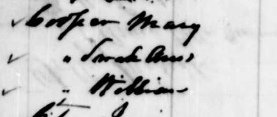
Mary Cooper listed with her children Sarah Ann and William Jr in the 1847 Savannah Free Persons of Color Register
- Because Mary was a free woman, her children were free, and they were all recorded in the U.S. Federal census. This entry for 1850 shows her with Andrew (17), Sarah A (16) and William (12), with the M indicating that they were all mixed race (mulatto).[2] Although the 1850 did not specify relationships, this taken with the Free Persons of Color registers does appear to indicate that Mary had three children: Andrew, Sarah Ann and William.
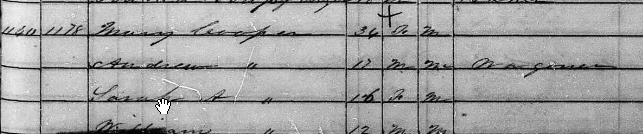
Mary Cooper listed in 1850 census with Andrew, Sarah A, and William.
- By 1860, William Cooper (now 22) and Mary Cooper (45) were living in Savannah with Henry Sharp (27) and Sarah A. Sharp (24), along with (presumably) Henry and Sarah’s children: Catharine Sharp (6), Mary C. Sharp (2) and Lucy A. Sharp (9 months).[3] Given the ages and proximity, Sarah A. Sharp seems almost certain to be Sarah Ann Cooper. Because enslaved people were not listed in the 1860 census by name, all people in this listing must have been free people of color. Note that Mary Cooper is listed as having been born in McIntosh County, Georgia, linking her to the Mary Cooper in the Free Persons of Color Register, said to have been born in Darien.

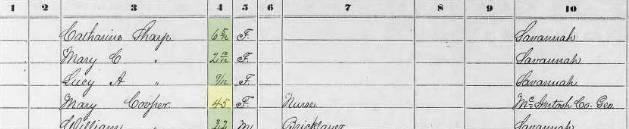
1860 Federal Census entry for the Sharp family and Mary and William Cooper
- What ties Sarah Ann Cooper Sharp to Sarah Ann Artson? In 1870, William Cooper Sr (64) was living in Liberty County, Georgia, with William Artson (27) and Sarah Ann Artson, plus four children: Gertrude Artson (7 months), Catherine Sharpe (16), Mary C. Sharpe (12) and Sarah Ann Sharpe (10).[4] Sarah A. Sharp had been a dressmaker in 1860, and Sarah Ann Artson was a dressmaker in 1870. The ages of the Sharpe children in 1870 match the ages of the Sharp children in 1860. Sarah Ann’s age is a little off but that is not at all uncommon in census records. William Cooper had testified in his SCC petition that he was living in Liberty County at the time of the petition.
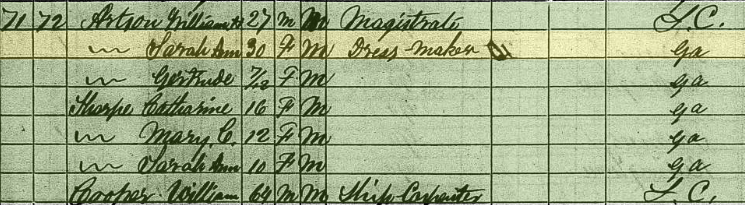
1870 Federal Census entry for William and Sarah Ann Artson, their children, and William Cooper
- In addition, on January 21, 1880, William and Sarah Ann Artson had a son, whom they named William Cooper Artson. His middle name is seen here in his World War I draft registration card.[5]
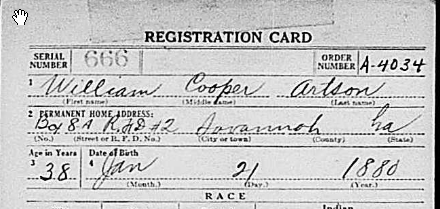
William Cooper Artson’s World War I draft card
- In one of the Savannah Free Persons of Color Registers, a Charles Cooper, 31, was listed just above Mary Cooper, and some people with Ancestry trees have identified them as being married and the parents of William and Sarah Ann, based apparently only on this record. However, Charles Cooper is listed in many other Savannah Free Persons of Color Registers separately from Mary Cooper and her children, and he was listed separately in the 1840 census as well.[6] Given William Cooper Jr’s identification of William Cooper as his father, the similarity of the names, and William Cooper Sr’s living with Sarah Ann in 1870, I believe he was her father. (Remember that as an enslaved man, William Cooper Sr could not have been living with them prior to Emancipation.)
- In 1870, William Cooper Jr applied for a Freedman’s Bank account.[7] He listed his occupation as a ship carpenter, his father as William (no last name given) and his mother as Mary (no last name given, listed as deceased). He also listed his sister as Sarah Ann Artson living in Liberty County.
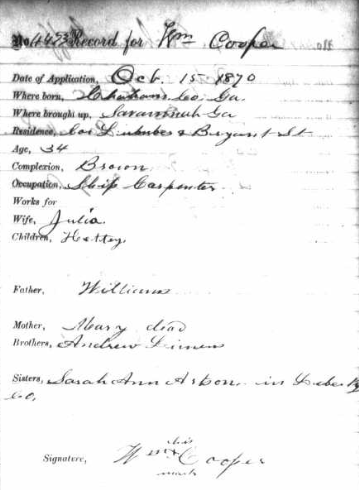
William Cooper’s 1870 application for a Freedman’s Bank account
- William Cooper Jr also had listed his brother as Andrew with a last name that looks like Limon. It will be remembered that Mary Cooper had a son named Andrew. In his SCC petition, William Cooper Sr listed as a potential witness an Andrew Lyons in Savannah.
Why would Sarah Ann Artson have claimed not to be related to William Cooper? It is certainly possible that the above linkages are misleading and that she was William Cooper Jr’s sister but not William Cooper Sr’s daughter. It is also possible that she was aware that the U.S. Commissioners of Claims placed more weight on testimony from non-relatives. Since William Cooper Sr only had two witnesses who would speak for him, it would have been better not to have both of them be relatives.
William Artson was a prominent man. He was identified by the 1870 census as a Liberty County magistrate and was also being paid by the Freedmen’s Bureau as the teacher at the Homestead primary school.[8] In October 1869, he had been elected as the Assistant Secretary of the “Colored Labor Convention,” at which Rev. Tunis G. Campbell gave the opening invocation.[9] James H. Deveaux was elected as the Secretary Pro Tem.In 1888, identified as Capt. W.H. Artson of the Forest Light Infantry, he marched in a Savannah parade celebrating the 25th anniversary of the Emancipation Proclamation.
Thomas Ferebee, a proposed witness who was apparently not called, was also related to William Cooper. William Cooper Jr married Julia Ferebee, who was probably Thomas Ferebee’s sister. Julia Farebee was a free woman of color born in Beaufort District, South Carolina, a seamstress. In 1860, she was living near Henry and Sarah Ann Sharp in Savannah. In 1870, William and Julia Cooper were living with William (27) and Virginia (30) Fariby, their two children, and Sarah Faribe (28).[10] William and Julia later had a daughter, Hettie.
Most of the older people named in this account were born in South Carolina, and were probably connected there before moving to Georgia. It’s worth noting that there is an area of Beaufort called Ferebeeville.
Who was William Cooper’s enslaver? His SCC testimony appeared to be a little misleading (or taken down incorrectly), as he said that his enslaver was John Keebler and that he had died soon after the Army came to Savannah. He said he thought “they had fretted themselves to death.” John J. Keebler died in 1846.[11] His widow, Harriet Winckler Keebler, inherited everything for her lifetime and in 1850 owned 30 people. She had three children: Louisa, Lemuel, and Harriet. Harriet and Lemuel both died in 1861.[12] Harriet Winckler Keebler died in 1877 so, assuming this is the correct Keebler family, would have been William Cooper’s owner when the Army arrived. It is worth noting that John Keebler was listed on the same page in the 1840 census as Mary Cooper was, so they evidently lived near each other.
Why was William Cooper using the surname Cooper, when his enslaver was a Keebler? It seems evident that he was known as Cooper because his wife, Mary, had that surname.
-
Savannah, Georgia, U.S., Registers of Free Persons of Color, 1817-1864, Volume 3 (1828-1847); digital image, Ancestry.com (https://www.ancestry.com/imageviewer/collections/8969/images/42454_331860-00563 : accessed 1/1/2026), images 8-9 of 45. ↑
-
1850 U.S. census, Chatham County, Georgia, population schedule, page 297 (stamped), dwelling 1140, family 1178, enumerated on October 4, 1850, entry for Mary Cooper household; digital image, Ancestry (https://www.ancestry.com/imageviewer/collections/8054/images/4193233-00154 : accessed 1/1/2026), image 149 of 236. ↑
-
1860 U.S. census, Chatham County, Georgia, population schedule, page 30, dwelling 71, family 72, enumerated on November 12, 1870, entry for Mary Cooper household; digital image, Ancestry (https://www.ancestry.com/imageviewer/collections/7667/images/4211374_00030 : accessed 1/1/2026), image 31 of 121. ↑
-
1870 U.S. census, Liberty County, Georgia, population schedule, page 8, dwelling 299, family 276, enumerated on June 16, 1860, entry for William and Sarah Ann Artson household; digital image, Ancestry (https://www.ancestry.com/imageviewer/collections/7163/images/4263491_00443 : accessed 1/1/2026), image 8 of 56. ↑
-
U.S., World War I Draft Registration Cards, 1917-1918 for William Cooper Artson -> Georgia -> Savannah City -> 2 -> Draft Card A; digital images, Ancestry.com (https://www.ancestry.com/imageviewer/collections/6482/images/005150624_01364 : accessed 1/1/2026), 304 of 358. ↑
-
1840 U.S. census, Chatham County, Georgia, population schedule, page 4, entry for Charles Cooper; digital image, Ancestry (https://www.ancestry.com/imageviewer/collections/8057/images/4411224_00044 : accessed 1/1/2026), image 46 of 184. ↑
-
Registers of Signatures of Depositors in Branches of the Freedman’s Savings and Trust Company, 1865-1874, for Georgia, Chatham County, Microfilm Series: M816, the National Archives in Washington, D.C. record for Wm Cooper; digital database, Ancestry.com (https://www.ancestry.com/imageviewer/collections/8755/images/GAM816_8-0627 : accessed 1/1/2026), “U.S., Freedman’s Bank Records, 1865-1874” -> “Registers of Signatures of Depositors, 1865-1874,” -> “Roll 08: Savannah, Georgia; Jan 10, 1866-Dec 17, 1870), image 627.689 ↑
-
Records of the U.S. Bureau of Refugees, Freedmen & Abandoned Lands, State Records of the Superintendant of Education, Georgia (M799), Roll 026, School Reports From Teachers, Jan-Mar 1870; digital database, Ancestry (https://www.ancestry.com/imageviewer/collections/62309/images/007675842_00435; accessed 1/1/2026), image 435 of 962. ↑
-
The Weekly Telegraph, 22 October 1869, accessed at Newspapers.com. ↑
-
1870 U.S. census, Chatham County, Georgia, population schedule, page 181, dwelling 1197, family 1290, enumerated on July 15, 1860, entry for William and Julia Cooper household; digital image, Ancestry (https://www.ancestry.com/imageviewer/collections/7163/images/4263397_00185 : accessed 1/1/2026), image 181 of 509. ↑
-
Savannah, Georgia, Vital Records, 1803-1966 for John J. Keebler -> Death -> 1846; digital images, Ancestry.com (https://www.ancestry.com/imageviewer/collections/2209/images/32850_B013306-00198 : accessed 1/1/2026), image 9 of 10. ↑
-
Harriet Winckler married John Keebler on November 23, 1822. (See Georgia, Compiled Marriages, 1754-1850 on Ancestry.com; https://www.ancestry.com/search/collections/2085/records/91616). John Keebler’s 1846 will left everything to her for her lifetime. (See Georgia, U.S., Wills and Probate Records -> Chatham -> Wills, Vol G-H, 1827-1852; https://www.ancestry.com/imageviewer/collections/8635/images/005759793_00367). For information on the people she held in slavery, see the 1850 U.S. Federal Census Slave Schedule for Chatham County (https://www.ancestry.com/imageviewer/collections/8055/images/GAM432_89-0063). She died on January 28, 1877, and is buried in Laurel Grove Cemetery North in Savannah (see FindaGrave memorial at https://www.ancestry.com/search/collections/60525/records/41492137). ↑