
Claim transcribed by Stacy Ashmore Cole with significant help from ChatGPT.
For research about William Cooper and other people named in this claim, click HERE.
About the Southern Claims Commission
The Southern Claims Commmission was set up by Congress in 1871 to adjudicate claims for property taken by U.S. federal troops during the Civil War. More than 140 Liberty County residents — both black and white — filed claims, mostly for property taken during December 1864 when a unit of Sherman’s Army commanded by General Kilpatrick camped at Midway Church and conducted foraging raids throughout Liberty County. Horses, cows, hogs, poultry, corn and rice were the most common items of property taken. In Liberty County, many slaveowners allowed their enslaved people to work on their own time and own small amounts of property, most of which was taken by the U.S. troops for use by the Army.
The claims files, which are held at the National Archives and Records Administration (NARA), have been digitized and are available at Ancestry.com or Fold3.com. For more information on these files, click here. A set of standard questions were used to take the testimony of claimants and witnesses. This set of questions was amended twice, in 1872 and 1874. The questions are not usually part of the digitized file, but we have included them to help make sense of the answers. The questions we used were provided online courtesy of the St. Louis County Library Special Collections, as taken from National Archives Microfilm Publication M87, Roll 1, Frames 104–105, Records of the Commissioners of Claims (Southern Claims Commission, 1871-1880), and can be found here.
About This Transcription
What you are seeing: The Southern Claims Commission files for each claimant included all forms filed for the claimant, including cover pages, standard forms with filled in information, a special agent’s report about the claim, remarks made by the Special Commissioner summarizing the case, testimony from the claimant and his or her witnesses based on a standard set of questions, and copies of other paperwork involved. Much of the information contained in the forms is repetitive. We have summarized that information into one block, and transcribed all testimony, the Special Commissioner’s remarks, the special agent’s report, and any other relevant text.
Methodology: The testimony of the claimant and the witnesses has been transcribed exactly as seen. Some of the files are faded and/or difficult to read. Any words that cannot be read are indicated by “[word]”, or, in the case of entire sections, “[section illegible]”. Alternative spellings of names are also indicated with brackets.
The Claim: Summary & Transcription
Find the digitized original of this claim file at this Ancestry.com link.
Summary
SCC Disallowed Claim Liberty County – William Cooper
Claimant’s Name (Last Name, First Name): Cooper, William
Listed as “Colored”? (Y/N):
Amount of Claim: $1950.00
Total Amount Allowed: N/A, disallowed
Nature of Claim: “the wanton and unnecessary taking or carrying away of two dwelling houses the property of petitioner by the United States Amy under command of Lieutenant General Sherman, situated on Mill Street near West Broad St., Savannah Georgia, on December 21, 1864.
Claimant living in: McIntosh Station No 3 of Atlanta & Gulf Railroad, Liberty County, Ga
Incident occurred in: Savannah, Georgia
Claim #: 12261
Secondary Claim #: N/A
Date Claim Submitted [YYYY-MM-DD]: 1872-11-19
Date Testimony taken [YYYY-MM-DD]: 1873-03-07
Claimant’s Attorney: Richard McAllister, Washington, D.C.; Augustine J. Smith, President National Co-operative Business Agency Company, Baltimore, MD; Grayson Mann
Special Commissioner: Virgil Hillyer
Property Removed to:
Date property removed: 1864-12-20
Army unit involved: Col. Leslie, 3d Brigade, 3d Division, 14th Army Corps
Date Submitted to Congress [YYYY-MM-DD]: N/A, disallowed
Post Office of Claimant:
Witnesses to be Called: |
Thomas Ferraby, Savannah, Ga (for loyalty) |
William Ferraby, Savannah, Ga (for loyalty) |
William Rivers, Savannah, Ga (for loyalty) |
Andrew Lyons, Savannah, Ga (other facts) |
Sarah Artson, Savannah , Ga (other facts) |
Abram Grady, Savannah, Ga (other facts) |
William Cooper, Jr |
Transcription
Items Claimed
Item # | Description | Amt Claimed |
1 | One Frame Dwelling House, two stories in height, fifteen feet in breadth by thirty two ft., in height/depth built by petitioner in 1862 | 1000.00 |
2 | One frame dwelling House partly carried off | 500.00 |
3 | Furniture | 200.00 |
4 | Bedding | 100.00 |
5 | Carpenter Tools | 150.00 |
6 | 214 bushels rice | 322 |
7 | 1 mule | 100 |
TOTAL | $2371.00
|
[Transcriber’s Note: Cooper had later petitioned to have the rice and mule added to his claim, saying they were left off the claim by accident.]
A.O. Aldis
O. Ferris } Commrs [Commissioners] of Claims
[Transcriber’s Comments: Testimony taken in Savannah.]
Testimony of Claimant
In answer to the First General Interrogatory, the Deponent says:
My name is William Cooper, my age 68 years, my residence Liberty County in the State of Georgia, and my occupation a ship carpenter. I am the claimant and have a beneficial interest in the claim.
In the case of William Cooper vs. United States } Before the Commissioner of Claims under act of Congress Mar. 1871 & May 11, 1872.
State of Georgia, County of Liberty } S.S.
The deposition of Wm. Cooper, the claimant, taken before Virgil Hillyer Esq. Spec’l Commissioner of the Southern Claims Commission: to be used in the investigation of a claim now pending before the Commissioners of claims against the United States under act of Congress Mar 3, 1871 and May 11, 1872 in the name of Wm. Cooper vs. the United States in the presence of H. Grayson Mann, claimant’s counsel.
General Interrogatories by Spec’l Com’r:
1. What is your name, your age, your residence, and how long has it been such, and your occupation?
My name is William Cooper. I was born in South Carolina & was a slave & became free when the army came here to Sav. I am 68 yrs old. I reside in Liberty Co. Ga. I am a ship carpenter. I am the claimant in this case & am the only one who has a beneficial interest in this account.
2. If you are not the claimant, in what manner, if any, are you related to the claimant or interested in the success of the claim?
From the 1st of April 1861 till the 1st of June 1865 I resided in Savannah I was a ship carpenter & did not change my residence on account of joining the army.
3. Did you ever pass beyond the military or naval lines of the United States and enter the rebel lines? If so, how often, when, where, and for what purpose, and how long did you stay within the Confederate lines on each occasion?
3 I was a ship carpenter & did not change my residence on account of joining the army I never was at any time in the military or naval service of the United States and enlisted the rebel service & remained in Savannah
4. Did you ever take any oath or affirmation to bear allegiance to the so-called Confederate States, or to aid or support them in any way, or to “bear true faith,” or “yield obedience” to them? If so, when and where? State fully in regard to the same.
4 I never took any oath or affirmation
5. Have you ever taken any amnesty oath? If so, when, where, and under what condition? Have you been pardoned by the President? If so, when and where, and upon what conditions?
5 I never took the amnesty oath I have never been pardoned by the President have never done anything to be pardoned for
6. Were you ever directly or indirectly, or in any manner, connected with the civil service of the so called Confederate States? If so, how, when, and where, in what capacity, and for what periods? Was any oath required of you for such service; and if so, what?
6 I never was directly nor indirectly so connected
7. Did you ever hold any office or place of trust, honor, or profit under the Confederate Government, or under any of the States or Territories subordinate thereto? If so, state the nature and character of the office, the place at which, and the period for which you held it?
7 I never held any such office or place of honor trust or profit
8. Did you hold any clerkship or have any agency or employment of any kind, for, or under, or for the benefit of the so-called Confederate States? If so, state fully in regard to the same.
8 I never held any such clerkship agency or employment of any kind
9. Were you ever, in any capacity, in the military or naval service of the so-called Confederate States, or of any State or Territory subordinate thereto?
9 I never was in any capacity in the military or naval service of the so called Confederate States nor of any state or territory subordinate thereto
10. Were you ever an officer or soldier in the Confederate army? If yea, when, where, how long, and when did you leave such service?
[Each one of these questions must be fully answered.]
10 I never was an officer or soldier in the Confederate army
11. Were you ever in the State militia of any State while subordinate to the Confederacy? If yea, state when, where, how long, and when you left the service?
11 I never was of the State militia of any state while subordinate to the Confederacy
12. Were you ever in the home guard, or upon any vigilance committee, or committee of safety, which subject to the Confederacy? If yea, state when, where, and how long?
12 I never was in the home guard nor upon any vigilance committee nor committee of safety while subject to the Confederacy
13. If you claim that you were conscripted into the rebel service, state fully all the circumstances.
13 I never was conscripted into the rebel service
14. Did you ever furnish a substitute for the rebel army? If yea, state fully all the circumstances.
14 I never furnished a substitute for the rebel army
15. Were you directly or indirectly, or in any way, connected with or employed in the quartermaster’s department of the Confederate service or the commissary’s department, or the medical department, the engineers’ department, the ordnance department, the impressment service, the provost-marshal’s department, or any other branch of the Confederate service?
15 I never was directly nor indirectly nor in any way connected or employed in any of the departments nor in any other branch of the Confederate service I never was so employed I never furnished any such aid or transportation
16. Were you employed on any railroad in the service of the Confederate government? Did you aid in the transportation of soldiers, munitions of war, or supplies for the Confederate government? If yea, state fully all the circumstances. If you claim that what you did was not “giving aid or comfort” to the rebel cause, state fully all the facts and reasons for such your claim.
I never was so employed. I never furnished any such aid or transportation.
17. Did you at any time have charge of any stores or supplies for the use of the Confederate army, navy, or government, or the charge or care of trains, team or teams, wagon or wagons, vessels, boats, or other craft, or munitions of war, for the use of the Confederate army or navy? If so, state fully in regard to the same.
17 I never at any time had any such care or charge
18. Were you ever in any service, employment, or business of any kind whatsoever for the Confederate government, or its army or navy? Did you ever furnish any aid, or any supplies or stores, or property of any kind, to or for the so called Confederate States, or any State in rebellion, or to the army, navy, militia, home guards, armed forces, or military organizations thereof, or for any officer, soldier, or sailor thereof? If so, state fully in regard to the same. Did you ever give any information to any officer, soldier, or sailor of the Confederate army or navy, or to any person employed by or for the so-called Confederate States, or acting on their behalf, or for their benefit, which might aid in any way any military or naval operations carried on against the United States? State fully in regard to the same.
18 I never was in any service employment or business of any kind whatever for the Confederate government or its army or navy I never furnished any such aid stores or supplies or property of any kind I never gave any such information
19. Were you in any manner employed in the manufacture of munitions of war, of clothing, of boots, shoes, saddles, harness, or leather; of equipment for soldiers, or of any stores or supplies for the use of the Confederate army or navy; or were you in any way employed by, or did you aid or assist, others engaged in such manufacture? If so, state when and where, and by or for whom you were so employed, and for what period of time?
19 I never was in any manner so employed
20. Were you ever, directly or indirectly, employed in the collection, impressment, or purchase, or the sale of stores, supplies or any property for the use or benefit of the Confederate government, or any State in rebellion, or the army, navy, or other forces thereof? Did you have any interest or share in contracts with, or purchases for, the Confederate government, or its army or navy, or any State in rebellion, or its forces? If so, state fully all particulars.
20 I never was directly nor indirectly nor in any manner so employed I never had any such interest or share
21. Were you ever engaged in blockade running, or illicit traffic or intercourse between the lines, or were you ever in any way interested therein? Did you ever have any interest or share in any goods, wares, merchandise, stores, or supplies brought into or exported from the so-called Confederate States during the war? If so, state fully all particulars.
21 I never was so engaged I never had any interest or share in any such property
22. Did you leave the so-called Confederate States between the 19th of April, 1861, and 19th of April, 1865? If so, when and how did you leave; where did you go; for what purpose; how long were you absent; in what business were you engaged while absent, and when and to what place did you return in the so-called Confederate States?
22 I never left the so called Confederate States between the dates
23. Were you the owner, or part owner, or in any way interested in any vessel used in navigating the ocean to or from any port in the Confederacy, or upon any waters in the Confederacy? If so, what vessels, when and where employed, and in what business?
23 I never was owner or part owner nor in any way interested in any such
24. Were you ever arrested by the Confederate government, or by any officer, soldier, or other person professing to act therefor, or for any State in rebellion? If so, when, where, by whom, and how long were you kept under arrest? How did you get released? Did you, for the sake of being released, or upon release, take any oath of any kind to the Confederate government? If so, what? [Put the same questions as to arrest by the United States Government, etc.]
24 I never was arrested by either the U S or Confederate governments
25. Was any of your property ever taken by the Confederate authorities, or by any officer, soldier, or other person acting or assuming to act on their behalf, or in behalf of any State in rebellion? If so, what property, when and for what use, and have you received pay therefor?
25 No one of my property was ever so taken
26. Were you ever threatened with damage or injury to your person, family, or property on account of your Union sentiments? If so, state when, by whom, and what the threats were?
26 I never was so threatened
27. Were you ever molested or in any way injured on account of your Union sentiments? If so, state fully all the particulars.
27 I never was so molested
28. Did you ever contribute anything—any money or property—in aid of the United States Government, or in aid of the Union army or cause? If so, state fully as to the same.
28 I never did so contribute I had no chance
29. Did you ever do anything for the United States Government or its army, or for the Union cause, during the war? If so, state fully what you did.
29 When the Union army came here I went 40 miles out to meet them & piloted them into the city & waited upon their officers & helped prisoners across the river into the Union lines at other times.
30. Had you any near relatives—any husband, son, brother, or nephew—in the Confederate army? If yea, state his name, whether he is now living, and where he resides. Did you furnish him with any military equipments, any clothing, or any money? Did you contribute in any way to aid or support him while in the rebel service?
30 I had no relatives in the Confederate army
31. Have you owned any Confederate bonds or any interest or share therein; or had any share or interest in any loans to the Confederate government; or did you in any way contribute to support the credit of the so-called Confederate States during the late rebellion?
31 I never owned any Confederate bonds nor any interest or share therein nor any share or interest in any loan to the Confederate gov nor did I ever contribute to support the credit of the so called Confederate States
32. Have you ever given aid and comfort to the rebellion? If so, state fully all the circumstances.
32 I have never given any aid or comfort to the rebellion
33. Were you ever engaged in making raids into the United States from Canada, or engaged in destroying the commerce of the United States in the lakes and rivers adjoining Canada?
33 I never was so engaged
34. Were you ever engaged in holding in custody, directly or indirectly, any persons taken by the rebel government as prisoners of war, or any persons imprisoned or confined by the Confederate government, or the authorities of any State in rebellion, for political causes? If so, when, where, and under what circumstances? In what capacity were you engaged, and what was the name, rank, and command of your principal?
34 I never was directly nor indirectly so engaged
35. Were you ever a member of any society or association for the imprisonment, expulsion, execution, or other persecution of any persons on account of their loyalty to the United States, or did you ever assist in such acts?
35 I never was a member of any society or association of any kind for any such a purpose
36. Were you ever a paroled prisoner of the United States? Is so, when and where, and by whom paroled?
36 I never was a paroled prisoner of the U.S.
37. Have you ever held any office in the Army or Navy of the United States? Were you educated by the United States at the Military Academy at West Point, or at the United States Naval Academy?
37 I never held any office in the army of the U S neither was I so educated
38. Did you ever receive any pass from any officer of the Confederate government, or from any person having or assuming to have authority to issue the same? If so, who gave you the pass; for what purpose; for what period of time; did you sign or swear to any promise or obligation in order to get it; or swear or promise to bear “bear true faith and yield obedience to the Confederate States;” did you use the pass, and for what purpose?
38 I never received any such pass
39. Are you or were you under the disabilities imposed by the Fourteenth Article of the Amendments to the Constitution of the United States? Have you held any office under the United States Government since the war? If so, what office; and did you take the (so-called) “iron-clad” oath?
39 I am not & never was under any such disabilities
I never held any office under the U S before nor since the war.
40. At the beginning of the rebellion did you sympathize with the Union cause, or with the rebellion? What were your feelings and what your language on the subject? On which side did you exert your influence and cast your vote? What did you do, and how did you vote? How did you vote on ratifying the ordinance of secession? After the ordinance of secession was adopted in your State did you adhere to the Union cause, or did you “go with the State?”
At the beginning of the rebellion I sympathized with the Union cause My feelings were that way – I longed to see them coming I couldn’t say much. I had no vote
After the passage of the ordinance of secession I adhered to the Union cause
41. [Original Question 34.] In conclusion, do you solemnly declare that, from the beginning of hostilities against the United States to the end thereof, your sympathies were constantly with the cause of the United States; that you never, of your own free will and accord, did anything, or offered, or sought, or attempted to do anything, by word or deed, to injure said cause or retard its success, and that you were at all times ready and willing, when called upon, or if called upon, to aid and assist the cause of the Union, or its supporters, so far as you means and power and the circumstances of the case permitted?
41 In conclusion I do solemnly declare that from the beginning of hostilities against the U S to the end thereof my sympathies were constantly with the cause of the Union that I never of my own free will and accord did anything or offered or sought or attempted to do anything by word or deed to injure said cause or retard its success & that I was always ready & willing when or if called upon to aid & assist the cause of the Union so far as my means power the circumstances of the case permitted
[Question 42 only asked of women]
If the claimant be a colored person, ask the following questions:
43. Were you a slave or free at the beginning of the war? When did you become free? What was your business after you became free? How and when did you come to own the property named in your petition? How did you get the means to pay for it? Who was your former master? Are you now in his employment? Do you live on his land? Do you live on land purchased of him? Are you indebted to your former master for land or property, and how much? Has anybody any interest in this claim besides yourself? State fully all the facts in your answers to these questions.
43 At the beginning of the war I was a slave and became free when the army came here. After I became free I still continued to be a ship carpenter – I earned this property by sometimes hiring my time & at other times working until 12 o’clock at nigh. My former master was John Keibler. He died soon after the army came here. I expect they fretted themselves to death. I am not indebted to them. No one has any interest in this claim but myself. After the army came in I took one officer & a soldier. Mr Cook was the Commissary & Mr Cayles was a soldier. Mr Cook brought in some provisions but Mr Cayles didn’t fetch anything & I gave them bed room & fed them for a month. I was so glad to see them.
Second Set of Interrogatories by Spc’l Com’r
1. Were you present when any of the articles of property specified in the claimant’s petition were taken?
[This sentence was crossed out:} 1 I was not present when this property was taken but I saw them take the houses down
1 I was present when they took one of the houses down
2. Did you see any of them taken? If so, specify the articles you saw taken.
2 I saw one house all taken down they carried the lumber to the fence they were building round the city
3. Begin with the first article (Item No. —) which you have specified that you saw taken, and give a full account of all you saw and heard in connection with the taking of that article? [The special commissioner should require the witness to state all the circumstances; for it is only by a knowledge of all of them that the commissioners of claims can judge whether the taking was such a one as the Government is bound to pay for. The common phrase, “I saw the property taken by United States soldiers,” is not enough, for there was much lawless taking. The witness should be required to detail the facts as to each item, when the items were taken at different times; but if all, or more than one, were taken at the same time, that fact should appear, and then a repetition of the circumstances is needless. The special commissioner must be careful to elicit all the facts, as well those against as for the claim, especially as to those articles of property which were the special objects of pillage and theft, such as horses, mules, cattle, hogs, &c. Claimants must bear in mind that a neglect to observe these directions works to the prejudice of the claimant, and may defeat the claim.]
3 The soldiers came there & said they were authorised to pull down the buildings; one of the soldiers went with me to the officer but he told me that the government would pay me that it was needed; I then went back they had torn the 1st building pretty much all away – then they commenced on the 2nd & pulled it all down.
4. Where were the articles taken? When were they taken? Give the day, month and year, if you can? By whom were they taken? Did you see more than one soldier engaged in the taking? How many soldiers were present? State the number as near as you can? How many helped take the property? How long were they engaged in taking the property?
These buildings were situated in Savannah on Mill St. The property was taken the next day after the army came here just before Christmas – I don’t remember the year. The soldiers took them down. They were Union soldiers. THere wasn’t a rebel soldier in the city. I think there were 15 or 16. I didn’t count them. It was all taken away in about 2 days.
5. Who were present other than soldiers when you saw them taken? Give the names of all you know?
5 There were present Sarah Anne Artson, Wm. Cooper Thomas Feribee & others
6. Was any United States officer, either commissioned or non-commissioned, present at the taking? If so, state his name, rank, regiment, and the command to which he belonged. Did he order the property to be taken? Did he say anything about the taking?
6 I don’t know whether there was any officers there or not There was one man with straps on his shoulder who was looking on not working
7. Describe how the property was taken, and give a full account of all you saw done, or heard said, upon the occasion of the taking.
7 First they tore off the weather boarding then they took up the floor .They was talking among themselves I don’t remember what was said
8. How was the property removed—by soldiers or in wagons, or in what manner? State fully as to each article taken and removed.
8 They toted it away on their shoulders.
9. To what place was it removed? Did you follow it to such place, or see it, or any portion of it, at any such place, or on its way to such place? How do you know the place to which it was removed?
9 They toted the lumber two or three blocks to where they were building the fence
10. Do you know the use for which the property was taken? What was the use, and how do you know it? Did you see the property so taken used by the United States army? Did you see any part of the property so used? State fully all you know as to the property or any of it having been used by the army; and distinguish between what you saw and know, and what you may have heard from others, or may think, or suppose, or infer to be true.
10 The lumber & timber was used for building a fence around the city. It was built about 6 ft high all around the city. I saw them using it in making the fence there were hundreds of them at work making up the fence.
11. Was any complaint made to any officer on account of such taking? If so, state the name, rank, and regiment of the officer. What did he say about it? State fully all that he said.
11 I made a complaint once to an officer I think he was a capt he told me that he couldn’t do anything that the government would pay me This complaint was made about the lumber then when they commenced taking the furniture they struck me with a chair when I resisted them & laid me up for 3 wks. I then made another complaint & the officer told me I ought not to fight them. I told them him to see my hand & he said well you will get pay for the things
12. Was any voucher or receipt for the property asked for? If so, of whom asked? State name, rank, and regiment. Was any receipt or paper given? If so, produce it, or state where it is, and why it is not produced. If no voucher or receipt was given, state why none was given, and if refused, why it was refused; state all that was said about it. State fully all the conversation between any officer or other person taking the property, and the claimant, or any one acting for him.
12 I asked for a paper but they wouldn’t give me any only told me that government would pay me
13. Was the property, or any of it, taken in the night-time? At what hour of the day (as near as you can tell) was it taken? Was any of the property taken secretly, or so that you did not know of it when taken?
13 They took part in the day & part in the night. It was about 9 o’clock when I went there & they kept on working at it till they took it all down
14. When the property was taken, was any part of the army encamped in that vicinity? If so, state how far from the place where the property was taken, and what was the company, regiment, or brigade there encamped? How long had it been encamped there? How long did it stay there, and when did it leave? Had there been any battle or skirmish near there, just before the property was taken? Did you know the quartermasters, or any of them, or any other officers of the army for whose use the property is supposed to have been taken?
14 When they took this property the army was encamped here all over the City & around it. They commenced taking down the building the next day after they entered the city. They were here over a month – I can’t tell exactly how long. There had been no battles or skirmishes near here. I knew Capt Estly & Capt Cue. I came into town with them The first may have been a Col. After I had lost all my things I used to go out to see these officers & they would give me plenty to eat & drink & I waited upon them
15. Describe clearly the condition of the property when taken, and all that tends to show its value at the time and place of taking? Thus, if corn, was it green or ripe? Had it been harvested? Was it in the shock, or husked, or shelled? Where was it? If grain, was it standing; had it been cut; was it in shocks, or in the barn or in stacks; had it been threshed? If horses, mules, or cattle, state when they were taken, how taken, and fully their condition, age, and value. Have you talked with claimant about their value?
15 The buildings were in good order when they took them down
16. What means have you of knowing the quantity taken? State particularly how you estimate the quantity? Did you count or weigh the articles? Give us all your data. How much did you see taken and removed? What quantity was taken in your presence? As to quantity, distinguish carefully as to what you saw and know, and what you may think or believe from what you have heard from others.
16 Item No. 1 This house was 15 x 32 or 35 ft. I built it myself with other help. It was 3 stories high weather boarded & plastered – 2 floors – all sawed lumber – sills, rafters joists & all. It was about 15 ft high – The kitchen was 15 ft by 10 ft & joined this 2 story building. I put on the house 5500 shingles – cypress shingles – I paid $10, $15 & $18 a thousand for the lumber for this building
Item No. 2 This was a building in the yard 15 x 32 or 35 a story & quarter high – 10 ft high. It was finished & we were living in it. There were 2 floors in it. This was covered with cypress shingles – 5550 of them at $6 a thousand & the lumber was from 10 to 15 & 18 dollars a thousand
Item No. 3 There was over $300.00 worth of furniture – chairs – tables etc [following crossed out: mattresses pillows bolsters tables] I don’t know the exact number of these. Some were mahogany & some black walnut
Item No. 4 There were 8 mattresses 8 pillows I think, bolsters the same quantity – all of a dozen woolen blankets – 12 counterpanes – they were white ones – 12 sheets – They took all of our clothing & there were 8 of us. They didn’t leave a single thing the next morning. Some was good, fine clothes & others everyday -There were a good many I can’t tell the number of pieces. They took my watch & revolver – I paid $40.00 for the watch & $15.00 for the revolver
Item No. 5 These were axes, chisels, planes, ad[ze]s & corking tools; saws, augers. It was a large chest full of tools. They took chest & all, the axe & ads worth, $7.00 augers were worth $1.10 cts a piece. I think there were not quite a dozen of them. I had 2 saws. I think they were all worth $50.00. I have received no pay on any of these things. All the pay they gave me was a lick on the hand that laid me up for three weeks
Item No. 6 This was 214 bushels of rough rice – I was selling it at $1.50 a bushel – they took it from me from the canal on a boat; it was rice that I had bought to speculate on & I had bought down 3 loads & they were measured & I know that this weighed just the same The soldiers took this under command of an officer. I knew the officer’s name but I have forgotten it .He said he wanted it to feed the horses
Item No. 7 This mule I had in my yard. They took this from my yard There was no officer there I think he was 8 yrs old – good size & in fine order. I heard an officer say that the government authorized to take these things & no pay & so I didn’t offer them in my petition I received no pay for them. This is the first & only claim that I have ever presented his
Witness
Amey M. Adlington
Wm. Cooper [signed by mark]
Sworn to and subscribed before me Virgil Hillyer S.C.
Wm. Cooper Claimant recalled by his counsel Dominick O. Burns
I owned the land on which I built my houses. I leased the land for 20 yrs – The terms were that I was to pay $12.00 a yr. There were no buildings on it. I bought the lumber with my own money & put up the houses myself. In making the lease I reserved the right to remove the houses whenever I chose The houses were my own property
Second Interrogatories by Spec’l Com’r
I leased a lot of land 100 ft by 150 ft. I had a written lease. It was recorded. I have it at home & can furnish it if necessary. I was to pay $12.00 a yr rent. I had lived there about 16 yrs when the army came here. I paid my rent regularly. I have the receipts & can produce them if necessary. I had the privilege of removing my buildings when the lease expired.
Wm Cooper [signed by mark]
Sworn to and subscribed before me
Virgil Hillyer
Special Commissioner
State of Georgia
[image of 13343]
General Interrogatories by Specl Comr
My name is Sarah Ann Artson – I was born in Savannah – I was free born. I reside now in Liberty Co. I am 33 yrs old. I am a dressmaker. I am not related to the claimant & I have no interest in this account. I knew him during the war. I never heard him say anything about the war. He was a Union man he wished that the Yankees would come in before the white people could take him off – as the white people took all their servants off at that time I was in favor of the Yankee cause I was a free born but had no privilege. He knew I was a Union woman from what I used to talk. The colored people all regarded him as a Union man. We were all opposed to the war at first for the white people told us that the Yankees was going to make us all slaves. Then when we found that they were taking all these places around us we were glad to have them come.
Second Set of Interrogatories by Specl Comr [Special Commissioner]
1. Were you present when any of the articles of property specified in the claimant’s petition were taken?
1 I was present when they commenced taking these things down
2. Did you see any of them taken? If so, specify the articles you saw taken.
2 I saw them take them down
3. Begin with the first article (Item No. —) which you have specified that you saw taken, and give a full account of all you saw and heard in connection with the taking of that article? [The special commissioner should require the witness to state all the circumstances; for it is only by a knowledge of all of them that the commissioners of claims can judge whether the taking was such a one as the Government is bound to pay for. The common phrase, “I saw the property taken by United States soldiers,” is not enough, for there was much lawless taking. The witness should be required to detail the facts as to each item, when the items were taken at different times; but if all, or more than one, were taken at the same time, that fact should appear, and then a repetition of the circumstances is needless. The special commissioner must be careful to elicit all the facts, as well those against as for the claim, especially as to those articles of property which were the special objects of pillage and theft, such as horses, mules, cattle, hogs, &c. Claimants must bear in mind that a neglect to observe these directions works to the prejudice of the claimant, and may defeat the claim.]
3 They came & knocked at the door & asked who was living there & I told them I was. They said they wanted that house & they commenced taking it down. Then I went into the small house & after they had taken down the big house they commenced on the small one & told me I must get out. They took the furniture in the night – they said they wanted it.
4. Where were the articles taken? When were they taken? Give the day, month and year, if you can? By whom were they taken? Did you see more than one soldier engaged in the taking? How many soldiers were present? State the number as near as you can? How many helped take the property? How long were they engaged in taking the property?
4 They took them at Mill St in Sav near the canal – they began taking the buildings down on Dec 22nd 1864. They were soldiers – I don’t know the regiment or command there were over 15 or 16. They were about 2 days in taking it.
5. Who were present other than soldiers when you saw them taken? Give the names of all you know?
5 I was present William Cooper Jun. & Thomas Ferribee & others
6. Was any United States officer, either commissioned or non-commissioned, present at the taking? If so, state his name, rank, regiment, and the command to which he belonged. Did he order the property to be taken? Did he say anything about the taking?
6 I don’t know whether there were any officers there or not
7. Describe how the property was taken, and give a full account of all you saw done, or heard said, upon the occasion of the taking.
7 They commenced pulling down the weather boarding then they unhanged the windows then came inside & kept pulling up the floor etc. They took off the furniture in the night.
8. How was the property removed—by soldiers or in wagons, or in what manner? State fully as to each article taken and removed.
8 They took all this property off on their shoulders.
9. To what place was it removed? Did you follow it to such place, or see it, or any portion of it, at any such place, or on its way to such place? How do you know the place to which it was removed?
9 It was moved down to the canal – I didn’t follow them but they moved in that direction.
10. Do you know the use for which the property was taken? What was the use, and how do you know it? Did you see the property so taken used by the United States army? Did you see any part of the property so used? State fully all you know as to the property or any of it having been used by the army; and distinguish between what you saw and know, and what you may have heard from others, or may think, or suppose, or infer to be true.
10 I heard the men say that they were building a fence & batteries. I didn’t see them use it – only take it away.
11. Was any complaint made to any officer on account of such taking? If so, state the name, rank, and regiment of the officer. What did he say about it? State fully all that he said.
11 The old man went & complained – I didn’t hear him.
12. Was any voucher or receipt for the property asked for? If so, of whom asked? State name, rank, and regiment. Was any receipt or paper given? If so, produce it, or state where it is, and why it is not produced. If no voucher or receipt was given, state why none was given, and if refused, why it was refused; state all that was said about it. State fully all the conversation between any officer or other person taking the property, and the claimant, or any one acting for him.
12 I didn’t hear any voucher or receipts asked for.
13. Was the property, or any of it, taken in the night-time? At what hour of the day (as near as you can tell) was it taken? Was any of the property taken secretly, or so that you did not know of it when taken?
13 They took the house part in the day & the furniture in the night. I suppose they commenced about 9 o’clock in the morning.
14. When the property was taken, was any part of the army encamped in that vicinity? If so, state how far from the place where the property was taken, and what was the company, regiment, or brigade there encamped? How long had it been encamped there? How long did it stay there, and when did it leave? Had there been any battle or skirmish near there, just before the property was taken? Did you know the quartermasters, or any of them, or any other officers of the army for whose use the property is supposed to have been taken?
14 The army was encamped very near there about 2 or three blocks off. I don’t know what branch of the army it was. It was the Union army. They had been here one day when they commenced taking the things down. I think they staid until Feb. There has been no battles or skirmishes near here. I knew 2 officers Quartermaster Cook & Lieut Cayle.
15. Describe clearly the condition of the property when taken, and all that tends to show its value at the time and place of taking? Thus, if corn, was it green or ripe? Had it been harvested? Was it in the shock, or husked, or shelled? Where was it? If grain, was it standing; had it been cut; was it in shocks, or in the barn or in stacks; had it been threshed? If horses, mules, or cattle, state when they were taken, how taken, and fully their condition, age, and value. Have you talked with claimant about their value?
15 These were nice buildings – nicely furnished.
16. What means have you of knowing the quantity taken? State particularly how you estimate the quantity? Did you count or weigh the articles? Give us all your data. How much did you see taken and removed? What quantity was taken in your presence? As to quantity, distinguish carefully as to what you saw and know, and what you may think or believe from what you have heard from others.
16 Item No. 1 I don’t know about the ft in it – It had 4 rooms downstairs & 2 up – There were 2 floors – It was weatherboarded & plastered – shingle roof. The kitchen was a little way off. It only had one floor.
Item No. 2 This was a 1 1/4 story building – 2 rooms downstairs & one up – It was the same length & width as the other but not as high.
Item No. 3 He had nice furniture – some was walnut, some rosewood, & some mahogany – 10 common chairs & one rocking chair, sofa, tables, oil-cloth etc They took everything clean.
Item No. 4 There were 6 moss mattresses 2 feather beds – geese feathers – 12 blankets – white wool – large, double blankets. 6 white marseilles spreads & 2 quilted comforts, 8 pillows – 8 bolsters, 11 sheets – 6 linen sheets & 5 cotton ones.
Item No. 5 I know that he had a fine chest of tools. I don’t know how much they cost.
Item No. 6 I know he had a ?flat? t load of rice & he came up & said that they had taken it.
Item No. 7 I know he had a mule I saw it taken away- it was a fine mule – I don’t know his age. I saw all these articles taken away except rice. I know he couldn’t buy a mule like it now for $100.00. I don’t know anything about the value of the rest of the property.
Sarah Ann Artson
Sworn to and subscribed before me
Virgil Hillyer
Special Commissioner
State of Georgia
General Interrogatories by Spec’l Com’r
My name is William Cooper – I was born in Sav. Ga – I was free-born – My mother was a free woman. I am about 35 yrs old. I live in Mill St. Sav. I am a ship-carpenter. I am the son of Mrs Cooper Senior – I have no beneficial interest in this claim – I was with him during the war. I always was a Union man. My father was a Union man – I knew it from his conversation of nights. He had to keep his thoughts in the dark a good deal – The white folks wanted to carry him over to Carolina but he ran off & met the Yankee army & piloted them into the city. I don’t know that he ever did anything for the soldiers before the army came here – I wasn’t with him all the time. I know he was a thoroughly loyal man
Second Set of Interrogatories by Spec’l Comr
1. Were you present when any of the articles of property specified in the claimant’s petition were taken?
1 I was present when this property was taken.
2. Did you see any of them taken? If so, specify the articles you saw taken.
2 I saw them tear down the houses. I saw them taking away the rice & mule.
3. Begin with the first article (Item No. —) which you have specified that you saw taken, and give a full account of all you saw and heard in connection with the taking of that article? [The special commissioner should require the witness to state all the circumstances; for it is only by a knowledge of all of them that the commissioners of claims can judge whether the taking was such a one as the Government is bound to pay for. The common phrase, “I saw the property taken by United States soldiers,” is not enough, for there was much lawless taking. The witness should be required to detail the facts as to each item, when the items were taken at different times; but if all, or more than one, were taken at the same time, that fact should appear, and then a repetition of the circumstances is needless. The special commissioner must be careful to elicit all the facts, as well those against as for the claim, especially as to those articles of property which were the special objects of pillage and theft, such as horses, mules, cattle, hogs, &c. Claimants must bear in mind that a neglect to observe these directions works to the prejudice of the claimant, and may defeat the claim.]
3 They said they had orders from the headquarters to take down the buildings – It was a lot of privates under a sergeant. They went to the boats & took the rice – They didn’t say anything -They took the mule right off – but we tried to stop them but didn’t succeed.
4. Where were the articles taken? When were they taken? Give the day, month and year, if you can? By whom were they taken? Did you see more than one soldier engaged in the taking? How many soldiers were present? State the number as near as you can? How many helped take the property? How long were they engaged in taking the property?
4 This property was situated in Mill St. Sav. I don’t remember the time. The sergeant & these privates took these houses down – There were 6 of them – They were about 2 days about it – They took the mule 2 or 3 days after they took down the buildings. It was about a wk after they tore down the buildings that they took the rice.
5. Who were present other than soldiers when you saw them taken? Give the names of all you know?
5 There were a lot of neighbors present – Phoebe Hardaway Nancy Golden &c
6. Was any United States officer, either commissioned or non-commissioned, present at the taking? If so, state his name, rank, regiment, and the command to which he belonged. Did he order the property to be taken? Did he say anything about the taking?
6 There were no officers but the sergeant I don’t know his regiment or Co- I heard him order them to take the property – He said he had orders from headquarters.
7. Describe how the property was taken, and give a full account of all you saw done, or heard said, upon the occasion of the taking.
7 They came there & commenced ripping the boards off They handed it off in a wagon. They so continued until they had got the buildings down.
8. How was the property removed—by soldiers or in wagons, or in what manner? State fully as to each article taken and removed.
8 They moved most of the articles in wagons. The furniture & bedding were moved by hand. They led away the mule -They took these things in a large military wagon marked U. S.
9. To what place was it removed? Did you follow it to such place, or see it, or any portion of it, at any such place, or on its way to such place? How do you know the place to which it was removed?
9 They carried the lumber to the canal & made a fence around the city.
10. Do you know the use for which the property was taken? What was the use, and how do you know it? Did you see the property so taken used by the United States army? Did you see any part of the property so used? State fully all you know as to the property or any of it having been used by the army; and distinguish between what you saw and know, and what you may have heard from others, or may think, or suppose, or infer to be true.
10 I think they used it for breastworks – I saw them using it – some for fencing & some for breastworks. I didn’t see them using the rice or mule.
11. Was any complaint made to any officer on account of such taking? If so, state the name, rank, and regiment of the officer. What did he say about it? State fully all that he said.
11 My Father complained – He told me so. He said that he went to some officer that he came into town with & he told him that the government would pay him .I think his name was Col. Estly.
12. Was any voucher or receipt for the property asked for? If so, of whom asked? State name, rank, and regiment. Was any receipt or paper given? If so, produce it, or state where it is, and why it is not produced. If no voucher or receipt was given, state why none was given, and if refused, why it was refused; state all that was said about it. State fully all the conversation between any officer or other person taking the property, and the claimant, or any one acting for him.
12 I had no voucher or receipts asked for.
13. Was the property, or any of it, taken in the night-time? At what hour of the day (as near as you can tell) was it taken? Was any of the property taken secretly, or so that you did not know of it when taken?
13 The property was taken in the day time. They commenced about 10 or 11 o’clock. They were about 2 days. The soldiers would march down in the morning & knock off about 5 o’clock. It was taken publicly.
14. When the property was taken, was any part of the army encamped in that vicinity? If so, state how far from the place where the property was taken, and what was the company, regiment, or brigade there encamped? How long had it been encamped there? How long did it stay there, and when did it leave? Had there been any battle or skirmish near there, just before the property was taken? Did you know the quartermasters, or any of them, or any other officers of the army for whose use the property is supposed to have been taken?
14 The army was encamped about half a mile from these buildings when they were taken down. I heard someone say that it was the 20th Corps. I don’t know how long they had been in camp before they commenced taking the property. There had been no battles or skirmishes near here at that time. I knew quartermaster Cook stopping with my father.
15. Describe clearly the condition of the property when taken, and all that tends to show its value at the time and place of taking? Thus, if corn, was it green or ripe? Had it been harvested? Was it in the shock, or husked, or shelled? Where was it? If grain, was it standing; had it been cut; was it in shocks, or in the barn or in stacks; had it been threshed? If horses, mules, or cattle, state when they were taken, how taken, and fully their condition, age, and value. Have you talked with claimant about their value?
15 This property was in good order – The buildings were in good order – The rice good seed rice.
16. What means have you of knowing the quantity taken? State particularly how you estimate the quantity? Did you count or weigh the articles? Give us all your data. How much did you see taken and removed? What quantity was taken in your presence? As to quantity, distinguish carefully as to what you saw and know, and what you may think or believe from what you have heard from others.
16 Item No. 1 This building was about 15 ft high – I think 25 x 30 was the dimensions of this building – I never measured it. It was weather board & partly [word ‘sealed’ crossed out and ‘ceiled’ written in] & partly plastered -It had 2 floors. Shingled with cypress shingles.
Item No. 2 This stood in the yard about 15 ft from the other one – It was weather boarded & shingled with cypress shingles – It wasn’t as high as the other one – It had 2 floors. I don’t know how large it was on the ground but it was a good deal smaller than the big building. There was a kitchen standing about 10 ft from the big building. I helped build it- I think it was about 18 x 20 ft .It was about 12 ft high only one floor – I saw them take this lumber away of all the three buildings.
Item No. 3 I saw them take the furniture away – chairs, tables, [word], rocking chair, 2 bed steads -They were French bed stead
Item No. 4 I couldn’t tell about the mattresses I know he had a plenty my mother always kept board beds I saw them taken away
Item No. 5 He had a broad axe, [word], augers, saws, chisels, planes. He had a large chest full of tools – everything complete for a carpenters use.
Item No. 6 He bought the rice for about 250 bushels – I was along with him – He bought it up the Savannah river. It was in a flat near the canal, at the foot of River st. They took it in the bags & put it in wagons & drove off with it. 3 soldiers took it – They carried it off in a 2 muled U. S. A. wagon. They carried it off in 4 loads. They rode right along on the bank of the canal – it was a hard, level road as hard as a pavement – It was a short distance, not more than 200 yards. They fed it to the cattle. I saw them feeding it.
Item No. 7 The mule was in the yard by the stable. A sergeant & some colored men & 2 soldiers with this – They rode along & the sergeant ordered the mule taken, hen he would go on to another place & do the same. They picked up mules & horses where they could find them – He said he was ordered from headquarters to take all the mules & horses in the city. The land on which the buildings were built belonged to the estate of O’Burn. It was leased 20 yrs at a time – $24.00 a yr for the lot. When the lease terminated the buildings belonged to him provided he paid the rent up to that time. I know he never failed to pay the rent – he has receipts to that effect. He put up the buildings & paid for them himself.
Wm. Cooper Jr [signed by mark]
Witness
Amey M. Adlington
Sworn to and subscribed before me
Virgil Hillyer
Special Commissioner
State of Georgia
————————————————
No. 12261
Claim of William Cooper
Savannah Georgia
For $2371.00
Statement of Daniel V. Lain
Ga
E Richmond
June 18/73
No. 12261
Claim of
William Cooper
Chatham county Georgia
For $2371.00
In regard to this claimant
M. Daniel N. Lain says
That he is well acquainted with the claimant and saw him frequently and has heard the claimant speak in favor of the rebels and opposed to the federal government. The claimant was considered a rebel during the war by every body here. And was never known as a union man. Lain also says the claimant had nothing to lose and that if the claimant had been loyal the claim would be a fraud because he did not own the property to lose.
———————————-
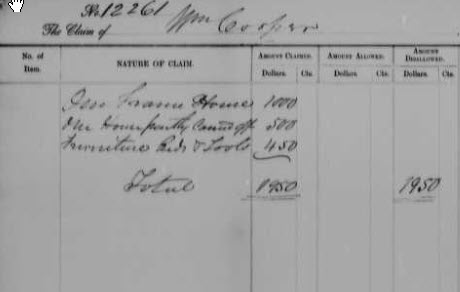
No. 12261
The Claim of Wm. Cooper of Chatham Co, in the State of Ga
Nature of Claim | Amount Claimed | Amount Allowed | Amount Disallowed |
One frame house | 1000 | ||
One house partly carried off | 500 | ||
Furniture beds & Tools | 450 | ||
Total | 1950 | 1950 |
Remarks
Slave during the War, and a ship carpenter by trade – He professes to have been loyal.
The witnesses are Claimant his son and a free colored woman. There is no reliable proof of ownership of the property claimed – It would seem that the soldiers [word] off part of the materials of the building, as well as furniture etc on their shoulders. If the property actually belonged to claimant of which there is not satisfactory evidence, the taking appears to have been attributable to mere depredation and plunder.
One witness whose deposition was taken by Mr. Richmond says that claimant was disloyal and the claim a fraud. We reject it for lack of proof of satisfactory ownership, and of the taking of the property as supplies for the Army.
A.O. Adkins
J.B. Howell
O. Ferriss } Commrs of Claims