
Scroll down to see the full transcript.
About the Southern Claims Commission
The Southern Claims Commmission was set up by Congress in 1871 to adjudicate claims for property taken by U.S. federal troops during the Civil War. More than 140 Liberty County residents — both black and white — filed claims, mostly for property taken during December 1864 when a unit of Sherman’s Army commanded by General Kilpatrick camped at Midway Church and conducted foraging raids throughout Liberty County. Horses, cows, hogs, poultry, corn and rice were the most common items of property taken. In Liberty County, many slaveowners allowed their enslaved people to work on their own time and own small amounts of property, most of which was taken by the U.S. troops for use by the Army.
The claims files, which are held at the National Archives and Records Administration (NARA), have been digitized and are available at Ancestry.com or Fold3.com. For more information on these files, click here. A set of standard questions were used to take the testimony of claimants and witnesses. This set of questions was amended twice, in 1872 and 1874. The questions are not usually part of the digitized file, but we have included them to help make sense of the answers. The questions we used were provided online courtesy of the St. Louis County Library Special Collections, as taken from National Archives Microfilm Publication M87, Roll 1, Frames 104–105, Records of the Commissioners of Claims (Southern Claims Commission, 1871-1880), and can be found here.
About This Transcription
What you are seeing: The Southern Claims Commission files for each claimant included all forms filed for the claimant, including cover pages, standard forms with filled in information, a special agent’s report about the claim, remarks made by the Special Commissioner summarizing the case, testimony from the claimant and his or her witnesses based on a standard set of questions, and copies of other paperwork involved. Much of the information contained in the forms is repetitive. We have summarized that information into one block, and transcribed all testimony, the Special Commissioner’s remarks, the special agent’s report, and any other relevant text.
Methodology: The testimony of the claimant and the witnesses has been transcribed exactly as seen. Some of the files are faded and/or difficult to read. Any words that cannot be read are indicated by “[word]”, or, in the case of entire sections, “[section illegible]”. Alternative spellings of names are also indicated with brackets.
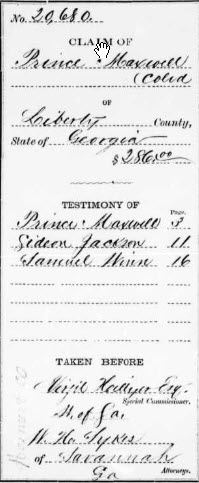
The Claim: Summary & Transcription
Find the digitized original of this claim file at this Ancestry.com link.
Summary
SCC Allowed Claim Liberty County – Prince Maxwell
Claimant’s Name (Last Name, First Name): Maxwell, Prince
Listed as “Colored”? (Y/N): Y
Amount of Claim: $286
Total Amount Allowed: $160
Nature of Claim: Stores for Genrl Sherman’s Army
Residence of Claimant: New Port Liberty County
Incident occurred in: Stone Hill, near Walthourville, Liberty County
Claim #: 20680
Secondary Claim #: 43602
Date Claim Submitted [YYYY-MM-DD]: 1873-06-03
Date Testimony taken [YYYY-MM-DD]: 1873-07-24
Claimant’s Attorney: W.H. Sykes; J.M. Simms [name crossed out]; Gilmore & Co successor of Hosmer & Co, Washington, D.C.
Property Removed to: Camp of the Army
Date property removed: 1864-12-15 to 1864-12-21
Army unit involved: Sherman’s Army under command of General Kilpatrick
Date Submitted to Congress [YYYY-MM-DD]: 1876-12-04
Post Office of Claimant: #3 A & G Rail Road [Atlantic & Gulf Railroad]
Witnesses to be Called: |
Ely Quarterman [did not testify] |
Mingo Maxwell [did not testify] |
Gideon Jackson |
Samuel Winn |
Transcription
Items Claimed
Item # | Description | Amt Claimed | Amt Allowed | Amt Disallowed |
1 | 1 sorrel mare & colt | 120 | 70 | 50 |
2 | 7 hogs | 70 | 40 | 30 |
3 | 30 chickens | 7.50 | 0 | 7.50 |
4 | 2 cows & 1 calf | 45 | 30 | 15 |
5 | 20 bushels of rice | 20 | 10 | 10 |
6 | 10 bushels of corn | 10 | 10 | 0 |
7 | bedding | 6 | 0 | 6 |
8 | 5 hives of honey | 7.50 | 0 | 7.50 |
TOTALS | 286 | 160 | 126 |
Remarks: The clmt was the slave of Thos. [Thomas] Quarterman. He tells the usual story of being allowed some time to work for himself & to earn & own property. Had owned the old mare 10 or 12 years – the colt was young. Three witnesses colored testify to his ownership of the property & to the taking of it from comant’s house on the plant’n.
The mare was old – colt not for army use – allow for horse $70 – 5 hogs – we allow in all $160.00.
A.O. Aldis
O. Ferris
J.B. Howell } Commrs of Claims
Testimony of Claimant
In answer to the First General Interrogatory, the Deponent says:
My name is Prince Maxwell, my age 62 years, my residence North New Port [Newport] Liberty Co, in the state of Georgia, and my occupation a farmer; I am the claimant and have a beneficial interest in the claim.
Interrogatories by Special Commissioner
1. What is your name, age, residence, and occupation?
My name is Prince Maxwell. I was born in Liberty County Ga a slave & remained so till the Union army passed through. I am 62 years of age. I reside at North New Port Liberty Co Georgia. I am a farmer. I am the claimant.
2. Where did you reside from the 1st of April, 1861, to the 1st of June, 1865? If on your own land, what is the size of your farm? How much of your farm was cultivated, and how much was woodland? Where is it situated? What was your occupation during that time? Did you change your residence or business during that time? if so, where was your new residence, and what [was] your new business?
I resided from the 1st of April 1861 to the 1st of June 1865 on Thomas Quarterman plantation I was farming and working for my master all the time and for a year after the Yankees came into the county. I did not change my residence or business during that time.
3. Did you ever pass beyond the military or naval lines of the United States and enter the rebel lines? If so, how often, when, where, and for what purpose, and how long did you stay within the Confederate lines on each occasion?
Irrelevant.
4. Did you ever take any oath or affirmation to bear allegiance to the so-called Confederate States, or to aid or support them in any way, or to “bear true faith,” or “yield obedience” to them? If so, when and where? State fully in regard to the same.
Irrelevant.
5. Have you ever taken any amnesty oath? If so, when, where, and under what condition? Have you been pardoned by the President? If so, when and where, and upon what condition?
The only oath I took was when I registered for voting & in Riceboro I think it was in 1867.
6 to 28 inclusive to each and every claimant answers “No”
29. Did you ever do anything for the United States Government or its army, or for the Union cause, during the war? If so, state fully what you did.
The only opportunity I had to do anything was after the Yankees came into the county. I then fed them with baskets full of provisions, the poor creatures were almost starved – and many of them almost naked – I “felt bad” for the men who had suffered so much for us – I was willing to do all I could to make them comfortable.
30 to 39 inclusive having been read over to claimant to each and every question he answers “no”.
40. At the beginning of the rebellion did you sympathize with the Union cause, or with the rebellion? What were your feelings and what your language on the subject? On which side did you exert your influence and cast your vote? What did you do, and how did you vote? How did you vote on ratifying the ordinance of secession? After the ordinance of secession was adopted in your State did you adhere to the Union cause, or did you “go with the State?”
When I heard the war was going on I rejoiced in my heart at the prospect of freedom. I felt it was too good to come here. I was on the side of the Union all the time till freedom came.
41. [Original Question 34.] In conclusion, do you solemnly declare that, from the beginning of hostilities against the United States to the end thereof, your sympathies were constantly with the cause of the United States; that you never, of your own free will and accord, did anything, or offered, or sought, or attempted to do anything, by word or deed, to injure said cause or retard its success, and that you were at all times ready and willing, when called upon, or if called upon, to aid and assist the cause of the Union, or its supporters, so far as you means and power and the circumstances of the case permitted?
In conclusion I do solemnly declare that I was all the time on the Yankee side, and that I never did anything by word or deed to injure the cause of the Yankees or to retard their success and always glad to do anything I could to help them along. Slaves could not do much only to talk and pray among themselves. We were afraid to [word] out “loud” before white folks. They punished those who did very hard when they were caught. They had men watching all the time and we had to watch too to be safe.
43. Were you a slave or free at the beginning of the war? When did you become free? What was your business after you became free? How and when did you come to own the property named in your petition? How did you get the means to pay for it? Who was your former master? Are you now in his employment? Do you live on his land? Do you live on land purchased of him? Are you indebted to your former master for land or property, and how much? Has anybody any interest in this claim besides yourself? State fully all the facts in your answers to these questions.
At the beginning of the war I was a slave and all my life before. I got my freedom when the Yankees came to free us. After freedom I worked right on for my old master, he agreed to give me half but he did not give me a cent said I owed him and I left him. I got my living just the kind I had when a slave hardly as good & he counted that worth more than my labor I planted 12 acres of rice and two acres of corn & all I got was my rations. I told him at the end of the year I could not stand that & so I left him. I got the property specified in my petition by commencing with raising chickens. I sold chickens and bought pigs and raised hogs & sold them and kept on till I had money enough to buy a mare colt. Then I raised a colt from her. I was 6 or 7 years raising chickens & pigs before I could buy the colt. I had the mare I think about 9 years before the raid passed through. I raised the colt from her. I belonged to Thomas Quarterman he died during the war. I do not live on land that ever belonged to him, I do not owe him or the estate anything, the old man owed me for work and for meat hogs that he bought of me & never paid for them. I worked for my young master Quarterman after freedom he drew me when the estate was settled. He was not as good a master as my old master Thomas Quarterman. I am the only person interested in this claim it all belongs to me. I am not prosecuting it for anybody but my self.
2nd set of interrogatories by Special Commissioner:
1. Were you present when any of the articles of property specified in the claimant’s petition were taken?
I was present when they took this property from me.
2. Did you see any of them taken? If so, specify the articles you saw taken.
I saw the property taken.
3. Begin with the first article (Item No. —) which you have specified that you saw taken, and give a full account of all you saw and heard in connection with the taking of that article? [The special commissioner should require the witness to state all the circumstances; for it is only by a knowledge of all of them that the commissioners of claims can judge whether the taking was such a one as the Government is bound to pay for. The common phrase, “I saw the property taken by United States soldiers,” is not enough, for there was much lawless taking. The witness should be required to detail the facts as to each item, when the items were taken at different times; but if all, or more than one, were taken at the same time, that fact should appear, and then a repetition of the circumstances is needless. The special commissioner must be careful to elicit all the facts, as well those against as for the claim, especially as to those articles of property which were the special objects of pillage and theft, such as horses, mules, cattle, hogs, &c. Claimants must bear in mind that a neglect to observe these directions works to the prejudice of the claimant, and may defeat the claim.]
They asked me what have you got, & who lives here, & they said they wanted it & some went right to work taking the things.
4. Where were the articles taken? When were they taken? Give the day, month and year, if you can? By whom were they taken? Did you see more than one soldier engaged in the taking? How many soldiers were present? State the number as near as you can? How many helped take the property? How long were they engaged in taking the property?
This property was taken at my house on Stone Hill plantation Mr. Quarterman’s place just before Christmas, when the Union army came here. It was taken by Sherman’s Army, I call them all Sherman’s Army but they were horsemen. I hear about Kilpatrick’s army being 3 miles from me but he didn’t come here himself just the horsemen came. There were present I can’t tell how many they came in gangs 20 & 30 at a time. They came to my house back & forward 2 weeks but it didn’t take them long to take my property, not more than a week. Sometimes when they came they couldn’t catch them then & when they came again they would [word] some then & then kept coming in this way till they took it all.
5. Who were present other than soldiers when you saw them taken? Give the names of all you know?
There were present Eli Brown or Quarterman, Mingo Maxwell, Gideon Jackson & myself & family at the taking of the property.
6. Was any United States officer, either commissioned or non-commissioned, present at the taking? If so, state his name, rank, regiment, and the command to which he belonged. Did he order the property to be taken? Did he say anything about the taking?
There were officers there for when he told them to come they all had to jump on their horses. I don’t know his rank but when he said come they came & when he said go they went.
7. Describe how the property was taken, and give a full account of all you saw done, or heard said, upon the occasion of the taking.
They just gathered round the horses & one or two of them put the bridles on them & the young horse they ride & lead the mare & one of them led their own horse. They just shot the hogs down & I had just killed 3 & had the meat cut up on the table & they killed 2 more & put them on the horses & took one sow in the wagon & took them off so. They took the corn & the rice & fed it to the horses right there.
8. How was the property removed—by soldiers or in wagons, or in what manner? State fully as to each article taken and removed.
They moved this property away in wagons & on horses.
9. To what place was it removed? Did you follow it to such place, or see it, or any portion of it, at any such place, or on its way to such place? How do you know the place to which it was removed?
They took this property away from me I don’t know when, but I heard they took it down to Camp at Midway Church. I did not go to the camp while they were there. They told me to come down to the they & they would give me what I wanted, but my master had a house full of rice in the straw & he wanted me to go & watch it & beg the soldiers not to burn it & I begged them & they did not burn it, but took a little of it to feed their horses there. They said that the reason they took property from us & did not take his was because they wanted us to get from the white folks, & they would not hurt us but they would hurt the white folks.
10. Do you know the use for which the property was taken? What was the use, and how do you know it? Did you see the property so taken used by the United States army? Did you see any part of the property so used? State fully all you know as to the property or any of it having been used by the army; and distinguish between what you saw and know, and what you may have heard from others, or may think, or suppose, or infer to be true.
I think the soldiers took this property just so the rebels couldn’t come & take it from us because they said if they left it the rebels would come & take it from us. Their horses were much broken down some of them & they stood in need of fresh ones some of their horses were raw from the back to the tail.
11. Was any complaint made to any officer on account of such taking? If so, state the name, rank, and regiment of the officer. What did he say about it? State fully all that he said.
I made no complaint to anyone on account of the taking of the property.
12. Was any voucher or receipt for the property asked for? If so, of whom asked? State name, rank, and regiment. Was any receipt or paper given? If so, produce it, or state where it is, and why it is not produced. If no voucher or receipt was given, state why none was given, and if refused, why it was refused; state all that was said about it. State fully all the conversation between any officer or other person taking the property, and the claimant, or any one acting for him.
I did not ask for any voucher or receipt.
13. Was the property, or any of it, taken in the night-time? At what hour of the day (as near as you can tell) was it taken? Was any of the property taken secretly, or so that you did not know of it when taken?
This property was not taken in the night.
14. When the property was taken, was any part of the army encamped in that vicinity? If so, state how far from the place where the property was taken, and what was the company, regiment, or brigade there encamped? How long had it been encamped there? How long did it stay there, and when did it leave? Had there been any battle or skirmish near there, just before the property was taken? Did you know the quartermasters, or any of them, or any other officers of the army for whose use the property is supposed to have been taken?
The army were encamped at Midway Church about 12 miles from claimant’s house. They called the Army by two names Sherman’s Army & then again they said it was Kilpatrick’s Army. I couldn’t tell which one it was. I couldn’t tell how long they were there but I think a little over a month. I did not know the quartermasters nor any of the other officers.
15. Describe clearly the condition of the property when taken, and all that tends to show its value at the time and place of taking? Thus, if corn, was it green or ripe? Had it been harvested? Was it in the shock, or husked, or shelled? Where was it? If grain, was it standing; had it been cut; was it in shocks, or in the barn or in stacks; had it been threshed? If horses, mules, or cattle, state when they were taken, how taken, and fully their condition, age, and value. Have you talked with claimant about their value?
This property was in good order, very healthy critters, they was young critters.
16. What means have you of knowing the quantity taken? State particularly how you estimate the quantity? Did you count or weigh the articles? Give us all your data. How much did you see taken and removed? What quantity was taken in your presence? As to quantity, distinguish carefully as to what you saw and know, and what you may think or believe from what you have heard from others.
Item No 1: The mare I think was about 12 years old. I had her about 9 years & she was about 3 when I bought her. She was a medium sized mare & in good order because she was not working much I think the young horse was about 3 ½ years old I had begun to have him work. They rode one of these horses away & led the other. I bought the old mare when she was a colt not quite old enough to back & I raised the young horse from her. I bought this mare with my own money & raised the colt. I raised hogs & poultry to get the money to pay for the first mare.
Item No 2: I had I know 38 head of hogs I counted them before the raid came in. Some of them were so small that I would not put them in my account. I had 3 or 4 sows with pigs they didn’t trouble the little bits of pigs only the big ones & the year old shoats I had about 13 head of large hogs besides the year old shoats. Some of these were meat hogs, the barrows, [two words] 4 of them would weigh about 150 lbs a piece; 3 of these I had just killed & I weighed one of them to sell it weighed 143 lbs I think the other 6 would average about the same as the 7 as they were born at the same time. I had these hogs in the field & they just gathered them up & that gang would leave & another one would come & kill some. These hogs were all of my raising. I had been raising hogs about 10 years.
Item No 3: They took off 30 head of poultry I counted them not long before the army came there, just a day before. This poultry was all of my own & my wife’s raising.
Item No 4: I had 2 cows & 2 calves. The cows were old enough one of them to raise a yearling. I bought a young heifer in the first place & then raised from her. The cow I think was 5 years old & maybe a little more. She was a medium sized sow in pretty good order. I could not tell how much she would weigh. The cows were the small breed cows & each of them had a calf. They drove the 2 cows & the 2 calves away.
Item No 5: I had pretty near 40 bushels rough rice thrashed out & in the corn house. I measured it when I first put it in the corn house. They took half of it to feed the horses.
Item No 6: I did not measure the corn but there was over 10 bushels. It was in the corn crib. They fed it out to the critters right there.
Item No 7: I had 2 blankets new ones of wool & 3 quilts taken from me. Some of the soldiers wanted them to ride on. The weather was very cold in the morning the earth was white with frost.
Item No 8: They took 4 bee hives right smart of honey from the corn house. They broke up the hives & took out a piece or 2 of the comb & left the hives & I mailed them up again.
This property all belonged to me & my wife, my own private property belonged to me & wife. I never have received any pay on my part of this property. This is the first & only claim I have presented against the Government.
Witness: E.E. Adlington
Prince Maxwell [signed by mark]
Sworn to and subscribed before me
Virgil Hillyer
Special Commissioner
State of Georgia
Testimony of Witness (Gideon Jackson)
Interrogatories of Special Commissioner
My name is Gideon Jackson. I was born in Liberty Co Ga a slave, became free when the Army came in. My master was Gideon Dean. I am 5? years old about I live on Col. [name] plantation in Liberty Co. I am a farmer. I know the claimant. I am not related to him. I have no beneficial interest in his claim. He was a Union man out loud.
1. Were you present when any of the articles of property specified in the claimant’s petition were taken?
I was present there about his house off & on when this property was taken.
2. Did you see any of them taken? If so, specify the articles you saw taken.
I saw this property all taken.
3. Begin with the first article (Item No. —) which you have specified that you saw taken, and give a full account of all you saw and heard in connection with the taking of that article? [The special commissioner should require the witness to state all the circumstances; for it is only by a knowledge of all of them that the commissioners of claims can judge whether the taking was such a one as the Government is bound to pay for. The common phrase, “I saw the property taken by United States soldiers,” is not enough, for there was much lawless taking. The witness should be required to detail the facts as to each item, when the items were taken at different times; but if all, or more than one, were taken at the same time, that fact should appear, and then a repetition of the circumstances is needless. The special commissioner must be careful to elicit all the facts, as well those against as for the claim, especially as to those articles of property which were the special objects of pillage and theft, such as horses, mules, cattle, hogs, &c. Claimants must bear in mind that a neglect to observe these directions works to the prejudice of the claimant, and may defeat the claim.]
They said nothing more than they had got to live as they went through the country & went on & took the property.
4. Where were the articles taken? When were they taken? Give the day, month and year, if you can? By whom were they taken? Did you see more than one soldier engaged in the taking? How many soldiers were present? State the number as near as you can? How many helped take the property? How long were they engaged in taking the property?
This property was taken at claimant’s house on Quarterman’s land. It was taken in the fall of the year near Christmas for [we] were done harvesting. This property was taken by the cavalry company. I don’t know the name of it. They took this property more or less every day till they took it all away.
5. Who were present other than soldiers when you saw them taken? Give the names of all you know?
The claimant & his wife & children were present there at the taking of the property also myself & my family.
6. Was any United States officer, either commissioned or non-commissioned, present at the taking? If so, state his name, rank, regiment, and the command to which he belonged. Did he order the property to be taken? Did he say anything about the taking?
There were officers there present at the taking of the property. There were 2 capts and 2 majors slept there at my house. The officers ordered the property to be taken & they had the government wagons there & loaded them up with corn & potatoes & such things.
7. Describe how the property was taken, and give a full account of all you saw done, or heard said, upon the occasion of the taking.
They brideled [SIC, bridled] & saddled the youngest horse the oldest horse they led. They killed the hogs & carried them off & left the heads. They drove the cows & calves. They fed the rice right there to the horses & the corn they fed some of it & carried off some of it in sacs. They took 2 or 3 quilts for their use & supplies. They put them right on the saddle.
8. How was the property removed—by soldiers or in wagons, or in what manner? State fully as to each article taken and removed.
They drove the cattle off & fed some [couple of words too faded to be read] & rice & killed the hogs & took them off on the horses.
9. To what place was it removed? Did you follow it to such place, or see it, or any portion of it, at any such place, or on its way to such place? How do you know the place to which it was removed?
They took this property to their camps. I did not go to camp, but they made men on the place go with them & help carry it, & that is the way I know they took it to camp.
10. Do you know the use for which the property was taken? What was the use, and how do you know it? Did you see the property so taken used by the United States army? Did you see any part of the property so used? State fully all you know as to the property or any of it having been used by the army; and distinguish between what you saw and know, and what you may have heard from others, or may think, or suppose, or infer to be true.
They took this property to feed & to eat. [?I saw?] them just bridle the horses & take them over to the officers. I saw them use some of that property right there at the house.
11. Was any complaint made to any officer on account of such taking? If so, state the name, rank, and regiment of the officer. What did he say about it? State fully all that he said.
I did not hear the claimant make any complaint.
12. Was any voucher or receipt for the property asked for? If so, of whom asked? State name, rank, and regiment. Was any receipt or paper given? If so, produce it, or state where it is, and why it is not produced. If no voucher or receipt was given, state why none was given, and if refused, why it was refused; state all that was said about it. State fully all the conversation between any officer or other person taking the property, and the claimant, or any one acting for him.
I did not hear him ask for any receipt or voucher of any of the officers.
13. Was the property, or any of it, taken in the night-time? At what hour of the day (as near as you can tell) was it taken? Was any of the property taken secretly, or so that you did not know of it when taken?
This property was taken in the daytime between 10 or 11 oclock. They went into camp at night & foraged in the day. They did not take any of it secretly no secret about the matter they came bold – [word] bold.
14. When the property was taken, was any part of the army encamped in that vicinity? If so, state how far from the place where the property was taken, and what was the company, regiment, or brigade there encamped? How long had it been encamped there? How long did it stay there, and when did it leave? Had there been any battle or skirmish near there, just before the property was taken? Did you know the quartermasters, or any of them, or any other officers of the army for whose use the property is supposed to have been taken?
The Army was encamped at Midway Church & at Jonesville about 12 miles to the claimant’s house from Midway & about 4 from Jonesville. They had no particular camp at Jonesville only the troops came through from the Altamaha & staid there 2 days. Gen Sherman’s brigade & Gen Kilpatrick’s came through Liberty Co & it was the horse company [?destroy?] us. They staid at Midway some 3 weeks & at Jonesville only so long as the columns could rest then after 2 days they went on to the Ogeechee ferry. There had been no battles any nearer than Fort McAllister they had a little scrimmage at the Altamaha but they all retreated the Southern army. I did not know any of the quartermasters or other officers.
15. Describe clearly the condition of the property when taken, and all that tends to show its value at the time and place of taking? Thus, if corn, was it green or ripe? Had it been harvested? Was it in the shock, or husked, or shelled? Where was it? If grain, was it standing; had it been cut; was it in shocks, or in the barn or in stacks; had it been threshed? If horses, mules, or cattle, state when they were taken, how taken, and fully their condition, age, and value. Have you talked with claimant about their value?
[No answers recorded]
16. What means have you of knowing the quantity taken? State particularly how you estimate the quantity? Did you count or weigh the articles? Give us all your data. How much did you see taken and removed? What quantity was taken in your presence? As to quantity, distinguish carefully as to what you saw and know, and what you may think or believe from what you have heard from others.
Item No 1: He had 2 horses. The old mare I think might be 9 or 10 I could not tell he bought her when she was a little on the down hill but not too much for good use with good feed, she was in good flesh. The young horse was one he raised from the mare, he was about 5 or 6 years old. He was a very fine horse, a sound good horse, a good colored man’s horse, a pony horse, a good bodied animal for colored people, that is all the kind they were allowed to own in those days. He was of medium size. They rode one of these horses away & led the other.
Item No 2: He had 4 meat hogs already killed & salted & some 20 or 25 running at large & they were in good flesh for it was just harvest time. Maybe some of them would go a 100 lbs & some 80 up to that. All those running out in the potato patch were fat. 10 or 12 of them were little pigs & the others good shoats a year old. Some of them might weigh 25 lbs & a good fat one might go 30. I have been weighing hogs since I was 18 years old & am now 52. I consider myself a judge of the weight of hogs. They ate up the little ?roasters? just where they happened to be, and the others they took off to the ?tents?. The claimant had been there on that place some 6 or 7 years & had been raising hogs all that time. He was allowed to do so by his master.
Item No 3: He had a fine chance of fowls. I couldn’t tell how many but they took all he did have. They tied the fowls all they did not eat to the horses & carried them off to camp.
Item No 4: He had 2 cows & 2 calves. The young cow was a fine cow & had her first calf. She might weigh 45 to 50 lbs to the quarter & the old cow would not have weighed any more than the young cow. The calves were not a year old about 8 or 9 months old. They drove the cows & calves off.
Item No 5: He had not over 12 or 15 bus[hels] of rough rice. It was in a bin in his house. I saw them feed it there, they did not take any of it away.
Item No 6: He had not over 10 bus[hels] if it were shucked, and it was in the ear. They fed some of this corn there & took some of it away in sacks.
Item No 7: They didn’t take any more than 3 quilts. That was all the bedding I saw taken. They carried them on their horses.
Item No 8: He had 4 hives of honey. They broke the hives open took out the honey & put it in their canteens & in kettles & ate some right there. I saw none of this property wasted. This property all belonged to Mr. Maxwell & his wife. I knew because I knew him when he came there & brought his stock with him. His master settled him there to have him out of his way with his hogs & his horses. I never heard any one else claim the property of claimant.
Witness: E.E. Adlington
[signed by] Gideon Jackson [signed by mark]
Sworn to and subscribed before me
Virgil Hillyer
Special Commissioner
State of Georgia
Testimony of Witness (Samuel Winn)
Interrogatories by Special Commissioner
My name is Samuel Winn. I was born in Liberty Co Ga a slave, became free when Gen. Sherman’s Army came through here. My master was Gideon Deane. I am about 35 I think. I live at John LeCounte’s place Liberty Co Ga. I am a farmer. I know the claimant Prince Maxwell. I am not related to him. I have no beneficial interest in his claim. I have known him ever since I was a little boy. He was a good Union man during the war.
2nd set of interrogatories by Special Commissioner
1. Were you present when any of the articles of property specified in the claimant’s petition were taken?
I was present when this property was taken from here by the soldiers.
2. Did you see any of them taken? If so, specify the articles you saw taken.
I saw it all taken.
3. Begin with the first article (Item No. —) which you have specified that you saw taken, and give a full account of all you saw and heard in connection with the taking of that article? [The special commissioner should require the witness to state all the circumstances; for it is only by a knowledge of all of them that the commissioners of claims can judge whether the taking was such a one as the Government is bound to pay for. The common phrase, “I saw the property taken by United States soldiers,” is not enough, for there was much lawless taking. The witness should be required to detail the facts as to each item, when the items were taken at different times; but if all, or more than one, were taken at the same time, that fact should appear, and then a repetition of the circumstances is needless. The special commissioner must be careful to elicit all the facts, as well those against as for the claim, especially as to those articles of property which were the special objects of pillage and theft, such as horses, mules, cattle, hogs, &c. Claimants must bear in mind that a neglect to observe these directions works to the prejudice of the claimant, and may defeat the claim.]
They said that they were foraging & went to work & took all they saw.
4. Where were the articles taken? When were they taken? Give the day, month and year, if you can? By whom were they taken? Did you see more than one soldier engaged in the taking? How many soldiers were present? State the number as near as you can? How many helped take the property? How long were they engaged in taking the property?
This property was taken at claimant’s house on Quarterman’s plantation, in the time of the raid near Christmas. Don’t remember the year. The United States soldiers of Kilpatrick’s Army took this property. I did not count them they came in gangs. They were about a week off & on taking it. They took a little every time from everyone till they got it all.
5. Who were present other than soldiers when you saw them taken? Give the names of all you know?
Gideon Jackson, Eli Quarterman, Mingo Maxwell & myself & claimant were there at the taking of this property.
6. Was any United States officer, either commissioned or non-commissioned, present at the taking? If so, state his name, rank, regiment, and the command to which he belonged. Did he order the property to be taken? Did he say anything about the taking?
There were lieutenants & sergeants there. I didn’t know their company or their regiment I only knew they belonged to Kilpatrick’s army. These officers ordered the men to take this property. They said they were sent to take everything they saw & [word] up everything.
7. Describe how the property was taken, and give a full account of all you saw done, or heard said, upon the occasion of the taking.
They rode one of the horses & led the other. I don’t remember which. They were there at claimant’s house. The hogs were in the pen & some out. They shot the hogs & cut off their heads & took them away. They caught the poultry & put them on the horses. They drove off the cows & calves from the field. The rice & corn they took in foraging, feeding their horses when they stopped & taking a part of it every time they came till they got it all. They took the bedding out of the house. They took a jug of honey & they took the bee gums & just broke them open & took what they could get & left the hives.
8. How was the property removed—by soldiers or in wagons, or in what manner? State fully as to each article taken and removed.
They removed this property from claimant’s house in wagons & on horses & some they drove off.
9. To what place was it removed? Did you follow it to such place, or see it, or any portion of it, at any such place, or on its way to such place? How do you know the place to which it was removed?
They removed this to camp. I saw them go to the camp. I didn’t go exactly with them I went to the camp but not with them.
10. Do you know the use for which the property was taken? What was the use, and how do you know it? Did you see the property so taken used by the United States army? Did you see any part of the property so used? State fully all you know as to the property or any of it having been used by the army; and distinguish between what you saw and know, and what you may have heard from others, or may think, or suppose, or infer to be true.
They took this property for foraging; for the use of the soldiers they told us. I saw them use the provisions.
11. Was any complaint made to any officer on account of such taking? If so, state the name, rank, and regiment of the officer. What did he say about it? State fully all that he said.
I did not hear claimant make any complaint to the soldiers or officers on account of the taking of the property.
12. Was any voucher or receipt for the property asked for? If so, of whom asked? State name, rank, and regiment. Was any receipt or paper given? If so, produce it, or state where it is, and why it is not produced. If no voucher or receipt was given, state why none was given, and if refused, why it was refused; state all that was said about it. State fully all the conversation between any officer or other person taking the property, and the claimant, or any one acting for him.
I did not hear him ask for a voucher or receipt for the property.
13. Was the property, or any of it, taken in the night-time? At what hour of the day (as near as you can tell) was it taken? Was any of the property taken secretly, or so that you did not know of it when taken?
This property was all taken in the day time, all times of day from morning till night.
14. When the property was taken, was any part of the army encamped in that vicinity? If so, state how far from the place where the property was taken, and what was the company, regiment, or brigade there encamped? How long had it been encamped there? How long did it stay there, and when did it leave? Had there been any battle or skirmish near there, just before the property was taken? Did you know the quartermasters, or any of them, or any other officers of the army for whose use the property is supposed to have been taken?
The army were encamped when this property was taken at Midway Church, about 4 or 5 miles from claimant’s house. They came up to claimant’s almost immediately after they got into camp. I think they staid there 2 weeks, I can’t tell how long they staid there. The soldiers went out foraging every day & brought in stock & provisions to camp. There had been a skirmish at Fort McAllister I was up on the railroad yonder just before they took this property. I could hear the guns. I did not know any of the quartermasters or any of the other officers of the Army.
15. Describe clearly the condition of the property when taken, and all that tends to show its value at the time and place of taking? Thus, if corn, was it green or ripe? Had it been harvested? Was it in the shock, or husked, or shelled? Where was it? If grain, was it standing; had it been cut; was it in shocks, or in the barn or in stacks; had it been threshed? If horses, mules, or cattle, state when they were taken, how taken, and fully their condition, age, and value. Have you talked with claimant about their value?
This property was in good condition when taken.
16. What means have you of knowing the quantity taken? State particularly how you estimate the quantity? Did you count or weigh the articles? Give us all your data. How much did you see taken and removed? What quantity was taken in your presence? As to quantity, distinguish carefully as to what you saw and know, and what you may think or believe from what you have heard from others.
Item No 1: This mare he had a long time 5 or 6 years before the raid. The colt was 3 years old. This mare I think was the mother of the colt. They led one & rode one. The colt was broken.
Item No 2: He had in all 30 head of hogs. He had 7 meat hogs. They would run, these piney woods hogs, from 80 to 100 lbs. They were fat. They took them away on the horse & in the wagons. I mean, the 7 head. The others they killed & carried off too but not all in one day.
Item No 3: A big lot of poultry but I don’t know how many head he had. They caught & tied them strung them on to the horses & went off with them.
Item No 4: He had 4 head of cattle. I count 2 calves. The cows had calves I don’t know how old they were. They were these common Georgia cows not very large would weigh from 50 to 60 lbs to the quarter. They cows were in good order. The calves were 6 or 8 months old. I can’t tell how much they would weigh, they don’t often kill calves in this part of the country. I think they would weigh 100 lbs. They drove these cows & calves away.
Item No 5: He had about 15 bus[hels] of rice I saw it measured they they first put it away. I judge from the pile there was about 15 bus[hels]. They took this rice in sacks & bags & took it on their horses.
Item No 6: He had 5 bus[hels] of corn in the ear. There was 10 bus[hels] of ears would make 5 bus shelled. I saw him measure it when he broke it in from the field. They carried it away & some of it they fed there.
Item No 7: They took 4 quilts & blankets together from him I am certain. They took everything he had in the house.
Item No 8: He had 5 hives of honey. They broke open the hives & took the honey out & carried off what they didn’t eat.
This property all belonged to the claimant. I saw it all taken away by the Union soldiers. He had it all the time & that’s the way I know it belonged to him. He got his property at first by raising poultry & kept on till he was able to buy a horse. He had been raising 20 or 30 years. The claimant worked task work. It was in this way he got his start by working task work & gaining time for himself. I never heard his master claim his horse or any of the other property.
Witness: E.E. Adlington
[signed by] Samuel Winn [signed by mark]
Sworn to and subscribed before me
Virgil Hillyer
Special Commissioner
In the case of Prince Maxwell vs. United States } Before Special Commissioner Virgil Hillyer, Esqr, Riceboro, Liberty County, Georgia
We have no further testimony to offer in the above case and hereby submit the same for the consideration and decision of the Hon. Commissioners.
W.H. Sykes
Claimant Counsel
———————
Requisition #3816 dated April 9, transmitted for warrant April 14, 1877 for $160 due Prince Maxwell.
———————-
Draft payable to the claimant Prince Maxwell for $160, dated in 1877
———————-
Copy of postcard sent to Charles T. Benjamin [clerk of the Southern Claims Commission Commissioners], dated February 14, 1877, from McIntosh, Liberty County, Georgia, signed Prince Maxwell.
“Dear Sir, Yours of the 6th Dec 1876 informing me that the sum of $160 has been awarded on my claim is appended. I hope that I shall get it soon. Please make all communications to me through the Rev. F. Snelson of the above office named. Respectfully yours. The no. of my claim is 20680.