
Daniel Bryant, a Liberty County freedman, sued the U.S. government in the 1870s for a mare and food taken from him by Sherman’s Army on their March to the Sea. The U.S. Southern Claims Commission was set up by Congress to compensate loyal Southerners for such items taken by the soldier. The Commission was not expecting freedpeople to make claims because they did not think they could own property. In coastal Georgia, though, enslaved people generally worked by the task system. Once they completed their task for the day, they could use their time to raise stock or grow food for themselves, which benefited the slaveowner by tying them to the land, reducing the number of runaways, among other benefits.
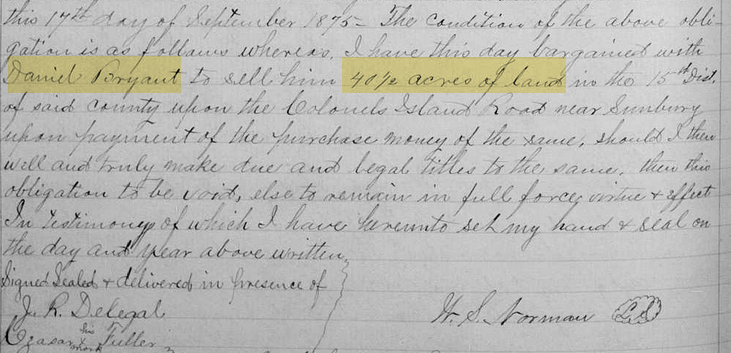
Daniel Bryant, in his mid-50s at Emancipation, received $190 for his mare and the food, after testimony by fellow freedmen Smart Chip and Moses Stevens, who were there on the Screven plantation when the soldiers came. For so many Liberty County freedpeople, buying land was their dream and it was no different for Mr. Bryant. He went from sharecropping 12 acres on his former master, Capt. Benjamin S. Screven’s land to purchasing 40 acres from William S. Norman in 1875. At Bryant’s death in the late 1870s, his wife Hagar and sons John and Spencer not only inherited the land but sued Norman’s estate because Norman had not made legal title to the land as he had promised. They won their suit.
Spencer Bryant ran into trouble in 1877 and fell into the convict leasing system. He was convicted of simple larceny for allegedly stealing a hog and received a 4-year sentence. The convict lease system was introduced after the Civil War. Georgia “leased” prisoners for companies as cheap labor for their own uses, with few or no controls over how they were treated. Research has shown abuse was common.
Why mention the Screven family in the title of this blog post? Because tracing the Screven family is the only way to find out more about Daniel Bryant’s life before Emancipation. Benjamin Screven died in 1871. He had inherited Daniel, Smart, and Moses from his father, Rev. Charles Odingsell Screven, a Baptist minister who died in 1830. Rev. Screven left a will in which he divided Retreat Plantation between his sons Benjamin and James Odingsell Screven. He left Erin Plantation, near Midway Church, to his wife Barbara. He divided his enslaved people among his children and wife. Daniel, Smart, and Moses stayed with the estate until 1844, when the estate was divided and they went to Joseph Maxwell, who was acting as guardian for Benjamin.
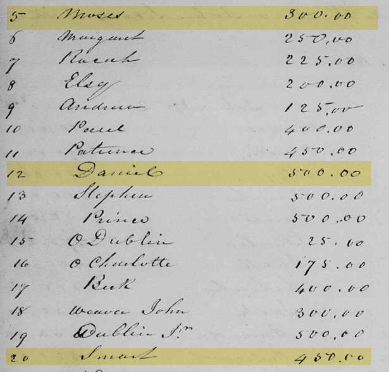
In 1846, Daniel, Moses, and Smart were attending the Sunbury Baptist Church as enslaved men. How do we know that? Rev. Charles Colcock Jones made a census that year of all the enslaved church members in Liberty County.
What about Daniel Bryant’s parents? It is very likely that his mother, at least, is named in the 1830 estate inventory performed after Rev. Screven’s death. His family origins probably reach back into South Carolina, as the Screven family came to Georgia from there.
How did Daniel Bryant come to use the Bryant surname? This is a mystery, since it appears that he was held in slavery by the Screven family since birth and no one named Bryant was found to have married into that family. There was a white man named John D. Bryant in Liberty County at the time of Emancipation but no connection was found.
It is interesting to note that Daniel, Moses and Smart each used different surnames after Emancipation (and possibly before). In fact, no freedpeople were found using the surname Screven in Liberty County in the 1870 census.
For more details about Daniel Bryant’s life, please see https://theyhadnames.net/2025/11/29/daniel-bryant/. You can find a transcript of his Southern Claims Commission petition and a link to the original at: https://theyhadnames.net/2025/11/29/daniel-bryant-southern-claims-commission/.