
Born into slavery in Liberty County, Georgia, around 1810, Daniel Bryant did not become free until his 50s, but still was able to amass 40 acres of land before his death in the late 1870s.
U.S. Southern Claims Commission Petition
Bryant also successfully sued the U.S. Government under the U.S. Southern Claims Commission program and was awarded $190 in the 1870s for a bay mare, corn and potatoes taken from him by Sherman’s Army when they came foraging in Liberty County after arriving at the Georgia coast on their March to the Sea.[1]
Daniel Bryant was owned during slavery by the Screven family. Many coastal Georgia enslaved people worked under the task system, in which they had an assigned amount of work to complete during the day and then could raise stock and farm for themselves afterward. This system benefited the slaveowners as well by tying the people to the land, making them less likely to run away, and reducing the amount of food the slaveowner needed to provide them. This system is how Daniel came to own the property he was compensated for.
The U.S. SCC Commissioners learned that Bryant had owned the mare for four years, since it was a colt. Two other formerly enslaved men, Moses Stevens and Smart Chip, acted as witnesses for him. They were both there on the Screven plantation when the soldiers took Bryant’s belongings. They and Daniel Bryant also served as witnesses for another formerly enslaved man, Moses Stewart, in his claim against the government.[2]
Bryant testified in 1874 that he was still living on his former master’s land. It appears that he started by sharecropping, renting 12 acres to start with. Smart and Margaret Chip lived nearby, doing the same thing.[3] Bryant’s wife Hagar and his sons John and Spencer lived in the 181st subdivision.[4]
Purchase of Land
In 1875, however, Daniel Bryant purchased 40.5 acres of land in Liberty County’s 15th District fronting on the Colonels Island Road near Sunbury from William S. Norman. He agreed to pay Norman $120.50 over time and that Norman would hand over title to the land once it was paid off.[5]
Spencer Bryant Convicted and Falls Into the Convict Leasing System
Spencer Bryant ran into a problem in 1877.[6] He and his wife Emma testified that they had gone fishing at Carr’s Neck and on their way home saw some plum trees. They knocked down some plums with a stick to take them home, when some hogs ran in to eat the plums. They drove them off.
James Monroe, owner of the hogs, testified otherwise. He said that he had heard a hog squealing and when he went in that direction, he saw the Bryants near the plum trees. He followed a trail of blood to their house and found the hog there. William Crawford corroborated his territory. Both the Bryants were jailed pending trial.
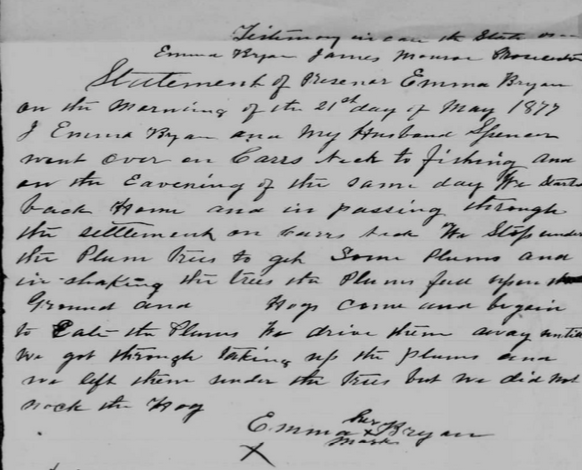
Spencer Bryant was convicted of simple larceny and sentenced to 4 years in prison.[7] He became part of the convict leasing system in Georgia’s post Reconstruction era. He was hired out to the T.J. Smith company. Many scholars consider the convict leasing system to have been slavery in all but name.[8]
Emma Bryant was not convicted because the witnesses did not testify that she was complicit. In 1880, she was continuing to live in Liberty County, with her daughter Hagar (7 years old), John (5) and Spencer (5) (twins?), Abram (2), and a daughter named Rosa Moss (9).[9] Re-using family names was clearly important in this family, as in many families.
Daniel Bryant Dies – Family Sues for Land Titles
Daniel Bryant died between 1875 and 1880. In 1880, Hagar Bryant was living by herself as a widow in Liberty County.[10]
Spencer Bryant appears to have served his sentence and returned to Liberty County. In 1885, Hagar, John and Spencer, as Daniel Bryant’s heirs, sued William S. Norman’s estate administrator, Newton J. Norman, because WIlliam S. Norman, who was said to have died on August 15, 1878, had never made over title to the land, even though Daniel Bryant had paid off the mortgage.[11] On January 17, 1885, Liberty County Ordinary Joseph Ashmore ordered that Newton J. Norman make the necessary title.
In 1885, Hagar, Spencer, and John also sold 2.5 acres of the land to Ezra Coe of Bristol County for $20.[12] The land was described as being in the 1359th District of Liberty County, bounded by land belonging to Daniel Bryant’s estate on the north, on the west and south by land belonging to Ezra Coe, and on the east by land belonging to Ned Winn and Ezra Coe. A month later, Ned Winn sold Ezra Coe ¼ acre of his land in that same area.
Daniel Bryant and Slavery Under the Screven Family
Knowing that Daniel Bryant had belonged to the Screven family allows us to trace him further back into time. His owner at the time of the Civil War was Captain Benjamin S. Screven, who served in the Confederate Army. Screven was born in June 1826 in Sunbury, Liberty County, and died in 1871 in Athens, Georgia. His father, Rev. Charles Odingsell Screven, was born in South Carolina in 1744, and was the son of General James Screven, who was killed in 1777 during a battle with British forces near the Midway Church.[13] Screven County, Georgia, was named for him.
Charles O. Screven was educated at Brown University and became a Baptist minister, with his first posting being at Sunbury. He died in 1830.
Rev. Screven’s 1830 will gave his son Benjamin one half of the Retreat Plantation and the other half to his son James Odingsell Screven.[14] He gave his wife Barbara the Erin plantation near Midway Church. His property named Seabrook, located near Sunbury, was to be divided between his children Ann Elizabeth Screven, William Edward Screven and any child he wife might have within 9 months of his death.
He named only a few of his enslaved people in his will: to James Odingsell Screven, Sally, Hetty, Cyrus, Juno, and Sophy; to wife Barbara Screven, Venus “who waits on her.” The rest were to be divided among his children.
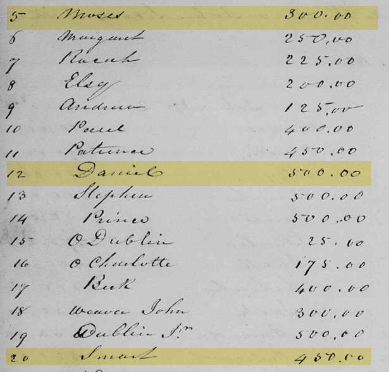
His estate was inventoried immediately, naming 121 souls. Individuals named Daniel, Smart, and Moses were listed in the inventory.[15] In 1838, the estate was inventoried again and part of the enslaved people were divided out. Smart, Daniel and Moses were again named but not divided out so presumably stayed where they were.[16]
In 1844, the final inventory and division took place. Daniel, Smart, and Moses all fell into the lot drawn by Joseph Maxwell, guardian for Benjamin S. Screven, who was still a minor.[17]
In 1846, Daniel Bryant was attending the Sunbury Baptist Church, along with Smart Chip and others from Screven’s plantation.[18]
In 1849, Benjamin Screven used Daniel as collateral on a promissory note to his mother, Barbara,[19] and in 1853, as collateral on a promissory note to the John Lambert estate.[20] In 1853, Daniel was said to be about 36 years old.
Because Benjamin Screven survived the Civil War and did not die until 1871, there were no probate records that would have named people held in slavery by him at his death, but the SCC petitions by Daniel Bryant and by Moses Stewart indicate indicate that they were still living on his land at the time of their petitions, though Daniel later bought land from William S. Norman.
Surname Choice and Origins
Why did Daniel use the surname Bryant after Emancipation? This is not clear, given that he likely belonged to the Screven family since birth. There was a white man named John D. Bryant in Liberty County at Emancipation but no evidence was found that would suggest a connection. It is noteworthy however, Daniel, Smart, and Moses all chose different surnames, even though their connections with the Screvens go back until at least 1830. In fact, no freed people were found using the surname Screven in the 1870 U.S. federal census in Liberty County.
Where might Daniel Bryant’s parents have been from? The Screven family came to Georgia from South Carolina and maintained deep ties there It is likely that descendants of Daniel Bryant might find DNA matches among people whose ancestors were in South Carolina.
-
“U.S. Southern Claims Commission, Allowed Claims, 1871-1880,” Liberty County, Georgia, case file of Daniel Bryant, claim no. 18114; indexed database, Ancestry (https://www.ancestry.com/imageviewer/collections/1217/images/RHUSA1871A_118421__0029-01101 : accessed 29 Nov 2025), image 338 and following. Transcription at: https://theyhadnames.net/2025/11/29/daniel-bryant-southern-claims-commission/. ↑
-
“U.S. Southern Claims Commission, Disallowed and Barred Claims, 1871-1880,” Liberty County, Georgia, case file of Moses Stewart, claim no. 18547; indexed database, Ancestry (https://www.ancestry.com/search/collections/1218/records/135736 : accessed 29 Nov 2025), image 11201 and following. Transcription at: https://theyhadnames.net/2025/11/30/moses-stewart-southern-claims-commission/. ↑
-
1870 U.S. census, Liberty County, Georgia, agriculture schedule, Subdivision 181, page 7, line no. 35, entry for Daniel Bryant; digital images, Ancestry (https://www.ancestry.com/search/collections/1276/records/5336224 : accessed 29 Nov 2025). ↑
-
1870 U.S. census, Liberty County, Georgia, population schedule, Subdivision 181, page 25, dwelling 237, family 236, enumerated on November 18, 1870, by W.S. Norman, entry for Daniel and Hagar Bryant household; digital image 25 of 56, Ancestry (https://www.ancestry.com/imageviewer/collections/7163/images/4263491_00460 : accessed 29 Nov 2025). ↑
-
“Georgia Probate Records, 1742-1990” > Liberty County > “Miscellaneous Probate Records 1878-1891 Vol R,” pp 524-5; digital images, FamilySearch.org (https://www.familysearch.org/ark:/61903/3:1:3QSQ-G93L-5FYL : accessed 29 Nov 2025), image 299 of 526. ↑
-
Georgia Probate Records, 1742-1990 -> Liberty -> Estates 1775-1892 Blackwell, Lee-Burton, Robert P, images 1033-1040; digital images, FamilySearch (https://www.familysearch.org/ark:/61903/3:1:3QS7-L9QW-23HZ : 29 Nov 2025). ↑
-
Georgia, U.S. Central Register of Convicts, 1817-1976 -> Central Regiser of Convicts, 1866-1879, A-Z, image 20 of 282; digital images, FamilySearch (https://www.ancestry.com/imageviewer/collections/3056/images/41170_1020705384_0432-00021 : accessed 29 Nov 2025). ↑
-
For more information on Georgia’s convict leasing program, see https://www.georgiaencyclopedia.org/articles/history-archaeology/convict-lease-system/. ↑
-
1880 U.S. Census, Liberty County, Georgia, population schedule, District 15, enumeration district 67, page 57, dwelling 630, family 633, entry for Emma Bryant household; digital image, Ancestry (https://www.ancestry.com/imageviewer/collections/6742/images/4240148-00457 : accessed 29 Nov 2026), image 57 of 84. ↑
-
1880 U.S. Census, Liberty County, Georgia, population schedule, District 15, enumeration district 67, page 63, dwelling 682, family 685, entry for Hagar Bryant household; digital image, Ancestry (https://www.ancestry.com/imageviewer/collections/6742/images/4240148-00463 : accessed 29 Nov 2026), image 63 of 84. ↑
-
“Georgia Probate Records, 1742-1990” > Liberty County > “Miscellaneous Probate Records 1878-1891 Vol R,” pp 524-5; digital images, FamilySearch.org (https://www.familysearch.org/ark:/61903/3:1:3QSQ-G93L-5FYL : accessed 29 Nov 2025), image 299 of 526. ↑
-
Liberty County, Georgia, Deeds & Mortgages, 1884-1885, Book U, page 403-4; digitized microfilm accessed through catalog, FamilySearch (https://www.familysearch.org/ark:/61903/3:1:3Q9M-C3QP-R9CQ-S : accessed 29 Nov 2025), Family History Library microfilm 008564336, image 482-3 of 531, item 2 of 2; citing original records of Liberty County Superior Court, Georgia. ↑
-
Liberty County Historical Society website: https://www.libertyhistory.net/screven-james-family/. ↑
-
Georgia Probate Records 1742-1990 -> Liberty -> Wills, appraisements and bonds 1790-1850 vol B, pp 98-100; digital images, FamilySearch (https://www.familysearch.org/ark:/61903/3:1:3QS7-L93L-GC8G : accessed 29 Nov 2025), images 478-8 of 689. ↑
-
“Georgia Probate Records, 1742-1990,” database with images, FamilySearch (https://familysearch.org/ark:/61903/3:1:3QS7-L93L-GCK1?cc=1999178&wc=9SYT-PT5%3A267679901%2C268032901 : 20 May 2014), Liberty > Wills, appraisements and bonds 1790-1850 vol B > image 492 of 689. ↑
-
Family Search.org. Liberty County Superior Court “Deeds and mortgages, 1777-1920; general index to deeds and mortgages, 1777-1958,” Film: Deeds & Mortgages, v. K-L 1831-1842,” Record Book L, 1838-1842, pp. 12-3. Image #332-3 (Link: https://www.familysearch.org/ark:/61903/3:1:3Q9M-C3QP-T9KK-3?i=331&cat=292358) ↑
-
“Georgia Probate Records, 1742-1990,” database with images, FamilySearch (https://familysearch.org/ark:/61903/3:1:3QS7-893L-GHJC?cc=1999178&wc=9SYT-PT5%3A267679901%2C268032901 : 20 May 2014), Liberty > Wills, appraisements and bonds 1790-1850 vol B > image 620 of 689. ↑
-
Charles Colcock Jones, “1846 Census of African American Church Members in Liberty County’s 15th District,” Liberty County, Georgia, entry for Daniel, Sunbury Baptist Church; transcription, TheyHadNames.net (https://theyhadnames.net/1846-c-c-jones-census/ : 21 Dec 2021); citing Charles Colcock Jones papers, Louisiana Research Collection, Tulane University, New Orleans, Louisiana. ↑
-
Family Search.org. Liberty County Superior Court “Deeds and mortgages, 1777-1920; general index to deeds and mortgages, 1777-1958,” Film: Deeds & Mortgages, v. M-N 1842-1854,” Record Book N, pp. 151. Image #486 (Link: https://www.familysearch.org/ark:/61903/3:1:3Q9M-C3QP-5WC5?i=485&cat=292358). ↑
-
Family Search.org. Liberty County Superior Court “Deeds and mortgages, 1777-1920; general index to deeds and mortgages, 1777-1958,” Film: Deeds & Mortgages, v. M-N 1842-1854,” Record Book N, pp. 554-5. Image #703-4 (Link: https://www.familysearch.org/ark:/61903/3:1:3Q9M-C3QP-5WQV?i=702&cat=292358). ↑