
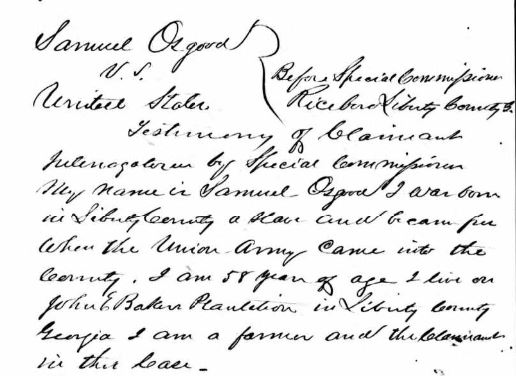
Samuel Osgood’s claim for compensation for property taken from him by Sherman’s Army in December 1864 probably would have been denied, because he only presented as witnesses two fellow formerly enslaved people, but his former slaveholder, John E. Baker, coincidentally visited Liberty County from his home in Thomas County while the Southern Claims Commission’s Special Agent was investigating the claim, and he corroborated Osgood’s testimony.
For the full transcript of this claim, see: https://theyhadnames.net/2021/01/11/samuel-osgood-southern-claims-commission/
Osgood had testified before the Southern Claims Commission’s Special Commissioner, local court official and former slaveowner Henry Way, in 1873 that he had been born into slavery in Liberty County, that he was about 58 years old, and that he was still living and farming on John E. Baker’s land, where he had previously been held enslaved. He said he became free when “the Yankees came in and told us we were free.” Before that, he added, “My feelings were if it was the will of the Lord that if our freedom was to come it would be much to my satisfaction. I cast all the influence I had and could give on the side of the Yankees I knew if the war didn’t go on our freedom would not come.”
Osgood said he had worked by the task for Baker, and had used his “free” time since he was 17 to raise crops, which he sold for cash to buy a cow from which he raised cattle to sell, and raised hogs and poultry the same way. He said he had used his money to buy clothes and other items that Baker would not provide, particularly nice clothes to wear to “meeting” (church). When the unit of Sherman’s Army commanded by General Kilpatrick came to Liberty County to forage in December 1864, they took everything he had, and he claimed $507.50 in compensation for 3 cows, 26 hogs, 60 bushels rice, 125 bushels corn, and cooking utensils. He said that Henry Harris, David Holmes, Jack Bacon, and Pulaski Baker had also been present when the soldiers came. The soldiers had camped at the Baker plantation, then moved to their camp at Midway Church, about 4 miles away.
Osgood’s wife and six children — only three of whom were living at the time of his testimony — “all belonged to the same master,” and helped him with raising the crops and stock, he said. Osgood testified that Baker had about “40 head of slaves little and big” and said that he was currently renting land from Baker at $25 a year for him and his wife, and $6-$10 each for his children, for all the land they could cultivate. He emphasized that he owed Baker nothing, and that he paid his rent as fast as it was due. When asked whether he was prosecuting the claim for anyone else (i.e., possibly Baker, who could not make a claim himself because he had served in the Confederate Army), Osgood denied it and said, “White men would not trust me in that way.”
Henry Harris testified as to Osgood’s loyalty to the Union and ownership of the property. He said he himself had been born into slavery in Liberty County near Riceboro, and that his slaveholder had been James Winn, who was dead. He lived currently at Judge Fleming’s place. He said he had known Osgood for about 35 years but was not related to him. He corroborated Osgood’s testimony and commented on how industrious Osgood’s family was.
Rachel Osgood was the other witness. She testified that she was about 78 or 79 years old, and had been born into slavery on “Mr. Delegal’s” place in Liberty County. She said that John E. Baker had been her last master and that she still lived on his land, where she was “trying to farm a little.” She also said that she was not related to Osgood. She corroborated Osgood’s testimony about his property, and noted that it had been a “bully good season” that year for crops, and “I think the Lord gave us a good season because he knew the Yankees was a coming and would want all.”
The Southern Claims Commission sent its Special Agent, W.W. Paine, to Liberty County to investigate Osgood’s claim, since it normally wanted testimony of a white man before approving claims by formerly enslaved people. Paine ran into John E. Baker accidentally while the latter was visiting Liberty County from Thomas County, so he interviewed him. Baker said he was 43 years old and had lived in Liberty County until 1866. He confirmed that Osgood had always owned hogs and cattle while Osgood was enslaved by him. He said he was in the Confederate service when the soldiers came, so had not seen the property taken, but knew that all of his own cattle and hogs were taken by the “Federal Army” and had no doubt that Osgood’s also had been taken. He said that Osgood was “a negro of good character.” He estimated the value of Osgood’s property much lower than Osgood’s claim had. Paine commented that Baker was “one of the best citizens of Thomas County Georgia” and that he was the principal of a “large female institution” there.
Based on Baker’s testimony, the Commission awarded Osgood $210 of his $507.50 claim, which was paid to him in 1877, care of James Atkins, the Collector of Customs in Savannah, Georgia. [Osgood’s attorney, Raymond Cay, Jr., had been barred from receiving the monetary awards for his clients because he had been caught taking excessive fees. Because the claimants did not have bank accounts, the money had to be sent to an intermediary, and Atkins was selected after Cay was barred.]
Which Samuel Osgood?
Research into Samuel Osgood’s life after the Civil War led to identifying and distinguishing among the records of four separate Sam Osgoods who lived in Liberty County at that time. Fortunately, two of them were very different ages from the claimant Samuel Osgood and could be set aside.
The first was Samuel L. Osgood, who was born about 1795 and died in 1870 after the U.S. federal census was taken, of influenza.
The second was Sambo Osgood, born in the 1840s, who died in 1912. His wife Adaline applied for 12 months widow’s support upon his death. Sambo Osgood appears to have had at least four children: Tena (b. ~1867), Nancy (b. ~1868), Edward (1874-1932), and Sambo Jr (1875-1912). Wife Adaline’s maiden name was listed as LeConte on Edward’s death certificate.
Unfortunately, however, there were also two Samuel Osgoods close in age listed in the 1870 and 1880 U.S. federal census records for Liberty County and both owned land, according to Liberty County property tax digests between 1878-1883. How to determine which of these Samuel Osgoods presented the SCC claim?
Samuel Osgood #1 was listed in the 1870 U.S. federal census records for Liberty County as being born in 1816 and in the 1880 census as having been born in 1810, living with wife Eve (about the same age), with a child named Albert, born around 1854.
Samuel Osgood #2 was listed in the 1870 and 1880 Liberty County census as being born around the same time (1814-1816), living with wife Eliza (about the same age), with children Betsey (b. ~1845), Charles (b. ~1852), and Candace/Candis (~b. 1854).
Neither man was found in the 1900 census, and presumably had passed away by then. Probate records were not found for either.
One Samuel Osgood owned 66 acres, and the other 120 acres, according to the property tax records of 1878-1883. Which was which?
This proved to be fairly easy to document. Samuel Osgood #2, married to Eliza, lived in the 181st subdivision. Listed in the census records next to Samuel Osgood #2 was Rachel Osgood, the elderly woman who testified for claimant Osgood in his SCC claim. Nearby was David Holmes, who was said to have been present when the soldiers took Osgood’s property, and not far away was Henry Harris, who also testified for claimant Osgood.
Samuel Osgood #1, married to Eve, lived in the 180th subdivision of Liberty in 1870.
A Samuel Osgood purchased 66 ⅔ acres of land in 1876 for $100 from John Brown, who also was living in the 180th subdivision in 1870. The land originally belonged to the estate of Gideon McGowan, and was bounded north and east by land belonging to his estate by land of Fleming & Baker, and west by land of E.P. Miller, also an 1870 resident of the 180th subdivision.
In 1877, a Samuel Osgood bought 120 acres of land from John E. Baker for $564. The land, said to be “known as the Osgood Tract” was bounded northeast by land of Rev. Robert Quarterman, west by “the Girardeau tract,” and southwest by land of Major A. Porter. Part of the purchase also was 20 acres known as the “Wilkinson tract” bounded northeast by the Riceboro & Darien road, southeast by land of John E. Baker, southwest by land of Prince Stevens, northwest by land of Laura E. & Charles E. Maxwell. Samuel Osgood bought an additional 6 acres of the same tract from John E. Baker for $23.96 in 1882.
Because Samuel Osgood #1 was living in the 180th subdivision, it seems logical to associate him with the purchase of 66 acres in that subdivision. Because Samuel Osgood #2 was living near witnesses for claimant Osgood’s SCC claim, in the 181st subdivision, it seems logical to associate the purchase of 120 acres of land from John E. Baker with him, and since John E. Baker had been claimant Osgood’s slaveholder, it seems logical to say that Samuel Osgood #2 is claimant Osgood. Of course, facts could come to light later that would put this in doubt, but it is a reasonable conclusion for now.
Slavery
Why did claimant Samuel Osgood take the surname Osgood at Emancipation, when his slaveholder was John E. Baker? Many freed people in Liberty County appear to have taken surnames that refer back to an early slaveholder of their family. Could this have been the case here?
It appears so. Remembering that Samuel Osgood purchased a tract of land known as the “Osgood tract” from John E. Baker, it seems likely that Baker possessed that tract either through inheritance or purchase. No purchase was found, and a preliminary look at his family tree (including his wife’s lineage) did not reveal an obvious Osgood connection, but a search of TheyHadNames.net for the terms “Osgood + Baker” revealed what likely happened. In 1830, Rebecca Osgood left most of her estate in her will to her nephew William Quarterman Baker, the father of John Elijah Baker. Rebecca was the daughter of Benjamin Baker, William Quarterman Baker’s grandfather, and sister of Elijah Baker, William Quarterman Baker’s father.
She had married John Osgood, but Osgood died in 1807, and left her ⅓ of his estate. He left the place where he was living to his son, John Osgood Jr, and to son William Osgood 176 acres that he had bought from Dr. Henry Wood, as well as enslaved people to his daughters. All of those children predeceased Rebecca Baker Osgood, which accounts for her leaving most of her estate to nephew William Quarterman Baker, who presumably passed it along to his son John Elijah Baker.
It is likely that Samuel Osgood came from that estate. Rebecca Osgood’s 1832 estate inventory named a Sam, valued at $500, when Samuel Osgood would have been about 15. It seems likely that one or both of Samuel Osgood’s parents were in John Osgood Sr’s 1808 estate inventory and division, which was before Samuel Osgood was born.
This also explains why Rachel Osgood, one of claimant Samuel Osgood’s witnesses, said she was not related to him, yet she had also taken the surname Osgood and lived near him. She was likely also originally from the Osgood family’s estates. She had testified that her slaveowner was also John E. Baker, but that he was not her original owner, and that she had been born on “Mr. Delegal’s” place.
Church
Samuel Osgood mentioned in his testimony that he attended “meeting” [church], but he may not have been a formal member. In antebellum Liberty County, enslaved people attended the same churches the white planters did. The Bakers and Osgoods were members of the Midway Congregational Churches, and records of its Black membership exist from 1752-1867 but no Samuel (or variant) owned by a Baker or Osgood was found listed as a member. Rev. Charles Colcock Jones did a census in 1846 of all the African American church members in Liberty County’s 15th District, and again, no Sam (or variant) owned by a Baker or Osgood was found. William Quarterman Baker was a founding member of the Walthourville Presbyterian Church in 1855, and his son John Elijah Baker, Samuel Osgood’s slaveholder, also attended there. A Sampson belonging to John E. Baker was found in its records, but since Samuel used the name Samuel in all the records found after the war, this seems unlikely to have been him.
Citations:
Census Records
Samuel Osgood #2 (claimant Samuel Osgood):
1870 U.S. Census, Liberty County, Georgia, population schedule, Subdivision 181, p. 16, dwelling #151 family #152, enumerated on November 15, 1870, by W.S. Norman, Samuel & Eliza Osgood household, digital image, Ancestry.com (https://www.ancestry.com: accessed 1/11/2021).
1880 U.S. Census, Liberty County, Georgia, population schedule, 15th District, p. 14, dwelling #143 family #144, enumerated on June 8, 1880, by D.A. Fraser, Samuel & Eliza Osgood household, digital image, Ancestry.com (https://www.ancestry.com: accessed 1/11/2021).
Samuel Osgood #1
1870 U.S. Census, Liberty County, Georgia, population schedule, Subdivision 180, p. 41, dwelling #391 family #391, enumerated on December 8, 1870, by Robert Q. Baker, Samuel & Eve Osgood household, digital image, Ancestry.com (https://www.ancestry.com: accessed 1/11/2021).
1880 U.S. Census, Liberty County, Georgia, population schedule, 15th District, p. 75, dwelling #798 family #808, enumerated on July 9, 1880, by D.A. Fraser, Sam & Eve Osgood household, digital image, Ancestry.com (https://www.ancestry.com: accessed 1/11/2021).
Liberty County Property Tax Digests naming both Samuel Osgoods:
Georgia, Property Tax Digests, 1793-1892, Liberty County, Georgia, 1878-1885, Militia District 1359, Samuel Osgood; digital image, Georgia, Property Tax Digests, 1793-1892, Liberty County, Georgia, 1878-1885, Militia District 1359, Images #89, 412, 537, 667 (https://www.ancestry.com: accessed 1/11/2021).
Liberty County Court of Ordinary, Old General Book “C”, 1850-1853, p. 505, Estate Appraisement of Edmund B. Way; digital image, Ancestry.com, “Georgia Probate Records, 1743-1990,” Liberty County, within “Miscellaneous Probate Records 1850-1853 vol C and L,” image #302. Record summarized and put online by Stacy Ashmore Cole at TheyHadNames.net (https://theyhadnames.net/2019/03/22/liberty-county-estate-inventory-edmund-b-way/)
Land Purchases
Liberty County Superior Court, “Deeds & Mortgages v. R 1874-1877,” p. 559-560, John Brown to Sam Osgood; digital image, FamilySearch.org, “Deeds & Mortgages, v. Q-R 1870-1877” within “Deeds and mortgages, 1777-1920; general index to deeds and mortgages, 1777-1958,” image #571-2, (https://www.familysearch.org/ark:/61903/3:1:3Q9M-C3QP-5999-X?i=570&cat=292358, accessed 1/10/2021)
Liberty County Superior Court, “Deeds & Mortgages v. R 1874-1877,” p. 497, John E. Baker to Samuel Osgood; digital image, FamilySearch.org, “Deeds & Mortgages, v. Q-R 1870-1877” within “Deeds and mortgages, 1777-1920; general index to deeds and mortgages, 1777-1958,” image #540, (https://www.familysearch.org/ark:/61903/3:1:3Q9M-C3QP-5938-G?i=539&cat=292358, accessed 1/10/2021)
Liberty County Superior Court, “Deeds & Mortgages v. T 1882-1884,” p. 304, John E. Baker to Samuel Osgood; digital image, FamilySearch.org, “Deeds & Mortgages, v. T-U 1882-1885” within “Deeds and mortgages, 1777-1920; general index to deeds and mortgages, 1777-1958,” image #163, (https://www.familysearch.org/ark:/61903/3:1:3Q9M-C3QP-R9D3-3?i=162&cat=292358, accessed 1/10/2021)
Probate Records
Rebecca Osgood’s 1830 Will
“Georgia Probate Records, 1742-1990,” database with images, FamilySearch (https://familysearch.org/ark:/61903/3:1:3QS7-L93L-GCHD?cc=1999178&wc=9SYT-PT5%3A267679901%2C268032901 : 20 May 2014), Liberty > Wills, appraisements and bonds 1790-1850 vol B > image 504 of 689 (see abstract at https://theyhadnames.net/2018/06/02/liberty-county-will-rebecca-osgood)
John Osgood Sr’s 1806 Will
“Georgia Probate Records, 1742-1990,” images, FamilySearch (https://familysearch.org/ark:/61903/3:1:3QS7-893L-P9K3?cc=1999178&wc=9SYT-PT5%3A267679901%2C268032901 : 20 May 2014), Liberty > Wills, appraisements and bonds 1790-1850 vol B > image 93 of 689; county probate courthouses, Georgia. (See abstract at https://theyhadnames.net/2018/03/17/liberty-county-will-john-osgood-senior)
John Osgood Sr’s 1808 Estate Inventory and Division
Family Search.org. Liberty County Superior Court “Deeds and mortgages, 1777-1920; general index to deeds and mortgages, 1777-1958,” Film: Deeds & Mortgages, v. E-G 1801-1816,” Record Book F, p. 194-5. Image #263 (Link: https://www.familysearch.org/ark:/61903/3:1:3Q9M-C3QL-J967-4?i=262&cat=292358) (See abstract at https://theyhadnames.net/2020/03/14/liberty-county-estate-inventory-division-john-osgood/)
Negative Searches:
Midway Congregational Church Records, digital images, FamilySearch.org (accessed 5/14/2020); Records abstracted at https://theyhadnames.net/midway-church-records/.
Jones, Charles Colcock, 1846 Census of African American Church Members in Liberty County’s 15th District, held in the Charles Colcock Jones papers, Louisiana Research Collection, Tulane University. Transcribed at: https://theyhadnames.net/1846-c-c-jones-census/.
Walthourville Presbyterian Church records are unpublished, and held in the TheyHadNames.net private collection while being transcribed and researched.