
Samuel Maxwell, who was held enslaved on George W. Walthour’s Westfield plantation in Liberty County, Georgia at the end of the Civil War, was interviewed in 1877/1878 about the U.S. Army’s 1864 raid there. As part of his claim against the U.S. government for property taken by the soldiers, Samuel Maxwell met with Southern Claims Commission Special Commissioner Henry Way and local businessman Robert Q. Cassels to have his testimony taken. A fellow formerly enslaved man named Jacob Dryer and G.W. Walthour’s white son Russell Walthour also testified for Maxwell.
For a full transcript of this claim, see: https://theyhadnames.net/2020/09/05/samuel-maxwell-southern-claims-commission/.
Maxwell’s claim, submitted by Savannah attorney James Simms, had said that $219.50 worth of property was taken, including two cows and calves, 20 hogs, honey, rice, corn, clothing and bedding, and the testimony Commissioner Way submitted on his behalf appeared to corroborate this claim. However, the Commissioners of Claims in Washington, D.C., were suspicious, because all of the testimony that Way submitted from multiple such claims looked very similar and was suspiciously short on detail. The Commissioners knew that many of the claimants and witnesses, including Maxwell and Dryer, had been enslaved and had been forbidden to learn to read or write during slavery, so could not verify that their attorneys had made a true submission or that Way had written down what they really said.
So the Commissioners assigned their Special Agent, R.B. Avery, to re-interview Maxwell and Dryer, which he did on June 8, 1878, at the Crossroads Church (now the First African Baptist Church in Riceboro). Maxwell told Avery that he had had only one cow and a calf, and that they were actually his wife’s, who was enslaved on the same plantation. He said her mother had given her the cow before freedom. Jacob Dryer said he remembered one cow, but when pressed, would not testify to any more than that.
Avery also interviewed William A. Golding, a prominent member of the Liberty County African American community at that time, but Golding’s testimony was kept in the Commission’s private files and was not part of the public record.
Avery noted in his report that he had visited Maxwell’s home, where he found a small pony picketed out on the grass. He commented that Maxwell had received the horse when his father-in-law, Joseph James, had died.
Avery’s report that both the lawyer’s claim submission and Way’s account of the testimony were likely inflated resulted in payment of only $40 on Maxwell’s $219.50 claim, and presumably further fueled the Commission’s doubts about Henry Way, James Simms, and Robert Q. Cassels.
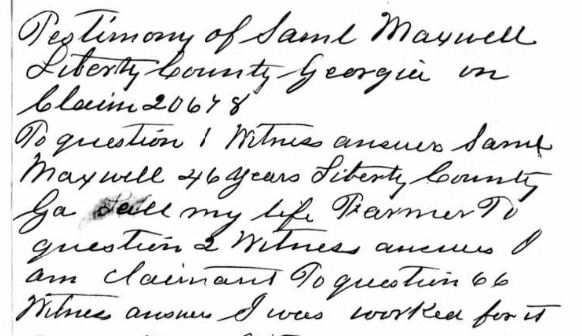
Reports of Samuel Maxwell’s birth year varied from 1829 to 1845 in the U.S. federal census records for 1870-1910. He himself reported his age as 46 in the 1877 testimony, so 1831 is likely closest to correct. In the 1900 census, it was reported that he had been married to wife Betsy for 37 years, or since 1863.
In the 1870 census, he and his wife had two children in the household: Sarah (4) and William (7 months). By 1880, they had added Dianah (8), and they were living near Joseph James, who according to Special Agent Avery’s report was Betsy’s father.
On September 23, 1887, Betsey Maxwell bought a 55-acre tract of land from Mrs. J.S. Fleming. The land was known as “a part of the Oakland Plantation,” bounded north by Mr. J.B. Fraser, east by same, south by the Midway and Walthourville road, and west by Dick Maxwell and Mrs. J.S. Fleming. [NOTE: At that time, Liberty County records referred to white people with “Mr” and “Mrs” and did not use that for Black people; that usage is only included here because it helps with identifying the people involved, and thus with where this land might have been. Mrs. J.S. Fleming was probably Mary Jane Way Fleming (1835-1918), wife of John S. Fleming (1837-1915). John S. Fleming was alive at the time of the sale, so this was likely land she had inherited from one of her parents or grandparents.]
On June 24, 1890, Sam Maxwell bought 10 acres from Prince LeConte for $30. The tract was known as “the pine land tract” in Liberty County, bounded north by F.R. Lyons and south by Samuel Varnadoe.
In the 1900 census, William and Dianah were still in the Maxwell family household. By the 1910 census, Samuel was a widower, and living with daughter Dianna and her husband, Isaac Jones. Later that year, in November, he sold a 30-acre tract of land in Liberty County to Robert H. Knox of Chatham County for $50. It had been surveyed in 1882, and was said to have been bordered at that time by land belonging to W.A. (or O) Walthour, R.F. Walthour, G.W. Walthour and Margaret Walthour.
No records were found for Samuel Maxwell after 1910, when he would have been about 80, and no record was found of his death or the probate process when the Liberty County probate records online were checked.
Slavery
George W. Walthour, who had been identified by Samuel Maxwell as his slaveowner at the time of the 1864 raid, died in 1859 with minor children. It was usual for estates, especially large ones like Walthour’s, not to be finalized until the minor children came of age, so it is likely that Maxwell belonged to the estate. Walthour’s estate inventory identified a total of seven enslaved men with names that were some variant of Samuel (Samuel, Sam, Sammy, Sambo) on his three plantations: Westfield, Homestead, and Richland. On Westfield, where Samuel Maxwell said he was living at the time of the raid, were Sambo, 35 years old; Sambo, 16 years old; and Sam, 20 years old. There was also Betsy, 40 years old, and an Elizabeth, also 40 years old, one of whom may have been Betsy Maxwell, his wife, since they were said to have been on the same plantation.
Samuel took Maxwell as his surname after Emancipation. Why? There were other formerly enslaved people who also took that surname, most notably Syphax Maxwell, who had belonged jointly to Charles Colcock Jones and his sister Susan Mary Maxwell Cummings until their property was divided in 1839. The Maxwell family was close to the Jones family, and it is likely that either Samuel or one of his parents or grandparents had been owned by them at some time. Unfortunately, Samuel or some version of it was a fairly common name, which makes it difficult to follow the trail back to that point.
Citations
Census Records
1870 U.S. Census, Liberty County, Georgia, population schedule, Subdivision 180, p. 3, dwelling #26, family #26, enumerated on November 14, 1870, by Robert Baker, Samuel Maxwell household, digital image, Ancestry.com (https://www.ancestry.com: accessed 9/4/2020).
1880 U.S. Census, Liberty County, Georgia, population schedule, District 15, enumeration district 67, p. 80, dwelling #853, family #860, Samuel Maxwell household; digital image, Ancestry.com (https://www.ancestry.com: accessed 9/4/2020).
1900 U.S. Census, Liberty County, Georgia, population schedule, Militia District 15, enumeration district 80, sheet #7, line number 75-78, digital image, Ancestry.com (https://www.ancestry.com: accessed 9/4/2020).
1910 U.S. Census, Liberty County, Georgia, population schedule, Militia District 15, enumeration district 114, p. 5A, line number 18-20, digital image, Ancestry.com (https://www.ancestry.com: accessed 9/4/2020).
Deed Records
Liberty County Superior Court, “Deeds & Mortgages v. AK 1910-1911,” p. 370-1, Samuel Maxwell to Robert H. Knox; digital image, FamilySearch.org, “Deeds & Mortgages, v. AK-AL 1910-1912” within “Deeds and mortgages, 1777-1920; general index to deeds and mortgages, 1777-1958,” image #226, ( https://www.familysearch.org/ark:/61903/3:1:3Q9M-C3QP-5SX8-X?i=225&cat=292358, accessed 9/3/2020)
Liberty County Superior Court, “Deeds & Mortgages v. AA 1892-1894,” p. 114, Prince LeConte to Samuel Maxwell; digital image, FamilySearch.org, “Deeds & Mortgages, v. AA-AB 1892-1896” within “Deeds and mortgages, 1777-1920; general index to deeds and mortgages, 1777-1958,” image #91, ( https://www.familysearch.org/ark:/61903/3:1:3Q9M-C3QP-594H-V?i=90&cat=292358, accessed 9/3/2020)
Liberty County Superior Court, “Deeds & Mortgages v. AA 1892-1894,” p. 141-2, Mrs. J.S. Fleming to Betsey Maxwell; digital image, FamilySearch.org, “Deeds & Mortgages, v. AA-AB 1892-1896” within “Deeds and mortgages, 1777-1920; general index to deeds and mortgages, 1777-1958,” image #104-5, ( https://www.familysearch.org/ark:/61903/3:1:3Q9M-C3QP-59CV-C?i=104&cat=292358, accessed 9/3/2020)
Probate Record for George W. Walthour
”Georgia Probate Records, 1742-1990,” database with images, FamilySearch (https://familysearch.org/ark:/61903/3:1:3QS7-993T-XTF2?cc=1999178&wc=9SB7-6T5%3A267679901%2C268014801 : 20 May 2014), Liberty > Miscellaneous probate records 1850-1863 vol C and L > image 231 of 703