
“I was so glad to be set free it seemed to me what little time I had been free was a long time.”
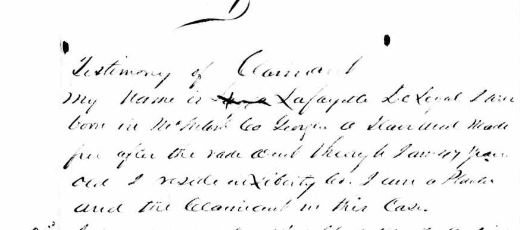
Lafayette Delegal was born into slavery in McIntosh County around 1825. When the U.S. Army came foraging through Liberty County in December 1864 during their march from Atlanta to Savannah, he was the “driver,” or foreman, on the plantation of Dr. Henry Harkley Delegal, who had died the previous year. The soldiers took the property he had painstakingly accumulated: a horse, 6 hogs, beehives, poultry, 2 cows, 3 wool blankets, rice and corn, and a wagon and harness, in addition to $1.50 he had in silver money in his pocket. The Southern Claims Commission allowed him $220 of his $578 claim in compensation.
Read the full transcript of this claim here: https://theyhadnames.net/2020/06/28/lafayette-delegal-southern-claims-commission/.
Described as a hard-working industrious man by witnesses, Delegal said he had been raising hogs and poultry since he was a boy, and after he got married and got some money together, he bought a horse and a wagon and harness. He testified that it was common practice in Liberty County for slaveowners to allow their people to own property and keep it on the plantations where they lived, with the only exception being Audley King, who would allow the people he kept enslaved to own everything but horses.
The enslaved people were able to accumulate what little property they had because they worked assigned tasks, and when their task was done for the day, they could work for themselves. This, of course, was done by the slaveowners because it encouraged hard work at the tasks, and because it alleviated their need to provide food, etc, for the enslaved people.
When the U.S. army raid happened in Liberty County, the soldiers were mostly camped at Midway Church, with a smaller encampment at Sunbury. Delegal and his witnesses testified that he was so overwhelmingly happy to see the soldiers and to know that he was free, that he did not even mind too much about his confiscated property. The soldiers had told him that “Uncle Sam” would pay him back but that they could not leave his property with him because the rebels would just take it from him.
In practical terms, Delegal became free when the U.S. soldiers came, and after that, he said, he went to Savannah and worked in the Commissioner’s department for six months at $15 a month. He then came back to Liberty County and rented land to farm. He said that at the time of his testimony (1873) he was living on Mrs. Dunwody Jones’ plantation. He denied owing anything to his old master, who was dead, and said that, on the contrary, Delegal’s family owed him a great deal because they had taken one of his horses after the U.S. Army raid and never paid him back for it.
A standard question for Southern Claims Commission testimony, since both whites and blacks could apply for compensation and loyalty to the U.S. cause had to be proven, was whether the claimant had relatives in the Confederate Army. Delegal answered, “I did not have any relatives in the Rebel Army but a great many in the Union Army.” Many enslaved people from coastal Georgia had fled their slaveowners during the war, and many enslaved men enlisted in the Colored Troops of the U.S. Army. Even some women, like formerly enslaved Army nurse Susie King Taylor from Liberty County, assisted in the effort to put down the rebellion.
Thomas H. Munroe, Richard (Dick) Cummings, and Samuel Elliott testified on Delegal’s behalf. Munroe said that he was about 30 years old (in 1873), not related to Delegal, and was born in Dorchester, Liberty County, a slave of Dr. Delegal. Munroe said he was not sure exactly how long the soldiers stayed in Liberty County because “I was so glad to be set free it seemed to me what little time I had been free was a long time.”
Richard Cummings testified that he was born into slavery in Bryan County, and that he had belonged to William Thompson. He said he was about 59 years old (in 1873) and was farming on Thompson’s place. He also said he was unrelated to Delegal and that he had known him for about 25 years.
Samuel Elliott said that he had been born into slavery at Laurelview Plantation in Liberty County and had belonged to Maybank Jones. About 54 years old at the time of the testimony, he was farming at Laurelview still.
Dr. Henry Harkley Delegal, son of David Delegal, died on December 28, 1863, a year before the raid on Liberty County. His estate had not been settled by the time of the raid, so Lafayette Delegal had not yet been passed to another owner by the time he became free. In the inventory done of Dr. Delegal’s estate in early 1864, Lafayette was valued at $3000; the value of the enslaved people owned by Dr. Delegal was listed as $51,500. The entire value of his estate, excluding land, was $57,244, indicating how great a proportion of Liberty County planters’ wealth was in their human property, as the farm land was of little value without people who could be forced to work in the harsh conditions of coastal Georgia. Throughout Liberty County’s history, it was common for enslaved people to make up 85-90% of the value of a slaveowner’s property, not counting land.
Unfortunately, unlike many of the Liberty County estate inventories, Dr. Delegal’s inventory does not appear to be listed in family order so tells us little about Lafayette Delegal’s family during slavery. In the 1870 census, he was listed with wife Sarah, and children Richard and Jane, who had been born in the early 1850s, indicating that they had been enslaved. However, there was no Sarah, Richard (Dick) or Jane in Dr. Delegal’s estate inventory, thus they must have been on another plantation.
There was a clue as to Lafayette’s birth family in the 1880 census. Living with him was Jane Miller, who was listed as his widowed sister. There was a Jane listed in Henry Delegal’s 1864 estate inventory. An Enoch Miller was living with Lafayette and Sarah in the 1870 census, and was listed as an invalid. Perhaps Jane’s husband? An Enoch was also listed in the 1864 Henry Delegal estate inventory.
Witnesses had testified that Adaline Munroe, Phillis McIver, Robin Munroe, and William McIver were present at Delegal’s plantation when Lafayette Delegal’s property was taken. All those first names are found in Dr. Delegal’s 1864 estate inventory. William McIver testified in his own Southern Claims Commission claim that he had belonged to Dr. Delegal.
Lafayette Delegal rented land after he returned from working in Savannah. In 1869, he applied for the Georgia homestead tax exemption, and had to list his personal property:
Annexed Schedule of Personal Property of Lafayette Delegal Col’d.
No. 1 One cow and calf valued at $30.00
No. 2 Four head of hogs valued at $15.00
No. 3 Provisions for self and family one year valued at $100.00
No. 4 Household & Kitchen furniture valued at $50.00
Living up to his reputation as a hard-working man, however, on February 7, 1881, he bought 70 acres of land for $70 from Florida Mallard Heeth, who was the daughter of former Liberty County slaveowners Cyrus S. and Sarah Law Mallard. Florida was living in Thomasville, where many former Liberty Countians had gone during and after the Civil War, and the land she sold Delegal bordered her mother’s land on the west, and on the north land owned by Valentine Grest and Mrs. Sarah L. Mallard, south by John Jones and E.D. Thompson, and east by John Jones.
As was the custom, Lafayette Delegal mortgaged his land for money to raise his crops in at least 1884, 1885, and 1886.
No record of Lafayette Delegal was found in the 1900 census, when he would have been about 75, so he either died between 1886 and 1900, or moved away.
Citations:
1870 Census for Lafayette Delegal
1870 U.S. Census, Liberty County, Georgia, population schedule, Subdivision 181, p. 24, dwelling #231, family #231, enumerated on November 17, 1870, by W.S. Norman, Lafayette Delegal household, digital image #24, Ancestry.com (https://www.ancestry.com: accessed 6/28/2020).
1880 Census for Lafayette Delegal
1880 U.S. Census, Liberty County, Georgia, population schedule, Disctrict 15, enumeration district 66, p. 35, dwelling #321, family #324, Lafayette Delegal household; digital image #35, Ancestry.com (https://www.ancestry.com: accessed 6/28/2020).
Dr. Henry H. Delegal’s 1864 Estate Inventory (transcribed version at this link)
“Georgia Probate Records, 1742-1990,” images, FamilySearch (https://familysearch.org/ark:/61903/3:1:3QSQ-G93L-RVHS?cc=1999178&wc=9SYY-ZNP%3A267679901%2C268025701 : 20 May 2014), Liberty > Wills 1863-1942 vol C-D > image 25 of 430.
Lafayette Delegal’s Application for Homestead Exemption
Liberty County Superior Court, “Deeds & Mortgages v. P 1860-187,” p. 553, Homestead Application by Lafayette Delegal; digital image, FamilySearch.org, “Deeds & Mortgages, v. O-P 1854-1870” within “Deeds and mortgages, 1777-1920; general index to deeds and mortgages, 1777-1958,” image #653, (https://www.familysearch.org/ark:/61903/3:1:3Q9M-C3QP-RSRN-B?i=652&cat=292358, accessed 6/28/2020)
Lafayette Delegal’s Purchase of 70 Acres from Florida Mallard Heeth
https://www.familysearch.org/ark:/61903/3:1:3Q9M-C3QP-RSLR-4?i=427&cat=292358
Liberty County Superior Court, “Deeds & Mortgages v. S 1877-1882,” p. 767, Florida Heeth to Lafayette Delegal; digital image, FamilySearch.org, “Deeds & Mortgages, v. S 1877-1882” within “Deeds and mortgages, 1777-1920; general index to deeds and mortgages, 1777-1958,” image #428, (https://www.familysearch.org/ark:/61903/3:1:3Q9M-C3QP-RSLR-4?i=427&cat=292358, accessed 6/28/2020)
Lafayette Delegal’s Mortgages
Liberty County Superior Court, “Deeds & Mortgages v. U 1884-1885,” p. 198-9, Lafayette Delegal to John Flannery & Co (1884); digital image, FamilySearch.org, “Deeds & Mortgages, v. T-U 1882-1885” within “Deeds and mortgages, 1777-1920; general index to deeds and mortgages, 1777-1958,” image #380, (https://www.familysearch.org/ark:/61903/3:1:3Q9M-C3QP-R9ZC-9?cat=292358, accessed 6/28/2020)
Liberty County Superior Court, “Deeds & Mortgages v. U 1884-1885,” p. 476-7, Lafayette Delegal to John Flannery & Co (1885); digital image, FamilySearch.org, “Deeds & Mortgages, v. T-U 1882-1885” within “Deeds and mortgages, 1777-1920; general index to deeds and mortgages, 1777-1958,” image #520, (https://www.familysearch.org/ark:/61903/3:1:3Q9M-C3QP-R9XC-P?i=519&cat=292358, accessed 6/28/2020)
Liberty County Superior Court, “Deeds & Mortgages v. W 1886-1887,” p. 95-7, Lafayette Delegal to John Flannery & Co (1886); digital image, FamilySearch.org, “Deeds & Mortgages, v. V-W 1885-1887” within “Deeds and mortgages, 1777-1920; general index to deeds and mortgages, 1777-1958,” image #276, (https://www.familysearch.org/ark:/61903/3:1:3Q9M-C3QP-GJYX?i=275&cat=292358, accessed 6/28/2020)