
George Powell, a 37-year-old formerly enslaved man who had lived in Liberty County, Georgia, all his life, testified to representatives of the Southern Claims Commission in 1878 that in December 1864 Union soldiers belonging to Sherman’s Army had taken $220 worth of property from him, including 15 hogs, 18 fowls, 25 bushels of corn, 30 bushels of rice, and cooking utensils. He said that his slaveowner was W.W. Winn and that he was still living.
See the full transcript of this claim at: https://theyhadnames.net/2020/10/28/george-powell-southern-claims-commission/
James Stacy, a 39-year-old formerly enslaved man who said he had known George Powell all his life, testified on his behalf, saying that he had lived about ¼ mile from Powell during the Civil War and that he had seen Powell’s property taken. In 1873, James Stacy had successfully prosecuted his own claim for property taken during the raid by the U.S. troops, receiving $170 from the U.S. Government via the Southern Claims Commission. Stacy had said at that time that his slaveowner was Lawrence Winn.
Powell’s former slaveowner, William W. Winn, testified on his behalf as well. Winn said he was a 60-year-old teacher who had lived in Liberty County all his life, and that Powell had “lived on my place.” He said he was not there when the U.S. soldiers took the property but that he had permitted Powell to own such property as provisions, poultry and hogs both before the Civil War and after it, and that he knew that he did own such property.
James Stacy had submitted his successful SCC claim in 1873, when the SCC Special Commissioner was Virgil Hillyer, a northerner who took detailed testimony from claimants. By the time Powell submitted his claim in 1878, the Special Commissioner was Henry Way, a former Liberty County slaveowner, who took very sparse and suspiciously similar-sounding testimony from the claimants. A number of the claims processed by Henry Way were denied by the Southern Claims Commission on the grounds that the claimants provided no details about how they had obtained the property. Powell’s claim was no different; he provided no details at all. So why was his claim approved, when others were not? His white former slaveowner testified for him. In other such cases, the former slaveowner was either dead or had left the county, and those claims were mostly denied. The Claims Commission was very specific about its reasons for approval in this case: “The claimant was the slave of W.W. Winn. His former master, W.W. Winn, testifies that he was allowed to own & did own such property as is charged.” So more than a decade after the Civil War ended, Powell still needed the testimony of his former slaveowner — a man who might be hostile, dead, or absent — to win his case, even though it was well documented that enslaved people in Liberty County had owned property and that this property had been taken by U.S. soldiers for Army use during the raid on Liberty County.
Powell received $86 of his $220 claim.

Because of the way Special Commissioner Henry Way took testimony on these claims, there are few genealogical details in George Powell’s claim. However, starting with his testimony and building on it with other Liberty County documents, we can put together a fairly detailed picture of his life after the Civil War.
Powell stated that he was 37 years old in 1878, making him born around 1841. The 1870 census put his birth year at 1830, the 1880 census as 1842, and the 1900 census at 1839. It was not at all unusual for there to be such a wide swing in reported ages in the U.S. census records, but his own reporting in the Southern Claims Commission record makes it likely he was born around 1839-1841.
In the 1870 census, he is listed in household with Ida Powell (25), Elsy Powell (4), and Georgia Powell (2). The 1870 census did not list relationships, but the 1880 census did, and it shows that Ida (28) was his wife, and Elsy and Georgia were his daughters. By then he had two more daughters, Louisia (8) and Rosa (3), and a 9 month old son named Rufus.
With the 1890 census having been destroyed in a fire, there is a large gap between the 1880 census and the 1900 census, by which time George and Ida Powell had only granddaughter Ella Powell (13) living in their household. The 1900 census listed the number of children a woman had had, and how many of those were living; Ida Powell had had 11 children but only three were living. A deed record to be discussed later identified the married names of those three surviving children, all of whom were living near George and Ida in 1900: Lulla (Louisia) King (married to Abram King), Elcy Williams (married to William Williams), and Rosa Frazer (married to January Frazer). Thus it appeared that daughter Georgia and son Rufus were no longer living.
George Powell appears to have prospered after Emancipation. On December 25, 1892, he paid $250 to Mrs. Annie E. McKinnie of Richmond County, Georgia, for 72 acres of land in Liberty County that she had inherited from her father, former slaveowner Washington Winn. The land was bounded on the north by the Midway Road, east by the estate of J.L. Mallard, south by other land belonging to McKinnie, and west by William Way.
Powell owned that land for the rest of his life, but in 1893 he sold a 10-acre right of way through it to the Florida Northern Railroad Company for $160.50, so they could run part of the railroad through it. Fortunately for Powell’s descendants, the court record included a plat showing the land.
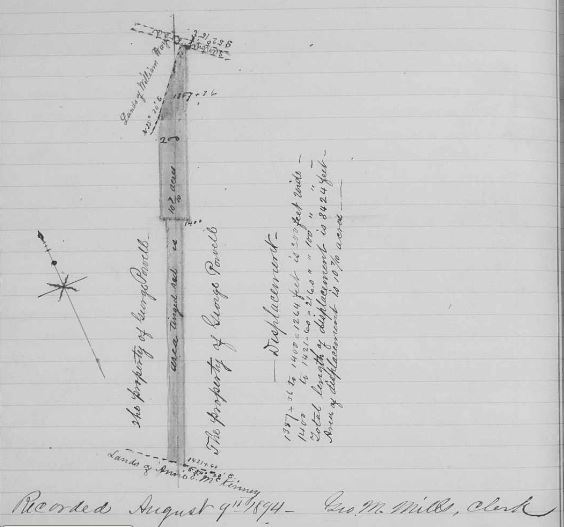
In 1896, Powell sold off two small pieces of the land, one a ¼-acre piece to S. (or C.) Cassels for $115, and the other a small piece to Albert G. Way of Gadsden County, Florida, for $110.
In 1905, Powell sold the timber rights to the land and the right to set up a sawmill there to the Hilton and Dodge Lumber Company for $30.
Powell died sometime between 1905 and December 1908, when Ida Powell and their daughters Lula King, Rose Fraser, and Ella Williams, described as “the sole heirs at law of George Powell, deceased” gave a 10-year right to build and operate a “sawmill, planing mill, store, blacksmith shop, houses for both white and colored employees and all other improvements necessary or convenient for carrying on a sawmill business” to Walter L. Bourne and Discoe J. Bourne, operators of the Chatham County business Bourne Brothers. The price? $10. Ida and her three daughters were entitled to continue to live and farm on the property, but could make no additional clearings. The land was still approximately 72 acres, excepting only the small plots sold to Way and Cassels.
A Limon Briggs was appointed as administrator of George Powell’s estate 17 years later, in 1925. His petition to become the administrator stated that he had been selected by the next of kin, that George Powell had died without a will, and that his estate was worth $500. The court appointed John C. Baker (or Bacon), William Way, and W.H. McGeth to appraise Powell’s estate, and they returned an inventory stating that the estate owned 60 acres of land in Liberty County’s 1359th District valued at $900, and bounded north by the Sunbury Road, east by Sam Stevens, south by Winn, and west by W.M. Way. No records were found about the disposition of the land after that but a more extensive search of deed records might be useful.
Ida Powell survived until at least 1920, when she was listed in the census as living with her granddaughters Viola (16) and Blossom (14) Fraser, and probable grandchildren Florrie (27) Williams and George McDonald (8). She was a 73-year-old widow, and since she was not found in the 1930 census, it appears likely that the 1925 appointment of Limon Briggs as administrator of George Powell’s estate was related to her death.
As for her origins, in December 1908, James Smith sold to Ida Powell for $1 his interest in a 15-acre parcel of land in Liberty County’s 1359th District (where George Powell’s land was also located), described as part of the land deeded to Nancy Stacy by James Stacy on December 26, 1900, and recorded in Deed Book AJ, pages 46-47, bounded on the north by the public road leading from McIntosh Station to Dorchester, on the east by T.M. Way, south by John Lambert & Scipio King, and west by W.A. Jones. The deed noted that “Ida Powell and James Smith being sole heirs at law of Nancy Stacy, deceased, has by mutual agreement divided the lands of the said Nancy Stacy…” According to census records, James Smith was Nancy (Lambert) Stacy’s grandson. Ida was of roughly the right age to have been her daughter. See James Stacy’s Southern Claims Commission transcript and research for more information on that family.
Slavery
George Powell had testified that his slaveowner was W.W. Winn, and William W. Winn testified for him and confirmed this. This is probably William Wilson Winn (1818-1887). Because Winn was still alive at the end of the Civil War, there were no probate records that could have named George as an enslaved man. A record of the Midway Church, which did have both Black and White members through its history, showed that an enslaved man named George, belonging to “Mr. W.W. Winn,” was admitted to church membership in August 1860. This seems very likely to have been George Powell.
Is there any way to find out George Powell’s history prior to 1860? In Liberty County, enslaved people were often inherited by a slaveowner’s children, and thus brought into a marriage by these children. So it is useful to look at a slaveowner’s wife’s inheritances. In this case, William W. Winn had married Louisa Varnedoe, daughter of Nathaniel Varnedoe, in 1843. Nathaniel Varnedoe died in 1856, and his estate inventory named an enslaved man or boy named George, valued at $500, who was in the lot drawn by…W.W. Winn. Winn was presumably representing his wife, Louisa Varnedoe Winn. Thus we can trace George Powell back to the Varnedoe family. It is noteworthy that 11 other people were inherited from Varnedoe by W.W. Winn and his wife: Toby, Peggy, Little Titus, William, Ned, Billy, Claudia, Betty, Rachael, Tola, and Ellena. It should also be noted that when Louisa died, W.W. Winn married her younger sister, Claudia, who had also inherited enslaved people from her father and may have brought them into that marriage: Caesar, Dianah, Paul, Augustus, Mary Jane, Hagar, William, York, Jupiter, Molly, Peggy, and Phebe.
Why did George take the surname Powell at Emancipation? In Liberty County, formerly enslaved people seem to have often adopted the surname of an early enslaver of their family. That is, not their most recent enslaver, but someone who might have been the enslaver of their mother or father, or even further back than that. In this case, the death of slaveowner James Powell in 1816 may give us some clues. While this was too early for George (born around 1840) to have been included, this estate inventory included names used by George for his children: Elsy, George, and Rose. Part of the enslaved people owned by James Powell were inherited by his wife, Mrs. Anne Powell. The names Elsy and Rose also appear in Mrs. Anne Powell’s 1831 estate inventory. Her heirs were James S. Bulloch, John Dunwody, and William & Jane Bulloch…but one of the appraisers of her estate was Nathaniel Varnedoe. An Elsy and a Rose were listed in Nathaniel Varnedoe’s 1856 estate inventory; it is possible that he purchased them from the Powell estate and that one of them was a relation, possibly the mother, of George Powell.
It is worth noting many of the same names found in James Powell’s 1816 estate inventory also occur in Josiah Powell’s late 1790s estate inventory, which might make it possible to trace George Powell’s lineage back even further.
Citations
Federal Census Records
1870 U.S. Census, Liberty County, Georgia, population schedule, Subdivision 181, p. 46, dwelling #438, family #438, enumerated on November 24, 1870, by W.S. Norman, George & Ida Powell household, digital image, Ancestry.com (https://www.ancestry.com: accessed 10/28/2020).
1880 U.S. Census, Liberty County, Georgia, population schedule, District 15, enumeration district 67, p. 85, dwelling #883, family #890, George & Ida Powell household; digital image, Ancestry.com (https://www.ancestry.com: accessed 10/28/2020).
1900 U.S. Census, Liberty County, Georgia, population schedule, Militia District 1359, enumeration district 86, sheet #5, dwelling #91, family #96, George & Ida Powell household, digital image, Ancestry.com (https://www.ancestry.com: accessed 10/28/2020.
1910 U.S. Census, Liberty County, Georgia, population schedule, Militia District 1359, enumeration district 120, p.5, line number 79, Ida Powell, digital image, Ancestry.com (https://www.ancestry.com: accessed 10/28/2020).
1920 U.S. Census, Liberty County, Georgia, population schedule, Militia District 1359, enumeration district 129, p. 4, line number 1, Ida Powell, digital image, Ancestry.com (https://www.ancestry.com: accessed 10/28/2020).
Deed Records
Liberty County Superior Court, “Deeds & Mortgages v. AB 1894-1896,” p. 14-16, George Powell to Florida Northern Railroad Company, right of way; digital image, FamilySearch.org, “Deeds & Mortgages, v. AA-AB 1892-1896” within “Deeds and mortgages, 1777-1920; general index to deeds and mortgages, 1777-1958,” image #330-331, (https://www.familysearch.org/ark:/61903/3:1:3Q9M-C3QP-598M-L?i=329&cat=292358, accessed 10/27/2020)
Liberty County Superior Court, “Deeds & Mortgages v. AC 1896-1898,” p. 97, George Powell to E. Cassels, sale of land; digital image, FamilySearch.org, “Deeds & Mortgages, v. AC-AD 1896-1901” within “Deeds and mortgages, 1777-1920; general index to deeds and mortgages, 1777-1958,” image #55, (https://www.familysearch.org/ark:/61903/3:1:3Q9M-C3QP-5SMQ-5?i=54&cat=292358, accessed 10/27/2020)
Liberty County Superior Court, “Deeds & Mortgages v. AC 1896-1898,” p. 341-2, George Powell to Albert B. Way, sale of land; digital image, FamilySearch.org, “Deeds & Mortgages, v. AC-AD 1896-1901” within “Deeds and mortgages, 1777-1920; general index to deeds and mortgages, 1777-1958,” image #186-7, (https://www.familysearch.org/ark:/61903/3:1:3Q9M-C3QP-5SMS-L?i=185&cat=292358, accessed 10/27/2020)
Liberty County Superior Court, “Deeds & Mortgages v. AG 1904-1906” p. 396-7, George Powell to Hilton and Dodge Lumber Company, timber rights; digital image, FamilySearch.org, “Deeds & Mortgages, v. AG-AH 1904-1907” within “Deeds and mortgages, 1777-1920; general index to deeds and mortgages, 1777-1958,” image #236, (https://www.familysearch.org/ark:/61903/3:1:3Q9M-C3QP-5S9G-4?i=235&cat=292358, accessed 10/27/2020)
Liberty County Superior Court, “Deeds & Mortgages v. AJ 1908-1910” p. 108-9, Ida Powell et al to Bourne Brothers, right to operate sawmill; digital image, FamilySearch.org, “Deeds & Mortgages, v. AI-AJ 1907-1910” within “Deeds and mortgages, 1777-1920; general index to deeds and mortgages, 1777-1958,” image #402, (https://www.familysearch.org/ark:/61903/3:1:3Q9M-C3QP-5394?i=401&cat=292358, accessed 10/27/2020)
Liberty County Superior Court, “Deeds & Mortgages v. AA 1892-1894,” p. 386, Mrs. Annie E. McKinnie to George Powell; digital image, FamilySearch.org, “Deeds & Mortgages, v. AA-AB 1892-1896” within “Deeds and mortgages, 1777-1920; general index to deeds and mortgages, 1777-1958,” image #231, (https://www.familysearch.org/ark:/61903/3:1:3Q9M-C3QP-5947-S?i=230&cat=292358, accessed 10/27/2020)
Liberty County Superior Court, “Deeds & Mortgages v. AI 1907-1908,” p. 99, James Smith to Ida Powell; digital image, FamilySearch.org, “Deeds & Mortgages, v. AI-AJ 1907-1910” within “Deeds and mortgages, 1777-1920; general index to deeds and mortgages, 1777-1958,” image #397, (https://www.familysearch.org/ark:/61903/3:1:3Q9M-C3QP-5QX6?i=396&cat=292358, accessed 10/27/2020)
Probate Records
Family Search.org. Liberty County Superior Court “Deeds and mortgages, 1777-1920; general index to deeds and mortgages, 1777-1958,” Film: Deeds & Mortgages, v. H-I 1816-1831,” Record Book H, p. 47-8. Image #44 (Link: https://www.familysearch.org/ark:/61903/3:1:3Q9M-CS42-SSB8-K?cat=292358) (https://theyhadnames.net/2020/03/14/liberty-county-estate-inventory-division-james-powell/)
Family Search.org. Liberty County Superior Court “Deeds and mortgages, 1777-1920; general index to deeds and mortgages, 1777-1958,” Film: Deeds & Mortgages, v. K-L 1831-1842,” Record Book K, p. 10-11. Image #39 (Link: https://www.familysearch.org/ark:/61903/3:1:3Q9M-C3QP-T9KP-G?cat=292358) (https://theyhadnames.net/2020/03/14/liberty-county-estate-inventory-division-mrs-anne-powell/)
“Georgia Probate Records, 1742-1990,” database with images, FamilySearch (https://familysearch.org/ark:/61903/3:1:3QS7-L93L-PPV?cc=1999178&wc=9SYT-PT5%3A267679901%2C268032901 : 20 May 2014), Liberty > Wills, appraisements and bonds 1790-1850 vol B > image 198 of 689 (https://theyhadnames.net/2019/05/22/liberty-county-estate-inventory-josiah-powell/)
”Georgia Probate Records, 1742-1990,” database with images, FamilySearch (https://familysearch.org/ark:/61903/3:1:3QS7-893T-XTP3?cc=1999178&wc=9SB7-6T5%3A267679901%2C268014801 : 20 May 2014), Liberty > Miscellaneous probate records 1850-1863 vol C and L > image 161 of 703 (https://theyhadnames.net/2019/10/21/liberty-county-estate-inventory-division-nathaniel-varnedoe/)
FamilySearch.org, digital images from “Administrations Phillips, L. R. – Shellman L. 1893-1967,” within “Georgia Probate Records, 1743-1990,” Liberty County. Starting Image #126. (https://www.familysearch.org/ark:/61903/3:1:3QS7-99Q4-QZ3X?i=126&wc=9SBV-SPX%3A267679901%2C267867001&cc=1999178, accessed 10/28/2020)