
“When I first heard of the war I was on the Yankee side…I was on the side of course the side of the United States there was no other way for me.”
David Stephens (also spelled Stevens) had been the enslaved “driver,” or foreman, for Captain Abial Winn for about 9 years when he was made free by the arrival of U.S. soldiers in Liberty County in December 1864. The soldiers took his horses, wagons, cows, hogs, rice, and corn, and when he protested, Union Captain Gilmore told him that he would get it back. Stephens sued the U.S. Government for compensation in 1873 under the Southern Claims Commission act and did get paid $243 for his loss.
For a full transcript of this claim, see: https://theyhadnames.net/2020/10/03/david-stevens-southern-claims-commission/
Stephens, who said he was 50 in 1873 when he testified, said that “when I first heard of the war I was on the Yankee side…I was on the side of course the side of the United States there was no other way for me.” He said that he used to say that when the Yankees came, of course he would join them, and that when they did come, he carried things back and forth for them to their camp at Midway Church. Since the war, he said, he was farming on Winn’s land, which he rented and gave Winn a third of the crop. He owed Winn nothing, he added.
The Winn family all lived in “the same settlement” about 3 miles from Midway Church, Stephens said, within 1.5 to 3 miles apart, and were all planters and slave owners. He named Abial Winn, Washington Winn, Lawrence Winn, and James Winn, and said Abial Winn had owned “about 20 to 30 hands and a 100 big and little.” When the soldiers arrived in December 1864, he said, there were other enslaved people present near his house: Peter Winn, Prince Ripley, and Albert Wilson.
Peter Winn testified for Stephens about his property being taken. He said he had been born into slavery on Captain Winn’s place, and was about 30 years old in 1873. He said he was now farming, but used to be a carpenter, and that he was not related to Stephens. Winn said that he and Stephens used to talk about the war a good deal and had wished for the Yankees to come. “I felt bad when they first came and took my property but when I found they gave me my time I felt prime – proud and as if I could do anything in the world for the Yankees.” In addition to the others present when the property was taken, he said that his brother Toby Pinckney was there.
Prince Ripley also testified that he was born into slavery in Liberty County, that Captain Winn had been his owner, and that he was, he thought, over 50 years old in 1873. He said he was not related to Stephens. Ripley said that Winn had had 16 slave houses and from one to two families in a house.
Albert Wilson testified that he was born into slavery in Liberty County and that he had belonged to John S. Andrews. He said that in 1873 he was 33 years old and was living on Mr. Cay’s property in Liberty County, farming. He said that he was David Stephens’ son-in-law.
The Southern Claims Commission usually put more weight on the testimony of white witnesses, and David Stephens got William M. Winn, Abial Winn’s son, to testify for him. Winn, who said he was 30 in 1873, said that Stephens had been a foreman on his father’s place for 7-9 years. He backed up Stephens’ claim to have owned horses, saying that the mare taken from him was “one of the finest in the county…I mean the horse was one of the finest of those owned by the negroes.” He said he did not see the property taken. Winn described Stephens as an “industrious hard working man” and a “great hand at” at raising hogs, and said that he always raised a lot of them and sold them to Abial Winn every winter. He noted that the foreman “had advantages in some respects and in others not for he had no task work and had no time of his own while the other slaves had the evenings to themselves.”
Another white witness, Dr. Edward J. Delegal, was asked to testify by the Commission’s special agent in 1876, after Abial Winn had died. Delegal was frequently consulted by the special agent in these claims. He said he knew Stephens had been allowed to own property and he estimated the value of each item of property Stephens had listed in his claim. The Commissioners cited these values — not the higher values Stephens gave — when deciding how much to award Stephens.
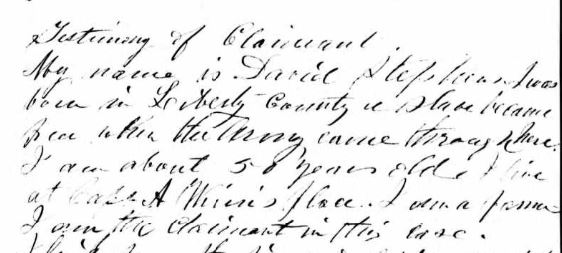
This Southern Claims Commission petition was the only evidence found indicating that David Stephens had a child. Albert Wilson said that he was Stephens’ son-in-law; Wilson’s wife was named Abby, and the 1870 and 1880 U.S. federal census records say that she was born around 1847. She appears to have died before 1900, as she was not listed with Albert Wilson in the 1900 federal census. [Albert Wilson was listed in the 1900 census as being married to a much younger woman named Clara and their very young children; however, this was likely his son Wallace’s wife Clara and their family.]
In the 1870 federal census records, David Stevens was listed as a 50-year-old farmer whose wife Peggy was 40 years old. They were living next to Peter Winn, who had been a witness for Stevens, and a few houses away from Albert and Abby Wilson with Stevens’ grandchildren, Diana (6), Albert (4), Elizabeth (3) and David (2). They were also living near a Billy Gilmore. [Interesting that a Captain Gilmore was one of the U.S. officers who came during the December 1864 raid.]
In the 1880 census records, David (now listed as 65) and Peggy (now 55) had grandson Charles Wilson (6) in the household with them, and were still near Peter Winn.
Neither Peggy or David Stevens were found in the 1900 census in Liberty County, and likely had passed away before then but could have moved away. No probate records or records showing they ever bought land were found (which does not mean that they do not exist).
During Slavery
Abial Winn died in October 1874, so there were no pre-Emancipation probate records for him that would have listed David Stevens. However, Abial Winn did use an enslaved man named David as collateral on an 1838 promissory note to R & W King of Savannah and an 1842 promissory note to George W. Anderson & Brother, merchants in Savannah. The documents named other enslaved people, and were likely the kind of loans that planters took out at each planting season to finance their operations. In 1853, he used an enslaved man named David, well as others, as collateral on a promissory note to Richard J. Arnold and Joseph L. McAllister, “trustees of the meeting house on Bryan Neck,” in addition to several pieces of land. [NOTE: There are also other deeds of sale and promissory note records for Abial Winn on TheyHadNames.com; please search for “Abial Winn” or “Abiel Winn” if you are researching other people held enslaved by him.]
Abial Winn was a deacon of the Midway Congregational Church, which had both white and black members since its inception in the 1750s. The Church records list an enslaved man named David, belonging to Abial Winn, as having been received into church membership on August 20, 1842 (which, of course, did not prevent Winn from using him as human collateral for loans).
According to a descendant of Abial Winn who has posted information on Ancestry.com, “during the Civil War Abial and family moved to Walthourville, GA, Aug 1864 and occupied the home of old Mrs. Stevens.” The Children of Pride (see citation) stated that he had resigned his commission in the Confederate Army in 1862 due to rheumatism. These facts probably explain why Abial Winn did not testify for David Stephens.
“Old Mrs. Stevens” was likely Elizabeth Sumner (Winn) Stevens (1790-1872), who was married to Oliver Stevens (1783-1853), and who died in Walthourville in 1872. She was the half-sister of Abial Winn’s father, Peter Farley Winn (1786-1834). Formerly enslaved people in Liberty County often took the surname of a slaveowner associated with their family line, so it is possible that David Steven’s parents or grandparents were owned by someone in that Stevens family.
Citations
Federal Census Records
1870 U.S. Census, Liberty County, Georgia, population schedule, Subdivision 181, p. 13, dwelling #175, family #176, enumerated on November 15, 1870, by W.S. Norman, David and Peggy Stevens household, digital image, Ancestry.com (https://www.ancestry.com: accessed 10/3/2020).
1870 U.S. Census, Liberty County, Georgia, population schedule, District 15, p. 18, dwelling #130, family #131, enumerated on June 8, 1880, by S.A. Fraser, David and Peggy Stevens household, digital image, Ancestry.com (https://www.ancestry.com: accessed 10/3/2020).
Deed Records
1842 Promissory Note: Family Search.org. Liberty County Superior Court “Deeds and mortgages, 1777-1920; general index to deeds and mortgages, 1777-1958,” Film: Deeds & Mortgages, v. K-L 1831-1842,” Record Book L, 1838-1842, pp. 346-7. Image #502-3 (Link: https://www.familysearch.org/ark:/61903/3:1:3Q9M-C3QP-T9L9-6?i=501&cat=292358)
1838 Promissory Note: Family Search.org. Liberty County Superior Court “Deeds and mortgages, 1777-1920; general index to deeds and mortgages, 1777-1958,” Film: Deeds & Mortgages, v. K-L 1831-1842,” Record Book L, 1838-1842, pp. 27-8. Image #340 (Link: https://www.familysearch.org/ark:/61903/3:1:3Q9M-C3QP-T9VL-9?i=339&cat=292358)
1853 Promissory Note: Family Search.org. Liberty County Superior Court “Deeds and mortgages, 1777-1920; general index to deeds and mortgages, 1777-1958,” Film: Deeds & Mortgages, v. M-N 1842-1854,” Record Book N, pp. 512-4. Image #682-3 (Link: https://www.familysearch.org/ark:/61903/3:1:3Q9M-C3QP-5WV7?i=682&cat=292358)
Church Record
Midway Congregational Church Records, digital images, FamilySearch.org (accessed 5/14/2020); David belonging to Mr. Abiel Winn entered into membership, August 20, 1842 in the quarterly session records. Records abstracted at https://theyhadnames.net/midway-church-records/.
Book
Myers, Robert Manson, “The Children of Pride,” p. 1734-5, unabridged version, 1972, published by The Colonial Press, Clinton, Massachusetts