
Andrew Stacy, born into slavery in Liberty County, Georgia, around 1838, became free at the end of 1864, when Sherman’s Army arrived. In 1873 Andrew Stacy told the story of that day to the U.S. Southern Claims Commision’s Special Commissioner in support of his claim for compensation for property the soldiers took from him.
For the full transcript of this claim, see: https://theyhadnames.net/2021/07/22/andrew-stacy-southern-claims-commission/
Stacy was living on his owner John E. Baker’s plantation when the soldiers came. They asked him where all the “white folks” were; Stacy told him they had all left. He added, “They tell me we were free. This was the first I know of our freedom. I did not run because I was glad when the Yankees came. My master was bitterly against the Yankees. I did not go with my master because someone told me when the Yankees came we would be free and I thought if there was a chance for me, better be here to get it. They did not say anything particular to me but just plunged right in and take it.” Stacy’s owner Baker had fled to Thomasville, Georgia, and stayed there after the war.
Stacy was amazed at the number of soldiers, who spent the better part of three days, off and on, taking property from the plantation, including, Stacy said, his 7 cows, 10 hogs, 30 bushels of corn, horse, and 20 bushels of potatoes, a total of $415 worth of property. Fellow enslaved people Jack Bacon, Scipio King and Plenty Porter were there with him when the property was taken. The soldiers flung a saddle on his horse and rode him off. They drove the cattle off from the field to their camp, smashed the beehives out to take the honey in any container they could find; and killed the poultry and the hogs and took them off over their saddles. Stacy didn’t complain, because he had seen officers order it done.
The soldiers took the property to their camp at Midway Church, where Kilpatrick’s Army was camped, about three miles from Baker’s plantation.
Stacy said that his horse was about 5 years old, and he had raised it from a mare he bought sometime before the war. He was his father’s only son, he said, and his father had left him a cow and a calf when he died, and he kept raising stock from then on.
When questioned about his loyalty to the Union, Stacy said, “I was all the time on the United States side during the war and hope to die so.”
Scipio King, who had been there that day, testified for Stacy in 1873. He said he was 47 years old and living on Lawrence Winn’s place. He had known Stacy since he was a boy. King testified that he had seen Stacy help the soldiers load up his property and that Stacy had said he didn’t care as long as he had his freedom. Stacy was a “great hand for bees…always had a plenty to sell and made money that way,” King said, adding that the soldiers were happier to get the potatoes than anything else. King said drily that he had counted the chickens as they were taken: “I counted them for my own amusement…had nothing else to do just at the time.”
John Bacon Jr also testified for Stacy in 1873. He was 26 years old and also lived on Lawrence Winn’s place but said he was at Stacy’s house on Baker’s plantation when the soldiers came. Plenty Porter was there too, according to Porter’s testimony. He was 65 years old at the time of his testimony, and had been owned by Major Porter; he was living at James Winn’s place farming. He had also known Stacy since Stacy was a boy and saw the property taken. Porter testified that Stacy’s father had died when Stacy was young, and had left him a cow. He also said that Baker allowed Stacy to own property and to buy and sell as he pleased. Porter’s wife lived at Baker’s plantation not far from where Stacy lived, so he happened to be there that day. After the soldiers came, Porter left Porter’s plantation and moved in with his wife on Winn’s plantation.
The Southern Claims Commission was a little dubious about Stacy’s claim, so they sent Special Agent W.W. Paine in to investigate in 1876. He interviewed Raymond Cay Sr, a white planter who was the father of Stacy’s attorney, Raymond Cay Jr. Paine did not feel that was a conflict of interest because Cay Sr was white “a gentlemen of high standing in the County of Liberty.” Cay verified that Stacy had owned some cattle, that he had pastured his cattle on Cay’s land, and that the cattle bore his (Stacy’s) mark. Although he had seen Stacy riding a horse during the war, he could not swear that it was his horse.
Paine also wrote to Stacy’s former owner, John E. Baker, in Thomasville, Georgia. Baker said that, “as well as he can remember,” Stacy did have a couple of cows, worth $10 each, and a few beehives. Paine noted that Baker was a “gentlemen of very high standing” and that he was principal of a “large female institution” in Thomasville.
Paine reported that “Mr. Baker and several other gentlemen give Claimant a good character,” but that L.J. Mallard and E.J. Delegal did not.
Based on Paine’s report, the Commission decided to award Stacy only $20 of his $415 claim. It was disbursed in 1877. It was supposed to have gone to Stacy’s attorney, Raymond Cay Jr, but Cay had been barred from receiving grants on behalf of these clients because of the exorbitant fees he was charging them, so it went instead to James Atkins, Savannah Collector of Customs.

Stacy had described his life after the war like this: “I was a slave at the beginning of the war. I became free after the raid came through. My business was Farming. I went over into Bryan Co [County] and staid [sic] there one year farming. I returned and bought a place of my former owner I mean [words] working for him till I got the means to buy it. I bought 42 acres. I paid $167.50 for the 42 acres. The land is none of the best. I raise corn and cotton. I manage to make a living. It is 3 times better than being a slave. My Father died and left me one cow and a yearling and I raised from that. My Father died when I was about 14. I was his only boy and he left me this corn and calf. This gave me a start and when I begun to be grown I raised chickens and take [word] of the money till I got a start. I raised cattle to sell. My master’s name was John Baker. I bought my place of my wife’s old master name was Wm [William] Winn. I do not owe my master or my wife’s master anything. No one has any interest in this claim besides myself and wife.”
Andrew Stacy was found in the 1870 and 1880 U.S. federal census records in Liberty County, living with his wife Charlotte. The 1870 census gave his birth year as 1838; the 1880 as 1844. His own Southern Claims Commission testimony would put it around 1837 or 1838.
In 1870, he and Charlotte had their son Solomon, 12, in the house, and were living near Joe and Celia Bacon.
In his 1873 testimony, Stacy said he owned the 42 acres he was living on. That original deed was not found in the online Liberty County deed records, but Andrew Stacy was involved in a number of deed record in the 1880s. It appears possible from the records that he originally bought the land as part of a collective, then purchased it from the other members later. (See deed records to follow.)
In 1880, Stacy was living with his wife Charlotte, their daughter Georgia (13) and their son Isaac (10). Andrew was listed as a farmer, but also as being sick with pneumonia. He and Charlotte were living near their son, Solomon Stacy, and his wife Phillis and their son Andrew, 4 months old. They were also living near Peter and Venus Stevens, Jacob and Chloe Quarterman, Shelman and Dianah Cassels, and Simon and Phillis Cassels.
In 1882, Andrew Stacy was listed as the Captain of the all-Black Georgia Lincoln Guards militia in Liberty County.
In the 1880s, Stacy bought several pieces of land. He was not seen to have sold any land except to his son, in 1889.
In 1880, he bought 8 ½ acres from George Gould, a fellow formerly enslaved man, for $25. The land was bounded north by land owned by the St. James Society, southeast by land owned by Harry Stevens, and northwest by land already owned by Andrew Stacy. The land deed was witnessed by Floyd Snelson and Leonard Brown. George Gould signed by mark, and Floyd Snelson probated his signature before Probate Judge Joseph Ashmore.
In 1882, he bought 53 acres from William C. Stevens, who was acting as agent for his wife Julia V. Stevens, for $159.60. The purchase was witnessed by William M. Stevens, Thomas Mallard, and Sumner W. Allen.
In 1883, he bought five acres in the “Midway settlement” on Midway road for $20 from William C. Stevens, who was acting as agent for his wife Julia V. Stevens.
In 1885, he bought a 42-acre lot of land for $150 from John Bacon, Stephen Bacon, Toney Elliott, Philis Cassels, Crawford C. Cassels, Murray R. Cassels, Harry Stevens, Peter R. Stevens, Xerxes Stevens, Margaret Stevens, George Gould, Jacob Quarterman, and Samuel Wright. The land was near the old Midway Church and was bounded North East by lands of Harry Stevens, South East by lands of C. Houston, South West by land of Cash Conley & North West by land of Peter, Xerxes and Margaret Stevens. [This is the piece of land he referred to owning in his 1873 testimony and that may have been purchased as part of a collective.]
In 1889, Andrew Stacy sold to Solomon L. Stacy, presumably his son, the 53 acres, now bounded north by Scipio King and John Lambert, east by J.C. Monroe, south by the estate of Thomas Mallard, and west by James Stacy. Solomon Stacy paid him $120 for it.
During this time, Stacy regularly mortgaged his land to a Savannah firm called John Flannery & Co as security for cash ranging from $20-$70 and to make sure he kept his commitment to market his cotton through them. He appears to have always paid off the loan.
There was no 1890 census, and by the 1900 census, Charlotte Stacy was living on her own as a head of household. She was listed as married, not widowed, but this may have been a mistake, because she was also listed as having had only one child in her lifetime, yet previous census records show her with at least three (though it is possible that Isaac and Georgia were listed as their children but had some other relationship to them). Charlotte Stacy was living next to her son Solomon, who was listed as having been married for 22 years to Phillis, who had had two children: Andrew, 20, and Maggie, 14, who were living with them.
Although no death date was found for Andrew Stacy, it seems possible that his sale of land to his son in 1889 might indicate failing health.
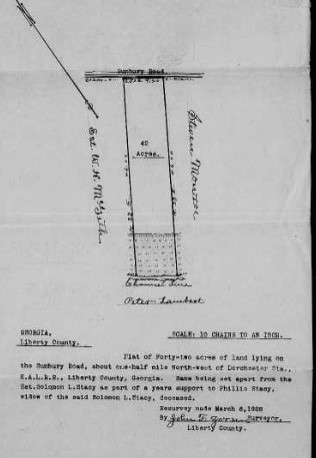
Solomon Stacy died on February 5, 1928, of acute nephritis, leaving behind his wife Phillis, who was the informant for the death certificate. She identified his mother’s maiden name as Charlotte Bacon. Solomon Stacy was living in Dorchester, and was to be buried in Midway. Alfred Monroe, Joe Stevens, Charles Galloway and C.C. Cassels were appointed to appraise his estate to determine his wife’s support benefit while the estate was being settled. The inventory showed that he still owned the 42-acre tract, now listed as being in the 1359th District, bounded north by the Sunbury Road, east by Steven Monroe, west by land belonging to the heirs of W.H. [last name illegible], and south by Peter J. Lambert. It was valued at $800.

Before Freedom Came
Andrew Stacy had been held in slavery by John Elijah Baker (1833-1906), who had moved to Thomasville in Thomas County, Georgia, either during or after the Civil War. Stacy’s wife, Charlotte Bacon, was said to have belonged to W.W. Winn, also named in the testimony as William Winn. Witness Plenty Porter belonged to Major Porter, but his wife lived at Baker’s plantation, near Stacy.
Note that none of the formerly enslaved individuals listed in this claim adopted the surname of their last enslaver after they became free.
Since John Baker died after the Civil War, there were no probate records that would have named Andrew to give an idea of his life before the Civil War. John Baker’s wife, father and mother all also survived the Civil War. However, John Baker’s wife, his cousin Margaret Baker, could possibly have inherited Andrew from her father, Thomas Baker, Jr, who died in 1837. Andrew Stacy is believed to have been born in 1837 or 1838. There was no Andrew in the initial 1837 estate inventory, but in the 1843 estate inventory there was an Andrew valued at $125, about the usual value for a child. If this is correct, it is possible that at least one of Andrew Stacy’s parents is listed in the 1837 or 1843 Thomas Baker Jr estate inventory.
Let’s talk about how easy it is to make a mistake in identifying the enslavers of an individual. The land deeds show that Andrew Stacy bought land that previously belonged to Washington Winn, deceased. Washington Winn’s 1864 estate inventory shows an Andrew, valued at $3000, about the usual amount for a young man, as Andrew would have been then. If we hadn’t seen the Southern Claims Commission file that provides multiple pieces of documentation that Andrew Stacy belonged to John E. Baker during the Civil War, it would be easy to conclude that this Andrew was him.
Charlotte Bacon Stacy was owned by W.W. Winn, also identified in the testimony as William Winn, who is likely William Wilson Winn (1818-1887). Because Winn survived the Civil War, there are no probate records for him that would name enslaved people. However, an 1859 record was found in which Rufus A. Varnedoe used a Charlotte and a Solomon as collateral on a promissory note to W.W. Winn. It is tempting to conclude that this must be Andrew Stacy’s wife Charlotte and his son Solomon, who was born around 1858, and to decide that either Varnedoe defaulted on the debt or sold them to Winn.
However, in 1854, this Charlotte, valued at $200, and Solomon, valued at $850, were in Nathaniel Varnedoe’s estate inventory and were drawn by Rufus A. Varnedoe, so are presumably the same individuals Rufus used as collateral. Solomon was almost certainly not born by then, and would not have been valued at $850 as an infant if he was, and the value of $200 does not make sense for a woman in her teens, as Charlotte would have been at that time.
However, there is a definite Varnedoe connection with W.W. Winn. He married Nathaniel Varnedoe’s daughter Claudia in 1858, and had previously been married to her sister Louisa, who died in 1857. Nathaniel Varnedoe’s 1854 estate inventory also listed two other Charlottes, one valued at $400 and drawn by the minor Mary Ellen Varnedoe, and the other valued at $500 and drawn by Miss Matilda Varndoe. W.W. Winn inherited people named in this estate inventory in the name of his then current wife Louisa and through Claudia Varnedoe, who later became his wife. It seems very possible that the Charlotte and Solomon owned by Rufus A. Varnedoe, although not Andrew Stacy’s family, were relatives of Charlotte Bacon, and that she is one of the other two Charlottes named in the estate inventory, who came to be owned by W.W. Winn through his Varnedoe connection. If that Solomon were her relative, it would make sense that she would name her son Solomon after him.
Charlotte was also likely a member of the Midway Congregational Church. In November 1860, an enslaved woman named Charlotte belonging to William Winn was admitted to membership in the Church.
Sources:
Census records for Andrew Stacy
1870 U.S. Census, Liberty County, Georgia, population schedule, Subdivision 181, p. 23, dwelling #218, family #218, enumerated on November 17, 1870, by W.S. Norman, Andrew and Charlotte Stacy, digital image, Ancestry.com (https://www.ancestry.com: accessed 7/22/2021).
1880 U.S. Census, Liberty County, Georgia, population schedule, District 15, enumeration district 67, p. 83, dwelling #890, family #897, Andrew and Charlotte Stacy; digital image, Ancestry.com (https://www.ancestry.com: accessed 7/22/2021).
1900 U.S. Census, Liberty County, Georgia, population schedule, Militia District 1359, enumeration district 86, sheet #4, line number 48, digital image, Ancestry.com (https://www.ancestry.com: accessed 7/22/2021).
Deed Records involving Andrew Stacy in Liberty County Superior Court
Book S, page 670: (11/1/1880, Gould to Stacy, land sale) https://www.familysearch.org/ark:/61903/3:1:3Q9M-C3QP-RSKH-S?i=378&cat=292358
Book T, page 332-4 (5/18/1883, Stacy to Flannery & Co, mortgage)
https://www.familysearch.org/ark:/61903/3:1:3Q9M-C3QP-R9C2-J?i=176&cat=292358
Book T, page 334 (5/1/1882, Stacy from William C. Stevens & Julia V. Stevens, land purchase)
https://www.familysearch.org/ark:/61903/3:1:3Q9M-C3QP-R9XQ-B?i=302&cat=292358
Book U, page 215-6 (1884, Stacy to Flannery & Co, mortgage)
https://www.familysearch.org/ark:/61903/3:1:3Q9M-C3QP-R9XZ-9?i=387&cat=292358
Book U, page 414-5 (11/1/1885, Solomon S. Stacy to Solomon Cohen, mortgage)
https://www.familysearch.org/ark:/61903/3:1:3Q9M-C3QP-R9XH-1?i=487&cat=292358
Book U, page 471-3 (3/10/1885, Stacy to Flannery & Co, mortgage)
https://www.familysearch.org/ark:/61903/3:1:3Q9M-C3QP-R9CB-D?i=516&cat=292358
Book U, page 473-4 (3/27/1885, Stacy from John Bacon et al, land purchase)
https://www.familysearch.org/ark:/61903/3:1:3Q9M-C3QP-R9Z3-N?i=517&cat=292358
Book U, page 511-2 (10/15/1883, Stacy from William C. Stevens & Julia V. Stevens, land purchase)
https://www.familysearch.org/ark:/61903/3:1:3Q9M-C3QP-R9ZH-3?i=537&cat=292358
Book Z, page 302 (1/31/1889, Stacy to Solomon L. Stacy, land sale)
https://www.familysearch.org/ark:/61903/3:1:3Q9M-C3QP-59MH-4?i=485&cat=292358
Charlotte Stacy’s’s admittance to Midway Church
Midway Congregational Church Records, digital images, FamilySearch.org (accessed 5/14/2020); Charlotte belonging to W.W. Winn admitted, in the quarterly session records. Records abstracted at https://theyhadnames.net/midway-church-records/.
Enslaver Probate Records
Rufus A. Varnedoe 1859 promissory note to W.W. Winn
Source: Family Search.org. Liberty County Superior Court “Deeds and mortgages, 1777-1920; general index to deeds and mortgages, 1777-1958,” Film: Deeds & Mortgages, v. O-P 1854-1870,” Record Book O, p 527-8. Image #313-4. (Link: https://www.familysearch.org/ark:/61903/3:1:3Q9M-C3QP-RSYK-M?i=312&cat=292358) (see abstract at https://theyhadnames.net/2019/06/05/used-as-collateral-varnedoe-winn-3/)
Thomas Baker Jr’s 1843 estate inventory naming an Andrew:
Find the digitized original at: “Georgia Probate Records, 1742-1990,” database with images, FamilySearch (https://familysearch.org/ark:/61903/3:1:3QSQ-G93L-GCSD?cc=1999178&wc=9SYT-PT5%3A267679901%2C268032901 : 20 May 2014), Liberty > Wills, appraisements and bonds 1790-1850 vol B > image 612 of 689) (see abstract at Find the digitized original at: “Georgia Probate Records, 1742-1990,” database with images, FamilySearch (https://familysearch.org/ark:/61903/3:1:3QSQ-G93L-GCSD?cc=1999178&wc=9SYT-PT5%3A267679901%2C268032901 : 20 May 2014), Liberty > Wills, appraisements and bonds 1790-1850 vol B > image 612 of 689)
Nathaniel Varnedoe’s 1854 estate inventory:
Find the digitized original at:”Georgia Probate Records, 1742-1990,” database with images, FamilySearch (https://familysearch.org/ark:/61903/3:1:3QS7-893T-XTP3?cc=1999178&wc=9SB7-6T5%3A267679901%2C268014801 : 20 May 2014), Liberty > Miscellaneous probate records 1850-1863 vol C and L > image 161 of 703 (abstract at https://theyhadnames.net/2019/10/21/liberty-county-estate-inventory-division-nathaniel-varnedoe/)
The All-Black Georgia Lincoln Guard Militia
https://theyhadnames.net/2025/06/29/an-all-black-liberty-county-militia-1882/