
The 1890 U.S. Federal Census was destroyed in a fire in 1921, with only 6,000 records remaining, none of them for Liberty County, Georgia. This means that there are no census records for the 20 years separating 1880 and 1900. Consider that a girl born in 1881 could have grown up, left home to marry, and changed her name by 1900. Birth records were not mandated in Georgia until 1919. Church birth and baptism records from the late 19th century may no longer be available, assuming they existed in the first place. What records can we use for 1890 census substitutes?
Enter homestead exemption petitions. Many small farmers — both Black and White — had to get loans from local merchants every year to buy seeds and other farming materials for the year’s crop. The merchant would take out a lien on their possessions to cover himself. In a bad year, the farmer and his family could lose everything, leaving them without the basics needed for life.
In 1868, the Georgia Legislature enacted Section 2013 of the Code of Georgia (also known as Irwin’s Code), which gave these farmers — at least the ones who had families — a break. They could go to the Court of Ordinary (now known as the probate court) and petition for a homestead exemption, which would exempt “realty and personalty” (land and personal possessions) on an approved list from seizure and sale to pay off debts.
Between 1868 and about 1880, the petition would list the petitioner’s name, identify them as “head of a family,” and list the items from the approved list. If a woman was married, and her husband refused to apply, or if she was a widow, she could file her own petition. Interestingly, in every case I have found so far, it was only White men who refused to file. I speculate that this is because there was social stigma attached to identifying oneself as a “poor debtor.”
Starting a little before 1880, these petitions started to give the names of the wives and any children under the age of 16 occasionally, and by 1880 almost all of them did so. At this time, the description of any land owned changed from “fifty acres of land” to detailed descriptions: “One tract or parcel of land, situate lying and being in the 1476th Dist. G.M. of said County containing Seventy acres, and bounded as follows, to wit: on the north by lands of James Williams; on the east by lands of Henry Anderson, on the south by lands of July E. Anderson and on the West by lands of Neger Anderson.” This land was owned by July E. Anderson as of 1894. The same record identified his family as “his wife, Elsie Anderson, and four minor children, all under sixteen years of age, to wit: Floyd Anderson, Annie Bell Anderson, Lola Anderson and George Anderson.”
Descriptions of other property also became more detailed after 1880. For example, in 1869, Lewis Bird filed this list:
1st. Fifty acres of land and five additional acres for each of his children under the age of sixteen years, to wit, three children Peggy, George & Sam.
2nd. One farm horse or mule
3rd. One cow and calf
4th. Ten head of hogs and fifty dollars worth of provisions, and five dollars worth additional for each child.
5th. Beds, bedding and common bedsteads sufficient for the family.
6th. One loom, one spinning wheel and two pairs of cards, and one hundred pounds of lint cotton.
7th. Common tools of trade of himself, and his wife, being farmers, to wit: axes, hoes, steel mill and Jersey wagon.
8th. Equipment and arms of a militia soldier, and trooper’s horse.
9th. Ordinary cooking utensils and table crockery
10th. Wearing apparel of himself and family.
11th. Family Bible, religious works and school books
12th. Family portraits etc.
Apart from naming his children, this list corresponds exactly to the list authorized by the Legislature:
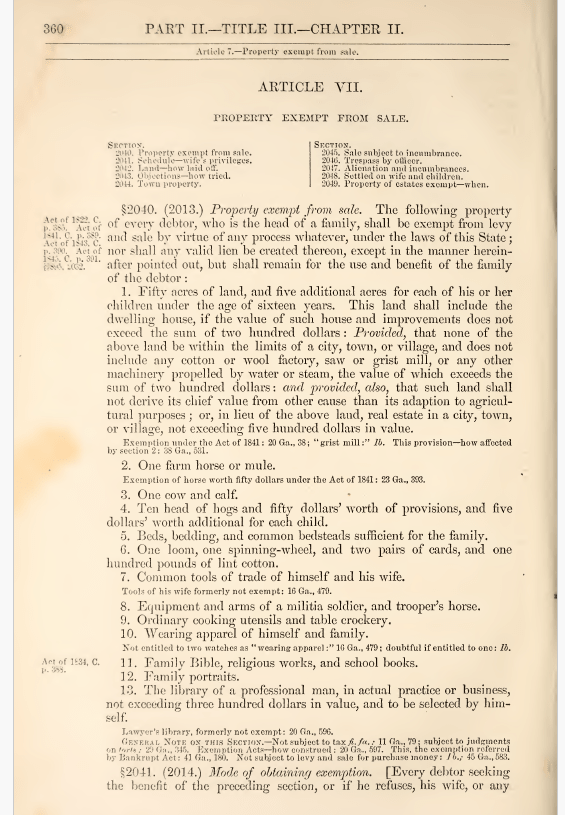
After 1880, a list was more likely to look like this one for James Stacy in 1884:
“One mare, bay with some gray hairs, and a white blaze in her forehead and three white feet, about five years old; one cow and calf, marked three slits in one ear and smooth crop in the other ear; two head of hogs, marked [word] hole in one ear and slit in the other; fifty dollars worth of provisions; three straw mattresses, one feather pillow and one cotton pillow and one feather bolster, thirteen quilts, two sheets and common bedsteads; one lot of farming tools, consisting of saws, hatchets, hoes, ploughs, pitch fork and rake etc the tools of trade of James Stacy who is a farmer; one musket gun; table crockery; wearing apparel of family; one Bible, lot of religious works and school books; one lot of family pictures; fifty bushels of corn, one thousand pounds of fodder, one one horse wagon, one table and a set of chairs; one morrow [sic], one bureau, one trunk, six water buckets, and book case; five bee-gums, the same being a part of the provisions to be included in the Fifty dollars worth of provisions.”
These records are obviously gold for family history researchers.
Where can you find these homestead exemption petitions? The Ordinary (the probate judge) was supposed to keep these petitions in a separate Exemptions book. In Liberty County, the Ordinary did keep them in books starting in 1873, but the ones recorded before that are scattered in the Superior Court Deed Books. Those appear mostly to be for sharecroppers and to have been filed by White property owner William B. Gaulden. They are noted as being filed by the Ordinary. In the FamilySearch.org database, the digitized exemption books are in a Liberty County database called “Schedule of property exempt from levy and sale for debt, 1873-1951, which includes Book A (1873-1881), Book B (1881-1912), and Book C (1913-1951).
Similar books exist for many other counties in Georgia, and other states have similar laws. One way to find these is to search the FamilySearch catalog for your county of interest, then look under “Land and Property.” For Bulloch County, for example, this will lead you to “Homestead records, 1873-1919.”
It is worth researching the laws on homestead records, as the acts were amended over time and there are many exceptions. You can find the historical Georgia Codes online at the University of Georgia School of Law Digital Commons: https://digitalcommons.law.uga.edu/ga_code/. Look for section 2013 of the Code of 1868, 2040 of the Code of 1873, 2040 of 1882, and 2866 of 1895. There were also amendments to those laws.
There is also a very useful article in JSTOR called “Homestead and Exemption Laws of the Southern States” by J.H. Thomas, which will give you ideas for where to look in other states. You can download it at: https://www.jstor.org/stable/3303295.
I have abstracted the 464 records for the period 1868-1900 found in Liberty County Superior Court deed books, all of Book A, and the part of Book B ending in 1900. The abstracts contain the names, description of the land (if any), the date, where the record can be found, and a link to the original record, where you can find the property claimed. I did not include the lists of personal property in the abstracts. The link in each abstract will take you to a digitized copy of the original record at FamilySearch. If it’s your first time using FamilySearch, you’ll need to create a (completely free) account. Again, the lists of property before 1880 were usually very generic and usually did not name family members but they are certainly worth looking at.
Find the Liberty County list and more details here: https://theyhadnames.net/homestead-exemption-petitions-1868-1900/.
Need help using this resource (for Liberty County or elsewhere)? Feel free to email me at jnscole@yahoo.com.